



By K. Richard Douglas
The tradition of the Veterans Health Administration goes back to the end of the Civil War, when President Abraham Lincoln authorized a soldiers’ and sailors’ asylum to care for members of the Union Army and Navy. The program became the Veterans Bureau in 1921, as programs for World War I veterans required more specialized care. The program became the Veterans Administration nine years later. In 1989, the Veterans Administration became the Department of Veterans Affairs.
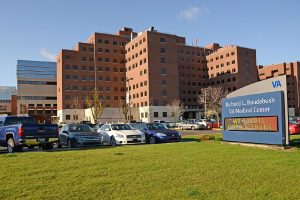 For the veterans in Indiana and Central Illinois, the Veteran Health Indiana health system provides a range of health services to address their needs. The system includes the Richard L. Roudebush VA Medical Center in Indianapolis as well as six community-based outpatient clinics (CBOCs). These clinics are located in the Indiana communities of Bloomington, Martinsville, Columbus, Terre Haute, Lafayette and the farwest side of Indianapolis.
“The Indianapolis VA Medical Center is a tertiary care facility that is a part of the VISN 10 VA Healthcare system which encompasses Indiana, Michigan and Ohio VA Medical Centers,” says Jordan Keebaugh, biomedical engineer and acting chief of the medical center’s Healthcare Technology Management (HTM) Department.
“The VA Medical Center provides acute inpatient surgical, medical, psychiatric, neurological and rehabilitation care with 159 available hospital beds,” Keebaugh says.
Besides Keebaugh, the HTM department is lead by Staff Engineer Tucker Scherger. The HTM Department is made up of four different sections: Project Management; Networked Medical Systems Support; Electronics; and Medical Equipment Systems Support.
Keebaugh says that the department is made up of 21 full-time employees.
“The Project Management section is composed of two staff engineers. Medical Systems Support Section encompasses the more typical face of the general Healthcare Technology field. The section is currently made up of 12 Biomedical Equipment Support Specialists (BESS) that focus on the corrective and preventive maintenance of the medical center’s medical systems,” Keebaugh explains.
Keebaugh says that the Electronics Section supports medical and non-medical systems throughout the VA Medical Center. There are currently two BESS within Electronics that manage the nurse call system, nurse call phones, the patient elopement system, TVs, and the medical center’s security systems (access control, security cameras, panic alarms, etcetera).
“The Networked Medical Systems Support section was recently developed due to the vast expansion of networked medical devices and the heightened focus on cybersecurity. Rob Goins, a systems admin, is currently the only HTM member within this section,” Keebaugh adds.
Forward Thinking
Innovation, pre-planning and cooperation are all part of the HTM department’s focus on embracing new approaches to their processes, brain-storming and quest for customer satisfaction.
“Veteran Health Indiana embraces a culture of systems redesign thinking when tackling identified problems of any caliber. Rapid Process Improvement Workshops (RPIW) are conducted with subject matter experts from various service lines throughout the medical center to breakdown an issue and critically think through the problem solving process,” Scherger explains.
He says that the HTM department has been involved in numerous RPIWs that have included sessions on improving temperature monitoring as well as equipment tracking processes. The results of these RPIWs have streamlined the department’s processes and have translated into increased efficiency of staff and a resulting cost savings to the medical center.
“The concept of systems thinking is applied in a more direct manner for each department via ‘huddle boards,’ which are conducted weekly,” Scherger says. “A huddle board is a quick department gathering that strays from the typical ‘meeting’ mentality. The huddles are to introduce new improvement ideas and then to discuss other improvement ideas already in the works only; there are no minutes or managerial assignment of work as typical meetings would dictate.”
“Staff have a chance to provide updates and elaborate on successes and failures in a peer setting. During FY17, the HTM department received a ‘Best Improvement Idea of the Week’ award for a simple, yet impactful, idea to designate a specific color of data cable for medical equipment. This change has already demonstrated decreased instances of medical device systems connectivity issues from improper patch cable management and also decreased incident response turnaround time during troubleshooting efforts of network problems,” Scherger adds.
In addition, Scherger says that the HTM department has helped to charter a service line value stream process improvement; a combined effort between HTM, OIT, and Clinical Informatics to increase the systemic capacity for collaboration between the three services.
“The ultimate goal of this value stream is to bolster inter-service relationships, which will reduce health technology downtime and increase customer satisfaction, ultimately leading to a better patient care experience. The group is reviewing process for planned and un-planned network outages and the subsequent contingency plans that this entails,” he says.
Through careful planning capital purchases and special install projects are allocated for and accomplished with the necessary resources.
“The health system has numerous High Tech/High Cost (HT/HC) medical equipment project installations that are underway and also in the pipeline. The VA has implemented a Strategic Equipment Planning Guide (SEPG) which allows a medical center to forecast medical equipment replacement dates and costs for any specified timeframe and turns this data into a strategic capital equipment plan,” Scherger says.
He explains that this allows leadership at the local, regional and national level to adequately forecast equipment-related expenses and for sites to submit equipment packages in a more organized and targeted fashion. The report breaks down the equipment due for replacement by equipment category or ‘type,’ summarizes associated asset value costs, and provides specifics on the equipment to assist in the facilitation of data gathering and equipment package compilation.
“In FY17 alone, Veteran Health Indiana has successfully installed two new digital radiograph systems, one linear accelerator, and one SPECT/CT,” Scherger says. “The sum total of these projects exceeded $10 million in construction and equipment costs. HT/HC projects installations in the pipeline currently for FY17 and FY18 include a hybrid operating room and an additional MRI to expand radiology services.”
He says that the installation of the hybrid operating room will allow the health system to establish a transcatheter aortic valve replacement (TAVR) program which will help provide improved survival for veterans with severe symptomatic aortic stenosis. It will also expand the vascular surgical capabilities at the medical center.
Specialization and Training
Imaging and storage are all in a day’s work because of the specialized resources available through the Veteran Health Indiana HTM team.
“Our relationship with the Radiology Department here at the Medical Center has expanded throughout the years. Scott McCammon, a senior BESS within the HTM Department, works cohesively with the PACs administrators to not only provide support to the PACs and dictation systems but also builds radiology workstations for in-house radiologists and tele-radiologists located throughout the country,” Keebaugh says.
“Many of our technicians are Certified PACs (CPAs) Associates or have obtained more than one PACs administrator certification,” she adds.
Training, in part, is accomplished through a sort of mentoring program that allows knowledge to flourish in the department.
“The HTM Department actively participates in the VHA Technical Career Field (TCF) Program which partners tenured VHA employees with new hires in a particular career field,” Keebaugh says.
“Here at the Indianapolis VA Medical Center, we have two biomedical engineering TCFs and one biomedical equipment support specialist TCF. The three TCFs have the opportunity to gain hands-on experience and absorb knowledge and expertise from more veteran individuals. This allows the VA to grow and develop the future workforce through a hands-on approach,” she adds.
The VA has a cutting edge group of biomeds in Indiana who embrace forward-thinking medical equipment management for the ultimate benefit of the region’s veterans continuing a legacy of service to the men and women who have served their country.
