



By K. Richard Douglas
Just north of the U.S.-Canada international border sits the city of Vancouver in the province of British Columbia. Off the coast of Vancouver, and across the Strait of Georgia, Johnston and Queen Charlotte, is Vancouver Island. The island is large, measuring 283 miles in length and 62 miles at its widest point. The island has a population of approximately 850,000.
With the large population of island-dwellers, health care is an important matter. Those needs are served by Island Health. The health care system provides island residents with a network of hospitals, clinics, health care centers and long-term care locations.
With such a large responsibility, the management of medical equipment is critical. That is the job of the Island Health Biomedical Engineering Department. With three tertiary care teaching hospitals, six community hospitals and many urgent care centers, supporting an acute care bed base of 1,824, along with 101 newborn beds, the task is a demanding one.
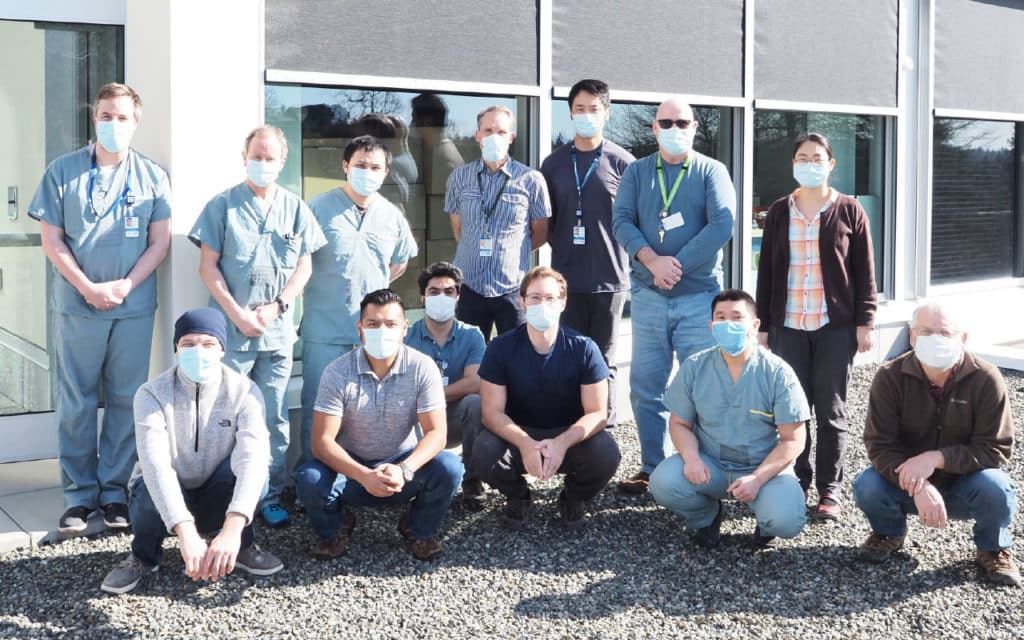
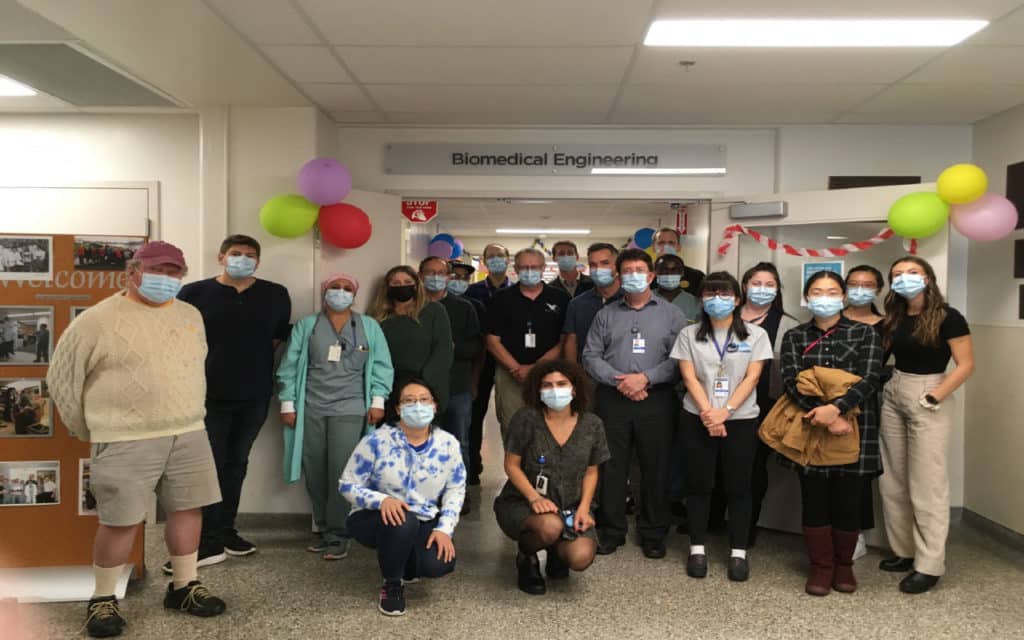
The 50-person HTM team includes Director Martin Poulin, M.Eng., P.Eng., FCMBES; managers Tedford MacLaggan, M.Eng., P.Eng. and Heydar Khalil, M.Eng., P.Eng.; Biomedical Project Engineer Angela Varghese, M.Eng., EIT; Biomed IT Support professional John Bowdige, five biomed engineering technologist supervisors, an administrative clerk and 40 biomedical engineering technologists.
“Our technologists have evolved by the investment in training into different areas of expertise including anesthesia and respiratory support, medical imaging, patient monitoring and hemodialysis,” Poulin says.
The team handles a wide range of tasks from service contract management to the disposal of medical technology, incident investigation to repair and maintenance and supervision of biomed student co-ops and practicums.
The department manages service contracts to find the perfect balance for its needs and its employer.
“Biomedical engineering optimizes service contracts to provide a level of service that best meets the needs of the customers and financial implications. The result is an array of different contract services ranging from time and materials contracts, shared service contracts to full-service contracts,” Poulin says.
He says that business case reviews are completed to determine whether training should be invested in biomed engineering technologists to support the equipment, or whether some level of contracted service makes sense.
The department is very diverse and includes members from a number of backgrounds. The team members continuously prove that they are not only up to the task, but able to meet all customer needs.
“We have a very dedicated and customer-focused group of people who originated from all over the world, including Europe, Russia, Middle East, Asia, Africa and India. Our customer satisfaction surveys are always very positive, in addition to the many compliments myself and the managers receive regarding the great service our department provides,” Poulin says.
He says that the team’s BME-IT support person is a leader in the development of provincial and local cybersecurity initiatives. His cybersecurity policy framework and patch management processes are being adopted by the provincial cybersecurity team.
Poulin says that Angela Varghese is the new laser safety officer for the island.
Managing Expansion and COVID Response
The department recently faced additional projects because of the COVID-19 pandemic. Prior to that, new facilities provided challenges.
“Some significant projects that we were integrally involved with recently revolve around the response to the ebb and flow of COVID patients into the hospital. Our Royal Jubilee Hospital (RJH) and Victoria General Hospital (VGH) staff recently set up a nine-bed high acuity unit within 24 hours at the request of our Ministry of Health. We had to move newly installed monitors from the VGH site to the RJH site,” Poulin says.
He says that similarly, at the beginning of COVID, the Nanaimo Regional General Hospital staff set up an expanded high-acuity unit adjacent to the ER department within a short time frame.
“One large project in 2017, that drew on staff throughout the island, was the set up of our two newest community hospitals. This project involved about 15 staff for the actual move days and weeks of effort prior to the move in. Every day was spent reviewing a list of problems to be resolved from network issues to patient monitor mounting challenges,” Poulin says.
He says that going farther back, it was their supervisor from RJH, in conjunction with the clinical nurse educator, who identified the possible blood contamination associated with the pressure monitoring ports of the Baxter hemodialysis machines.
“This identified problem resulted in a worldwide recall by Baxter with changes to their hardware and processes,” Poulin says.
The team has also been a partner in the integration of biomed devices to the electronic health record. Integration projects have included vital signs monitors, anesthesia monitors, endoscopy images and patient monitors.
Helping the Canadian HTM community and serving the health care needs in their province, team members are active even outside of work hours. They even help provide assistance to health services in a developing country.
Poulin says that manager Ted MacLaggan is the lead for the PM program in the province and is also the Awards Chair for the Canadian Medical and Biological Engineering Society (CMBES).
“I am the past president of CMBES and currently work with the international outreach team. This team is working with Ghana Medical Help in conjunction with Ghana Health Services to assist with the establishment of clinical engineering in the northeast area of Ghana,” Poulin adds. “I am also a member of the ACCE educational webinar planning team.”
He also sits on the advisory boards for the University of Victoria Biomedical Engineering program and the BCIT Biomedical Engineering Technologist program.
When a large island community like Vancouver Island depends on a network of health care facilities for emergencies and health care needs, it is reassuring to know that the task is in capable hands. The HTM professionals that make up the Island Health Biomedical Engineering Department get the job done every day.
