



New AAMI Report Offers Guidance for Medical Equipment Service Responsibilities
By Heather Johnson
When a fetal monitoring system goes down in the middle of the night, who do you call? Too often, no one knows for sure. That’s why AAMI’s Technology Management Council (TMC) recently strove to help healthcare technology management (HTM) leaders resolve confusion regarding the “gray areas” of responsibility for hospital devices.
“In the 40 years that I’ve been in the industry, medical equipment gray areas have been a topic of discussion and an area of confusion,” said Mike Busdicker, CHTM, FACHE, system director, clinical engineering at Intermountain Healthcare. “The TMC Committee saw this as an opportunity to shed light on existing practices and provide baseline guidance.”
To help health care facilities define the scope of inspection, testing and maintenance responsibilities for various medical products, the TMC surveyed leadership representing nearly 200 HTM departments across North America to understand where equipment service responsibilities commonly lie. The results of the survey were compiled into a comprehensive report.
“Service responsibility has shifted between HTM, IT and facilities as technology has become more complex,” Busdicker added. “Devices that used to be considered furniture or non-medical equipment have become clinical devices or equipment.”
Hospital beds, for example, now connect to electronic medical record systems and contain integrated sensors and software to monitor patients’ movement, weight and other data. In years past, few HTM departments would have serviced hospital beds. Today, about 60% of HTM departments take responsibility for this evolving example of medical equipment, according to the survey.
Patient Safety and Compliance Concerns
Regardless of the reason for the gray areas, lack of clarity around equipment service can cause confusion, frustration and wasted time among busy clinicians. Depending on the product at issue, “passing the buck” potentially extends downtime, which leads to patient safety, regulatory compliance, incident response and inventory control issues.
“A malfunctioning desk printer may not cause an adverse outcome, but if a patient lift isn’t working properly, and you have a patient in that room, the malfunction could result in clinicians not mobilizing or rotating that patient at the right time,” said AAMI’s Vice President of HTM Danielle McGeary, CHTM. “That’s one reason responsibility needs to be clearly defined and documented – so we’re not spending precious time figuring this out.”
Because medical equipment falls under mandates of the U.S. federal agency the Centers for Medicare & Medicaid Services (CMS), extended downtime of this equipment could affect accreditation. During an audit on behalf of CMS, the Joint Commission (TJC) review responsibility agreements and other documentation related to equipment service.
“At the end of the day we’re here for the patient,” said McGeary. “If equipment breaks on Christmas morning, facilities should have a documented plan in place that identifies who should come in and service that equipment.”
What the Results Show
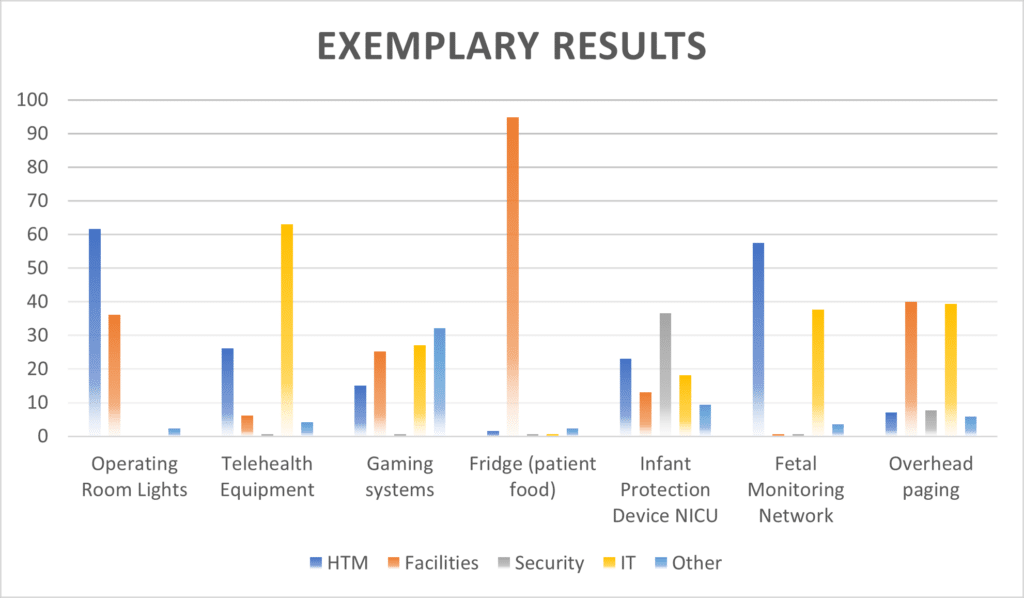
The TMC compiled a list of more than 45 types of medical and non-medical equipment that tend to fall into gray areas. The committee then asked HTM leaders surveyed to select the department responsible for these products. Respondents also had the opportunity to list additional equipment excluded from the list.
Some results came as no surprise. For example, more than 80% of those surveyed reported freezers and fridges for patient food are strictly within the court of the facilities department. Other equipment, however, was more contentious. Both hospital nursery cameras and gaming systems for patient use, for instance, were notably split between HTM, facilities, IT, security or other departments.
With help from the Joint Commission, the TMC also classified each type of equipment into medical equipment, utility and other categories. “It was helpful for TJC to provide standardized nomenclature and terminology to the report, specifically within the medical equipment and utility components chapters, which address direct links to Joint Commission standards and elements of performance,” said Herman McKenzie, director of TJC’s Department of Engineering in the Standards Interpretation Group. “The document will help healthcare technology management (HTM) professionals become better aware of how health care equipment fixtures and devices are managed by health care organizations.”
How HTM Leaders Can Use the Guidance Document
The TMC committee developed the report as a resource for the HTM industry and not as a recommendation of service responsibilities. It serves as a guide to help HTM, facilities and other health care leaders standardize their own processes. It may also help rsource-strapped HTM departments take the lead in redefining responsibilities if they choose.
“The report may help them justify what they should and shouldn’t be servicing,” said McGeary. “The survey results give them data to back their claim.”
The report makes clear that written documentation of equipment service responsibility is essential to ensure patient safety and compliance. Regardless of how health care facilities allocate responsibility, “it is imperative to have written policy defining departmental roles and responsibilities for these devices and systems,” the report states.
The TMC committee also recommends health care facilities review and update their equipment service responsibility document periodically. To help inform those updates, the TMC committee intends to conduct more gray area surveys in the future.
“We intend to resurvey the field to see how things change over time,” said McGeary. “Depending on the response, it may trigger another project. We’d also like to hear success stories on how HTM leaders have used this information to structure equipment responsibilities. We’ve had a lot of interest from the field so far and anticipate this report will be welcomed by the field.”
Members of AAMI can download Gray Areas of Equipment Service in HTM for free from AAMI ARRAY.
