


By K. Richard Douglas
In the southern part of Alaska, just south of the city of Anchorage, is the Kenai Peninsula Borough, a peninsula that juts out into the Gulf of Alaska. There are a series of islands nearby as well.
It is a place where you can observe the northern lights dancing in the night sky, encounter a grizzly bear or fish for halibut or salmon. Kayaking and hiking are also popular activities.
The Kenai Fjords National Park takes up a good portion of the peninsula. The Kachemak Bay State Park is next door on the southern portion of the peninsula. And that portion is also intersected with bays, inlets and waterways.
In 2020, the population of the peninsula was 58,800 and the largest city was Kenai. Close to Kenai is the borough seat of Soldotna. Soldotna is home to Central Peninsula Hospital (CPH), which serves the residents of the Central Kenai Peninsula. The full-service hospital has 49-beds (all private rooms), four surgical suites, a family birth center, 24-hour emergency department, oncology/infusion center and other services. The hospital is owned by the Kenai Peninsula Borough.
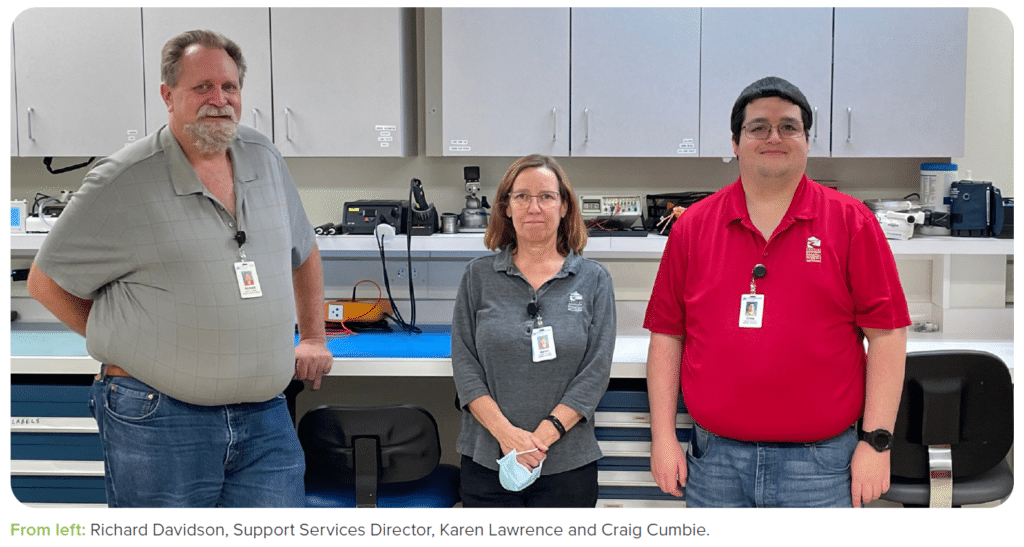
A two-technician biomed team manages the 2,700-piece medical equipment inventory. They are led by Support Services Director Richard Davidson, CHFM, CHC. The two technicians are Karen Lawrence and Craig Cumbie, CompTIA A+. The team handles duties at the main hospital as well as duties at 18 clinics and a 36-bed skilled nursing facility called Heritage Place.
Cumbie has been a biomed for nine years; most of that time spent at CPH. Lawrence has worked for the hospital since 1987 and has been a biomed since 1998. Davidson has been with the hospital since 2005.
Cumbie says that the small team primarily provides general biomedical services.
“We also provide electronics support to facilities, do some IT work with the equipment we support, perform first call for some radiology equipment, perform product evaluations for new equipment and assist in capital planning by doing our own internal risk assessment for end-of-life equipment,” he says.
Presently, there is not much integration with IT.
“We have no integration at all between the two departments, and it presents challenges for us. We have recently started having bi-weekly meetings to encourage collaboration and keep each other aware of current issues and future projects,” Cumbie says.
Service contracts are not managed exclusively by biomed.
“Radiology contracts are managed by the radiology director. Laboratory contracts are managed by the lab director. All other contractors are managed by biomed,” Cumbie says.
“Anesthesia, sterilizers, lab and imaging are all under contract,” he says. That is possible because of the close proximity to Anchorage.
Data is collected using MediMizer CMMS.
Tracking the Faceplates
The team has taken on additional projects and done its share of problem-solving.
“In 2019, we opened a new obstetrics unit, helped commission a cath lab, and brought a new nurse call system online,” Cumbie says.
“We have Masimo Radicals in our med/surg rooms for SpO2 monitoring and we had an issue last year where staff were removing the faceplates and taking them to other rooms if they had a unit that was not working. The problem is that these units connect to a central monitor, and if you move a faceplate from say room 105 to 112, the faceplate from Room 105 will connect in Room 112 and show up on the central as Room 105. If you had a patient connected to this, and they started de-sating, you would go to Room 105 and possibly find an empty room. You would have no idea where the patient actually was,” Cumbie says.
He says that the faceplates have locks on them to prevent moving, but you can still pop the faceplate out with a screwdriver or key.
“After this happened, we went through the entire floor, revalidating and labeling every unit. We reported our findings through an incident report and won a safety award for it. Nursing made it clear not to remove those faceplates and to contact biomed for any issues,” Cumbie says.
The technicians encountered another issue during the height of the global COVID-19 pandemic, when there was a need to monitor more patients than the central monitoring room was capable of.
“We installed two new PC monitors in the central monitoring room. We took the central monitor at our ICU nursing station, used a video splitter, and connected a KVM (Keyboard Video Mouse) to it. We had to use a video splitter to be able to have video locally. We ran ethernet into the central monitoring room to the other end of the KVM. That KVM was cascaded into an existing KVM in that room. We ended up with the staff having the ability to control the ICU central monitor from the central monitoring room with a keyboard/mouse and from the ICU nurses station using the touchscreen,” Cumbie says.
He says that they ran audio from the ICU central monitoring station into the central monitoring room so that they could hear the alarms, and if they turn off the display associated with the alarm, it shuts the audio off so they don’t hear alarms if it is not in use.
“It was not an ideal solution, but it was one of those ‘make it work’ situations that were common during the height of the pandemic. We had Spacelabs on site recently to prepare for an upgrade and they were impressed with our ingenuity,” Cumbie adds.
Away from work, the biomeds are involved with the newly formed Alaska State Biomedical Association.
“We also try to attend the annual AAMI convention,” Cumbie says.
For a small biomed team on a peninsula in Alaska, the technicians represent the profession well. It is a testament to their skill sets and experience.
