


By K. Richard Douglas
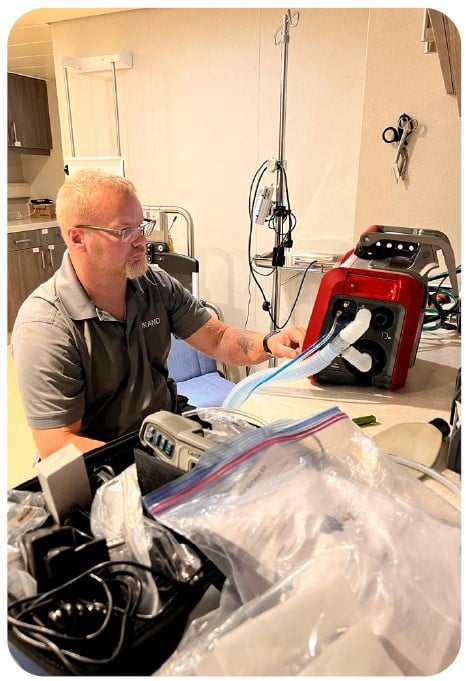
Imagine being a mobile biomed, but instead of traveling between hospitals or clinics, you instead travel between ships? Repairing a device, or providing a PM, and then announcing that things are now “ship-shape” may have greater significance for these biomeds.
This is one of the services provided by VIKAND Medical Solutions. According to the company’s website: “VIKAND provides proactive total health care solutions for the commercial shipping, cruise, yachting and offshore industries.”
Operating out of Dania Beach, Florida, the company’s Biomedical Operations Department oversees medical equipment management for seagoing devices.

“The department team members are composed of by a team of four account managers, five biomedical field service technicians, two remote technical support biomedical technicians, one in-house biomedical technician, four CMMS administrators (TMS Online) which handle the software infrastructure as well as data management, three administrative assistants, which assist with recall management, reporting, parts management and financial records,” says Robert Wentworth, vice president of biomedical operations.
He says that the department is also supported by a travel coordinator who, although not organic to the biomedical operations department, spends much of their time directly supporting the biomed department by coordinating and arranging travel.
Although this biomed department is unique compared with most, Wentworth says that it is also unique because most team members are trained across a variety of modalities.
“Most of our technicians are trained on lab equipment, ventilators, portable X-ray including digital radiography and computed radiography, as well as various other types of equipment. As VIKAND continues to grow, we have begun creating a new diagnostic imaging division in which we will expand our capabilities of providing support for X-ray, ultrasound and PACS,” he says.
Wentworth says that the department supports roughly 225 cruise ships.
“Medical facilities on these vessels range from a single treatment room on smaller ships to centers that have an ER/treatment room, up to three ICUs, laboratory and multiple patient wards. They also have secondary medical centers, which can contain medical equipment that can be used in the event the main medical center is unusable/reachable, as well as medical equipment such as AEDs and oxygen concentrators around the ship,” he says.
Starting with Design
While the department has projects that are more aligned with traditional biomeds, there are many unique challenges that face HTM professionals working with ships or fleets of ships.
“VIKAND has participated in the design of medical centers, [and the] outfitting and installation of medical equipment for those medical centers located on cruise ships. Most recently we began installing patient monitoring systems on the larger ships,” Wentworth says.
He says that the biomedical operations department plays a crucial role in the ship building and launching of new ships.
“When new ships are being built, the owners must design a medical center and outfit it with appropriate medical equipment. This requires collaboration between the biomedical operations, medical operations and supply chain departments. Through a unique process, we are able to analyze equipment requirements, ensure that the shipyards are designing the medical center to accommodate the equipment such as power requirements, networking, spacing and so forth. It also allows for proper planning of equipment type, brands and models,” Wentworth says.
He says that not all medical equipment is suitable for such environments, which can contain higher levels of humidity and particles in the air, vibration, power fluctuations and so forth.
“We work with different manufacturers to thoroughly evaluate each new type of device being brought to market before we recommend or distribute those products to our clients. We look at things such as operating and storage environments, service requirements, maintenance reports and history, recall activity, support capabilities of that manufacturer, initial cost of product, cost of ownership over time, and availability of parts, consumables and accessories, and so forth,” Wentworth says.
He says that since VIKAND has performed many of these projects over the years, they have been able to help standardize the medical equipment across fleets.
“This has enabled our biomedical technicians to become experts by reducing the number of various brands and models of a particular equipment type, such as defibrillators. It has also allowed for the medical staff to become more familiar with the equipment, resulting in reduced work orders related to operator error,” Wentworth adds.
There are also logistical challenges that face biomeds assigned to working on ships that the VIKAND team has contended with.
“From time to time, there are ships that sail in very remote locations which makes traditional methods of providing biomedical support impossible. During the pandemic we faced periods where international travel was banned. Our department created relationships with biomedical organizations and expanded our relationships with manufacturers around the world. We worked with these other organizations to develop strategic support agreements, provided them resources and training, which allowed us to continue to support our clients,” Wentworth says.
Team members also stay active away from their many work locations.
“We are involved in internal discussions, which from time to time, have an impact on [the] American College of Emergency Physicians (ACEP) and Cruise Line International Association (CLIA) guidelines for cruise ship medicine. All of our U.S.-based techs are members of local biomedical societies. We aim to attend the Florida Biomedical Society Symposium, MD Expo, and AAMI conferences each year to engage in training opportunities. Additionally, we aim to attend other events such as FIME, Seatrade, and both the Fort Lauderdale and Miami international boat shows,” Wentworth says.
The VIKAND biomed team must be one of the most unique HTM departments anywhere. Their special skill sets facilitate the health of sea-going people and medical equipment around the globe.
