


By K. Richard Douglas
In 1989, the Ministry of Health and Welfare in the Republic of Korea formulated a plan to establish a national cancer center. Ten years later, the hospital building was completed, and by 2005, the research building was finished and an information center was opened.
In 2014 came the inauguration of the Graduate School of Cancer Science and Policy. In 2015, the National Cancer Center (NCC) signed a memorandum of understanding with the University of Texas MD Anderson Cancer Center for the collaboration of cancer diagnosis, treatment, education and prevention.
Subsequent to accomplishing all of this development, the National Cancer Center opened a data center, central hospice center and national survivorship center.
The Republic of Korea National Cancer Center uses some of the most advanced cancer-fighting equipment to treat patients.
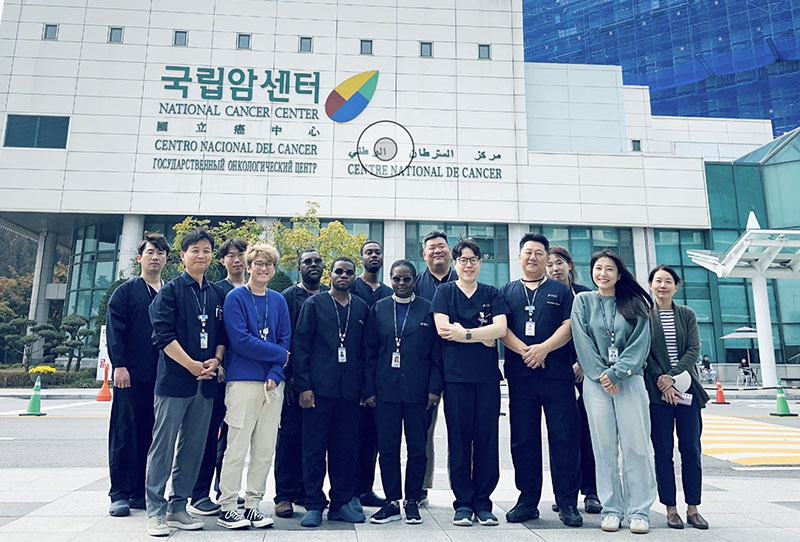
The team that manages that medical equipment is the Innovative Technology Department.
The department’s head manager is Dr. Hong Man Yoon. The team also includes Technical Team Leader Nak Bin Choi; Innovative Development Part Leader Dong Jun Kim; Technical Management Part Leader Yong Su Choi as well as eight engineers and an admininstrative support member.
“Our department’s name is the Innovative Technology Department and consists of eight technical engineers and one administrator,” Nak Bin Choi says.
He says that the department is divided into a technical team leader who acts as the overall medical and research equipment manager of the institution and two part-leaders who have jurisdiction over affiliated hospitals and lab equipment.
“A total of eight engineers are divided into special zones – OR, ICU, ER, CSR, proton therapy center – and general zones – ward, clinic, Center for Cancer Prevention and Detection – and an expert is in charge of imaging diagnostic equipment,” Choi says.
He says that in the case of the research institute, it is divided into a research core center (animal laboratory, proteomics core, flow cytometry) and general department, and each person is in charge of their work.
“The National Cancer Center is a government of the Republic of Korea-funded institution established to contribute to the improvement of public health by reducing the incidence and mortality of cancer patients and improving the quality of life of cancer patients,” Choi says.
He says that among the world’s cancer center research institutes, affiliated hospitals, National Cancer business management headquarters, and the international cancer graduate university are the only NCC in one institution.
“The affiliated hospital currently operates 500 beds, and our department belongs to the Healthcare Platform Center,” Choi says.
He points out that there are only two sites that offer proton therapy centers in the entire country and NCC was the first to introduce the technology in Korea.
The team handles everything related to medical devices and service contracts.
“We manage the whole cycle of mid- to long-term medical device introduction plan and strategy establishment, introduction deliberation, technical review, inspection, repair and service contracts and disuse,” Choi says.
The team reviews contract conditions such as the preventive maintenance cycle and the scope of parts provision and strives to maintain the best operation rate of medical devices by managing repair initiation, repair progress and a preventive inspection schedule in case of failure.
Choi says that by completing the technical training that manufacturer’s engineers get for initial diagnosis and preventive maintenance for MRI, it was possible for the team to reduce costs by about 10 percent for the initial response service by a biomedical engineer.
PROVIDING TOP-NOTCH TRAINING
As a special project, the team of biomeds helped prepare cancer center counterparts in a West Africa country with an extensive overview and training.
“In preparation for the opening of the National Cancer Center in Ivory Coast, Africa, two local medical technician engineers and two technicians visited the National Cancer Center in Korea to conduct an educational training project,” Choi says.
He says that the training was conducted for six months from May to November 2023 with eight instructors from the Department of Medicine at the National Cancer Center.
“The main content was the general work of the Department of Medicine at the National Cancer Center, theoretical classes for medical equipment to be installed at the National Cancer Center in Ivory Coast, repair practice, field training, equipment manufacturer’s field visit and attendance at the conference,” Choi adds.
The team of engineers is also ready and able to address problem-solving.
“In relation to medical and research devices, devices or equipment are produced that increase convenience during treatment or research and parts of discontinued equipment are produced using 3D printers to contribute to the increase in equipment operation rates,” Choi says.
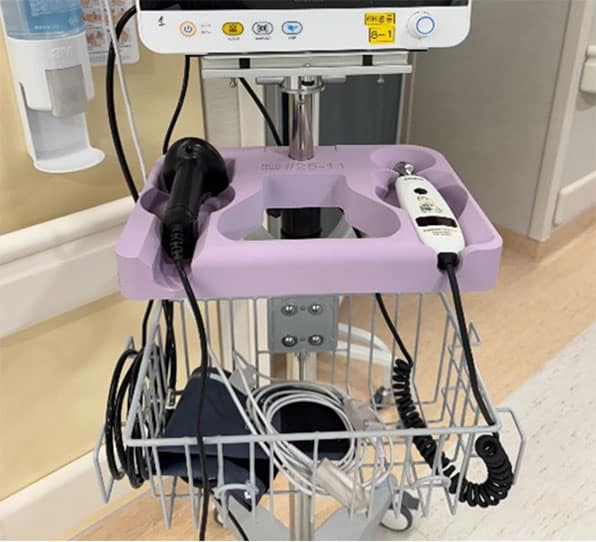
Another example of resourcefulness was the team’s ability to address the need for a cradle to allow clinicians a handy way to hold accessories for a patient monitoring device.
“The video monitoring system (VMS) in use in the ward is using a barcode scanner for Patient ID scanning and a thermometer for EMR interworking, but there was no cradle at the time of introduction, causing inconvenience to staff. To solve this problem, a dedicated cradle was designed and manufactured, and a patent was applied for construction, and the results are waiting,” Choi says.
When team members are not on the job, they are involved in several national organizations.
Choi says that the cancer center regularly attends and presents seminars at the Korean Medical Association, which includes most hospital technicians in Korea, and the team leader is in charge of the association’s educational promotion and learning executive position.
He says that they also actively participate in training to acquire and complete the qualification as a medical device safety manager and strive to create a safe medical device use environment in the hospital.
The group also participates with the Korean Society of 3D Printing in Medicine.
“Attending 3D printing conferences every year, we are actively trying to utilize the latest 3D printing technologies and excellent use examples used in the medical field,” Choi says.
The department also is involved with the Korean Society for Quality in Health Care and the International Society for Quality in Health Care.
“We regularly attend [the] society for quality to identify excellent cases of quality improvement in other hospitals and try to apply them to our hospital,” Choi says.
As an HTM professional, when you represent your government’s official center of excellence in cancer care and treatment, you have to be at the top of your game. The Innovative Technology Department members’ resourcefulness and innovation along with the willingness to train other biomeds shows that they are up to the task.
