



By K. Richard Douglas
Tampa, Florida is one of the best-known cities in the country. The city features the largest port in the state of Florida, the most lightening nationwide and is where Ray Charles started his singing career. It is also where Teddy Roosevelt and the Rough Riders launched their operation to Cuba.
Today, the city is best known for its beaches, manatees, cigars, climate and events. It provides an ideal spot on the west coast of Florida for residents and tourists.
It is also home to 1,100-bed Tampa General Hospital (TGH). The hospital is the region’s largest teaching hospital and is a Level I trauma center. The research and academic medical center is located on Davis Island in Tampa.
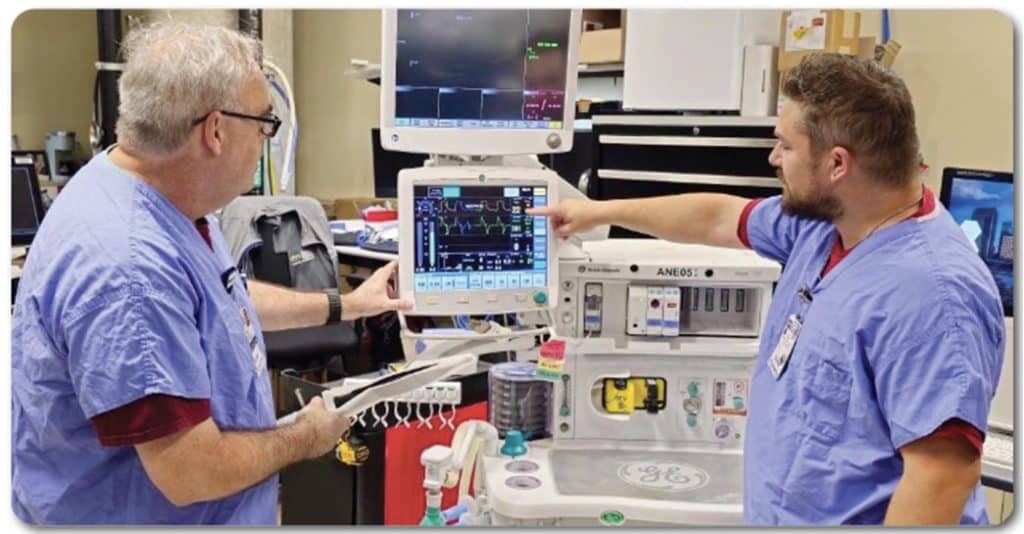
Managing Tampa General’s medical device inventory is the organization’s clinical engineering department.
The department includes Director Ryan Poggenpohl; Managers Steve Anderson, Brad Taylor and Mike Robinson, CBET; Supervisors Mike Jackson, John Reardon, Sergio Zamudio, Craig Cyr, CBET; and 30 technicians.
The CE team has responsibility for approximately 40,250 pieces of equipment at the main campus, as well as devices at three Tampa General North hospitals, a behavioral hospital, a freestanding ED and more than 150 clinic locations.
The department has proactive involvement in managing service contracts.
“One of Steve Anderson’s main functions as a manager is to manage contracts. Brad and Craig manage contracts for our TGH North facilities. Up until recently, we have been managing contracts with a homegrown system. We have recently moved more and more of our contracts into the NTRACTS application,” Jackson says.
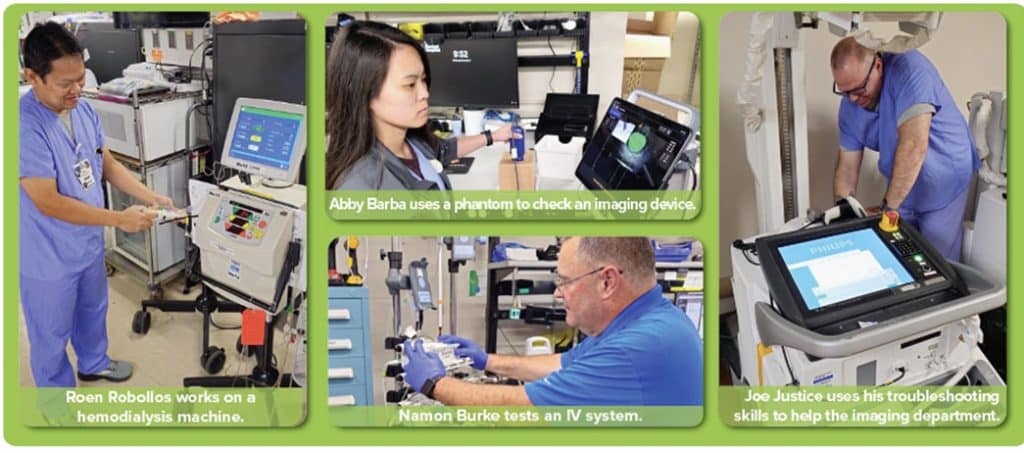
The department has techs assigned to equipment they specialize in.
“We have imaging specialists who manage X-ray, ultrasound, C-arms and first look on cath labs, IR rooms and MRI. We have a team of technicians that manage the repair and planned maintenance for our fleet of 80+ anesthesia machines. We have technicians who are dedicated to supporting our 6,000-plus infusion pumps and 1,000-plus beds,” Jackson says.
In a sign of the times, the group has a device integration team that supports medical equipment sending information into the Epic EMR charts.
“Our device integration team implements and supports the integration of medical equipment into our EMR (Epic) with integrations including patient monitors, dialysis machines and CRRT machines, anesthesia machines, ventilators, hospital beds and NICU incubators and warmers,” Jackson says.
He says that this includes: patient monitoring (Philips, Mindray) integrated through Philips middleware called “Philips IBE” or Mindray middleware called “eGateway,” ventilators, anesthesia machines, dialysis machines and CRRT machines (Nxstage-System One); wireless connectivity and uses Capsule middleware.
Other devices include patient bed integration and NICU incubators and warmers (GE Healthcare-Giraffe, Panda); that uses Capsule middleware and an integration device called a “neuron.”
The CE team uses AIMS 3 as its CMMS.
“This system tracks all PM and repair work orders. We also manage recalls through a combination of AIMS and ECRI. The department also has access to Philips Focal Point, a helpful tool that allows us to access information and perform security patching on our large inventory of Philips patient monitoring systems,” Jackson says.
EXPANSION AND REPLACEMENT PROJECTS
Several special projects also keep the Tampa General Hospital Clinical Engineering Department biomeds busy including expansion projects and equipment replacements.
Jackson lists a few of the current projects underway.
“Re-opening of level 2 NICU at TGH Spring Hill. We are actively working through the implementation of the centralized monitoring unit for the TGH main campus. Replacement of Stanley Mobile View RFID system with Intelligent Locations RTLS solution,” he says.
Jackson also says the department is heavily involved in replacing the out of support Rauland Borg Responder 4 nurse call system with the new Responder 5 system.
Other projects include expanding TGH’s footprint through the opening/acquisition of offsite facilities including three TGH North Hospitals in the past couple of years and more than 150 clinic locations.
There are also projects ongoing at the TGH Behavioral Hospital and the Kennedy freestanding emergency department.
Jackson says that the team often partners with clinical staff throughout the hospital to identify areas of opportunity in making TGH a safer place for team members and patients.
“We meet frequently with the risk management team to work through medical equipment improvements to reduce incidents or safety concerns,” he says.
Jackson says that the department plays a major role in capital equipment replacement.
“We hold meetings and have a recurring steering committee set up to prioritize the replacement of aging equipment in a proactive manner,” he says.
In addition to approximately 1,100 licensed beds at the main campus, the hospital system is looking to expand with the building of the Taneja Tower on the TGH main campus. This will provide future projects for the experienced CE team.
Some members of the department are also active in the local HTM community away from work.
“The department itself is not directly involved with any professional association activities. We have team members that attend BAAMI meetings and FBS expos. We have a working relationship with St. Pete College for their internship program,” Jackson says.
While the focus in Tampa is frequently on the mild climate and proximity to the gulf, there will always be a need for healthcare, and often emergent care. The experienced Tampa General Hospital Clinical Engineering Department is there to support clinicians and patients.
