


By Steven Hughes 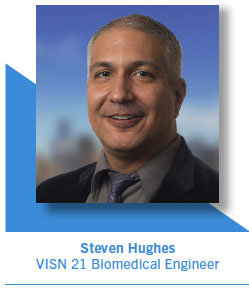
Growing up I heard a phrase daily from my family: What did you learn today? … If you didn’t learn anything new, you wasted the day.” Learning and improving are important skills for any professional. As an individual, you always want to grow and become wiser than you were yesterday. The ability to learn and teach others what you know and what you have learned is a very valuable commodity that folks in the healthcare technology management (HTM) community are always willing to share. The HTM community is unique in that they easily check their egos at the door and are always willing to listen and learn from those around them.
EVERYBODY IS A SME
Take every opportunity to learn from your co-workers. If you have downtime and someone is going on a “call” or heading to a meeting ask if you come along and “shadow” to learn how they handle and solve problems, interact with staff, establish connections and how to create strong working relationships. One of my favorite television shows is “Undercover Boss,” where members of the C-suite of various organizations learn from their “boots on the ground” employees doing everyday activities where solutions to problems are shared as well as bringing to light challenges that need additional assistance in solving. This is a prime example of learning from your local Surface Matter Expert (SME). I am personally thrilled I get to interact and learn from all my coworkers every day and is one of the reasons why so many people have long successful careers in the HTM field.
GET LOCAL
One way to improve yourself and others around you is being involved with local, regional and national organizations related to your career. The benefits of joining an organization go beyond the great comradery, learning from others, but also contributing and improving the field and career you have chosen to make a living with and are passionate about. Talking, networking and interacting with people opens conversation to learn from those whom have already solved your problem. It is hard in the current state of events with COVID-19, but there are ways we can safely network and support the advancement of our field through HTM associations —local biomedical, clinical engineering and HTM chapters. It has been hard, but many organizations are still gathering safely and providing online virtual events. The California Medical Instrumentation Association (CMIA), Colorado Association of Biomedical Equipment Technicians (CABMET), Florida Biomedical Society (FBS), New England Society of Clinical Engineering (NESCE), and Philadelphia Area Medical Instrumentation Association (PAMIA) are a few that I have been involved with and are great resources that are still conducting meetings, trainings and gatherings. They can also provide guidance on how to utilize resources available if you are interested in joining a local chapter in person, virtually or in starting your own.
GET INVOLVED
The HHS 405(d) Program and Task Group is a collaborative effort between industry and the federal government, which aims to raise awareness, provide vetted cybersecurity practices and works diligently to update, revise and create official 405(d) products to provide effective and current cybersecurity practices. If you would like help developing products like Health Industry Cybersecurity Practices (HICP) and the upcoming Enterprise Security Risk Management (ESRM) product to strengthen the health care and public health (HPH) sector’s cybersecurity posture against cyber threats get involved at 405d.hhs.gov.
Information Sharing and Analysis Centers (ISACs) sanitize data to hide the identities of organizations that provide sensitive information before sharing among members or with the government. The Healthcare and Public Health Sector Coordinating Council (HSCC) Cybersecurity Working Group (CWG) collaborates with the Department of Health and Human Services and other federal agencies to identify and mitigate systemic risks that affect patient safety, security, and privacy, and consequently, national confidence in the health care system. If you would like to get involved with the development of recommendations, best practices, and guidance for enterprise cybersecurity improvements, as well as advice to government partners about policy and regulatory solutions that facilitate mitigation of cybersecurity threats to the sector visit h-isac.org.
GATHER OFTEN
- Attend conferences and local meetups. Networking with the HTM community is priceless.
- AAMI (aami.org) has over 10,000 members, 5,600 of which are certified professionals with over 7,300 members who participate in frequent education events and have contributed to over 400+ resources. They provide annual networking and education conferences at the annual AAMI eXchange.
- MD Expo (mdexposhow.com) is a conference targeting and showcasing healthcare technology management professionals with education and networking opportunities with peers, industry experts and vendors.
- HIMSS (Himss.org) Global Health conference and exhibition is one of the largest shows for the health care community chock full of networking opportunities, education tracks and sessions that are available in person and digitally.
LEARN THROUGH TEACHING
There are many ways to mentor others in and entering the HTM field both inside and outside of your organization. The experience is rewarding and provides introspection, reflection and evolution by both the mentor and the mentee. AAMI has established a mentorship program that pairs AAMI members who are looking for guidance in particular interest areas with those who have expertise on a variety of health technology topics.
The Veteran Affairs Technical Career Field (TCF) program has 300 to 400 recent university graduates apply for the 15 to 20 available openings annually. Approximately 200 of the VA’s current 300 clinical engineers are alumni of the TCF program, which provides new clinical and biomedical engineers with two years of structured learning and real-world work experiences, guided by a preceptor, plus a $10,000 stipend to attend professional meetings and network in the HTM community.
The AAMI BMET Apprenticeship Program guides employer partners in training the next generation of HTM professionals recognized by the U.S. Department of Labor to meet a growing need for biomedical engineering technicians (BMETs) across the United States.
GET CERTIFIED
The best and easiest way to have fulfillment and advancement in your career is to invest in yourself through self-development and by taking classes and learning from others to strengthen your skill set. There are many online and in-person certification programs out there for getting certified such as a Certified Healthcare Technology Manager (CHTM) and Certified Biomedical Equipment Technician (CBET) by ACCE (ACCEnet.org), Project Management Professional (PMP) by PMI, and A+, Security+, Network+, CySA+ by CompTIA (comptia.org). The (ISC)2 – International Information System Security Certification Consortium (ISC2.org) have several cybersecurity certifications like the Certified Information Systems Security Professional (CISSP), Certified Cloud Security Professional (CCSP) and HealthCare Information Security and Privacy Practitioner (HCISPP) that are approved by the American National Standards Institute (ANSI). These do take a lot of time and dedication but are very rewarding both personally and professionally. Be sure to check with your employer if they can sponsor and assist with your professional development. ACCE also provides several online webinars and sessions. ECRI (ecri.org) is another great online resource that has several online training events available monthly. These resources help with meeting several continuing education requirements for many certifications.
Whenever you go to bed, you should have a smile on your face and a feeling that you accomplished and learned something today. You should always strive to become better each day. You are the element of change not only in your life, but also the circles of people you interact with — the greater your reach, the greater the impact and the greater the fulfillment. We are our own coalition-builders, weavers of opportunity and rainmakers on our career path. Our knowledge is generally the sum of the knowledge of those around us and the people we interact with. The best investment you can make is an investment in yourself. I wish you all the best in you journey and look forward to your contributions to the field as well as seeing your own personal and professional growth as you grow and share your experiences with others!
– Steven Hughes, FAC-COR FACP/PM VHA-CM, is a VISN 21 Biomedical Engineer at VA Sierra Pacific Network.
