



By K. Richard Douglas
In 2011, TechNation profiled the McLeod Health Biomedical Services Department. The world of health care looked very different in 2011. The specter of a global pandemic was not even a thought for most.
Today, McLeod HTM professionals face a new reality. Biomeds everywhere are on the front lines of the COVID-19 pandemic and have been for more than a year.
McLeod Health serves patients in North and South Carolina. The health system serves the health care needs of more than a million people in the region. The McLeod network includes seven hospitals and more than 125 physician offices in northeast South Carolina and southeast North Carolina. There are nearly 1,000 beds at McLeod Health that are available to serve people in 18 different counties.
Managing the system’s medical equipment is a team that includes six imaging service technicians and 12 biomeds, two equipment technicians, an administrative assistant and a director.
Department leadership is made up of Director Roger Moore, CRES, CBET; Supervisor Jonathan Hatley, CBET; Supervisor Mike Williams; and Robert Fuller, CBET, BMET III.
The McLeod Health Biomedical Services Department reports to Todd Hazzard, vice president of patient services.
Keeping the Vents Running
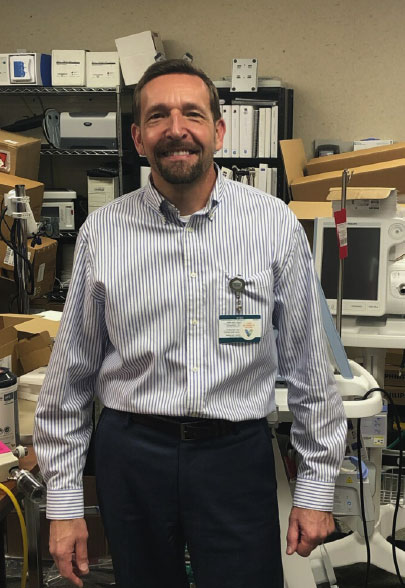 Along with the challenges presented by the pandemic, the biomed team has been busy problem-solving and integrating devices to allow for electronic medical records.
“Recently Biomedical Services has participated in our systemwide EMR go-live of Cerner. This included many hours of preparation to interface multiple medical devices using different interfacing platforms. We have expanded at multiple hospitals in our organization. Some of these include new patient bed towers, surgical suites, multiple emergency departments, intensive care units, endoscopy, neonatal intensive care unit, women’s care unit and ambulatory surgery centers just to highlight some recent projects,” Hazzard says.
He says that Biomedical Services participates in the planning, selection, implementation and maintenance strategy of the medical and imaging equipment for these projects.
The team has employed its troubleshooting skills to the accreditation process and assisted clinical colleagues.
“Recently, Biomedical Services assisted Mammography in obtaining ACR and MQSA certification. There was an issue with the media that Mammography had in sending images for review in the certification process. Biomedical Services was able to problem-solve and come up with a solution that met the needs and requirements of all parties. This is just one example of a problem that Biomedical Services encounters on a weekly basis,” Hatley says.
He adds that the department sees problems as opportunities, knowing that every opportunity has a resolution.
“Since the beginning of the COVID-19 pandemic, ventilators have been high priority. When one is down it puts a major strain on Respiratory Therapy to find another vent with the software options that can be used to treat that patient’s needs, especially when all of our hospitals were at/near maximum capacity for vent patients,” Hatley says.
He says that the department always tries to keep a limited number of stocked parts and PM kits on hand to fix a vent as quickly as possible.
“And, pre-COVID, if we didn’t have the part we needed on hand to make the repair, it was fine to order the part and install it when the part arrives because there would be enough spare vents available for the respiratory therapist (RT) to use. So, even though you have a broken vent, it was a high priority repair, but a ‘low pressure’ type of repair because it was not likely that this one vent being down was going to delay treatment of any patient due to the number of spare vents the RTs can pick from,” Hatley says.
He says that earlier, at the beginning of the pandemic, and during the different spikes of COVID-19, when a vent was down, it was even “higher than top priority” to get it repaired.
Hatley says that much like he uses tools and simulators to fix equipment, the RT uses vents, bi-paps and sat monitors to help fix the patient. RNs use medications, pumps and monitors to care for the patient.
“It’s that kind of situation that reminds me how much of an impact biomedical equipment technicians have in the recovery of any sick patient,” he says.
The biomed team was even able to help facilitate the addition of an option to some of the health care system’s ventilators during this period of increased use.
“Recently, McLeod has purchased quite a few of the Philips V60 ventilators. After having them for a while, it was determined that these units would be more versatile if they had an option added to them. Software and licenses were purchased for some of these vents across all of the McLeod campuses,” Williams says.
He says that because of the COVID-19 pandemic, the ventilators had been in high use and were often hard to access for maintenance.
“Biomed was able to coordinate having a person come to multiple campuses and update the software and install these upgrades. This took cooperation between the biomed that was on site with the person coming in to do the upgrades. It also took a great deal of cooperation with the respiratory departments to get the affected machines available to be upgraded,” Williams says.
He explains that, in some cases, it took the biomed working with the respiratory department to get the patient taken off of one machine and put onto another so that the work could be completed in a timely manner. This had to be done in order to provide the respiratory department with upgraded equipment that better suited their needs and provided for improved patient care.
Away from work, many of the team continue their contributions to HTM.
“Biomedical Services has members that participate in the North Carolina Biomedical Association (NCBA) and the Healthcare Technology Management Association of South Carolina (HTMA-SC),” Hazzard says.
This HTM team continues to ensure that treatment is available to patients during a critical time in American history and into the future.
