


It’s not a news flash that computer networks continue to grow in size, traffic and function. Healthcare Information Systems (HIS) are in the same boat. Router functions and configurations become some of the most important methods to help manage traffic conditions and preserve medical device security and interoperability function. This month Tech Savvy delves into router terminology and basic functionality. Being aware of these terms and general concepts will help when meeting with your local healthcare IT team.
 First a side note for clarification about router terminology is the use of the terms router and gateway. Originally routers were known as gateways. As router function evolved it was viewed as a special kind of gateway and the term router came into use. The older terminology is still in use however such as default gateway in a routing table. The default gateway is the go-to path when a router does not recognize the destination network. Included in the network level packet is a time to live metric. Each time a router sends a packet to its default gateway the time to live counted is decremented by one. Eventually a bogus or corrupted packet’s time to live metric reaches zero and the last router will discard it. This way the bogus packet will not run around the network forever.
Routing Terms
The first acronym to look at is Autonomous System (AS). Within the Internet, an AS is a single or group of networks controlled by a common network administrator. In Figure 1 – the Healthcare Information System (HIS) is an AS – a network system that is internally controlled without need of the Internet – a “standalone network”.
Managing traffic in the AS are strategically deployed Internal Routers (IR). All of the various routing connections shown in Figure 1 are running Border Gateway Protocols (BGP). Within the AS or intra-network the IRs are running IBGP or Internal BGP, where the connections and routes are trusted and freely exchange information. When connecting to another AS via Internet routers will use EBGP or External BGP, with EBGP connections containing only pre-specified information with other pre-specified external routers is allowed.
The HIS in St. Jeff’s hospital (Figure 1) shows the remaining router terminology to be aware of:
- ABR – Area Border Router. An ABR manages traffic within different areas of an AS
- ASBR – Autonomous System Boundary Router. This one is rather obvious – this type of router manages traffic control between 2 or more AS.
- Stub area – a stub area is a network that has no other connections to the internet or any other network – a dead end.
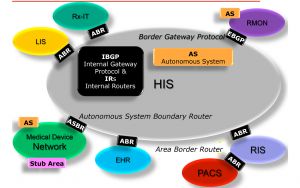 Other acronyms used in Figure 1:
- RIS – Radiology Information System
- PACS – Picture Archive Computer System
- Rx-IT – Pharmacy Information System
- RMON – Remote Monitoring
- EHR – Electronic Health Record
- LIS – Laboratory Information System
Please note that Figure 1 is built as an example to enable router terminology discussion. As such several department areas have been left out.
Terms like AS and BGP are not immediately clear and is why they’re covered in Tech Savvy. The main thing to be aware of is that the position of the router within an AS or straddling more than one AS will determine its function and security trusts.
