



By Chris Dissinger
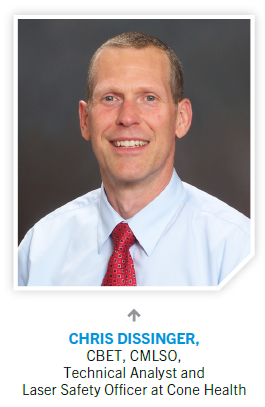 Several years ago when our health system was looking to set up a laser safety program, they looked to the biomedical department. Why us? If anyone would know which lasers were purchased for the health system and what departments were bringing in loaners and rentals, it would be us according our leadership’s thought process. Because the laser safety program was brought under the auspices of our department, my director encouraged me on the journey of being the laser safety officer for the health system. Whether or not the laser safety program falls under biomedical or some other department, why is one needed? I thought I’d share some lessons learned, or events we have had over the years, to give you some understanding of why.
I had just finished going to medical laser safety officer training and was as green as you can get, when I received an urgent phone call from one of our day surgery centers. A patient was in flight from out of state for a cochlear implant procedure, and a vendor had just showed up at the center with a rental laser. The OR staff wasn’t exactly sure if the laser should be used, nor were they exactly comfortable with a laser being brought in at the last minute without notice. It wasn’t too long after this scenario, where again, I got a last-minute phone call from one of our hospitals. The physician had talked to a laser company’s sales representative at a conference weeks earlier. That sales rep had convinced the doctor their laser was the best for OB/GYN procedures using the daVinci robot. So the physician invited the sales rep to fly in from out of state with the laser to use for a scheduled case, of which none of the OR staff were aware of their arrival. Again, luckily the OR staff called me because they felt uncomfortable allowing this laser to be used on their patient. So, why were both of these cases canceled?
In talking with medical staff services, the physicians didn’t have privileges to use these particular lasers because of the medium (thulium) or for the type of procedure. Neither of the companies had submitted copies of their liability insurance to our contract administration to verify that they had enough coverage in case of patient injury. The sales rep for the one laser was placing the responsibility on the OR staff to operate the laser and reprocess the fibers. The staff had not had any training to perform these functions.
To prevent last-minute events like this; protect patients and the health system from liability, my director and I embarked on working with leadership to have a laser safety policy that included a formal laser approval process. This process would require signatures from key stakeholders for any lasers brought into the system whether it is; purchased, rented, loaned or demo.
Every facility is different. What works for us, may not work for you. The main point I want to make is that there is a lot at stake in regard to patient safety, liability and meeting regulatory requirements with lasers. If your system does not have a laser safety program in place, I highly encourage you to talk with your leadership to start one. Who knows, it may be a new adventure for you. So far, I have enjoyed the ride!
