


E ntering the biomed profession means you never know where it will lead you. That was the case with one HTM professional at the Medical University of South Carolina (MUSC Health) in Charleston, S.C. While not even planning to be a biomed, his skills eventually led him to the east coast of Africa.
Robert Tritt is a BMET III with the biomedical engineering department at MUSC Health. Tritt did not plan on a career in biomed from the beginning. Like many, it became apparent after he started in another position.
“(I) really just fell into it,” he recalls. “Right after college, I worked for a company installing and repairing nurse call systems and one account was MUSC. At that time, I wasn’t sure what I wanted to do as a career. After about two years there, Biomed from MUSC called and asked if I would work for them; they liked me and my work. So in July of 2003, I started at MUSC.”
Tritt earned an associate of science degree in Electronics Engineering Technology from ITT Technical Institute. He has racked up his biomed experience with his current employer from the beginning. Back when he was starting out, he didn’t know much about biomed or the equipment he would be working on.
“Learning the job was done by some manufacturer training, some on-the-job training, and some thrown in water (and) learn as you go training,” Tritt says. “The first two years was learning what I can in the way of the equipment, PMs, areas and locations of the hospital and the campus. I’m still learning new equipment, and technology coming into the hospital and healthcare.”
Tritt has worked on equipment in almost every area of the hospital.
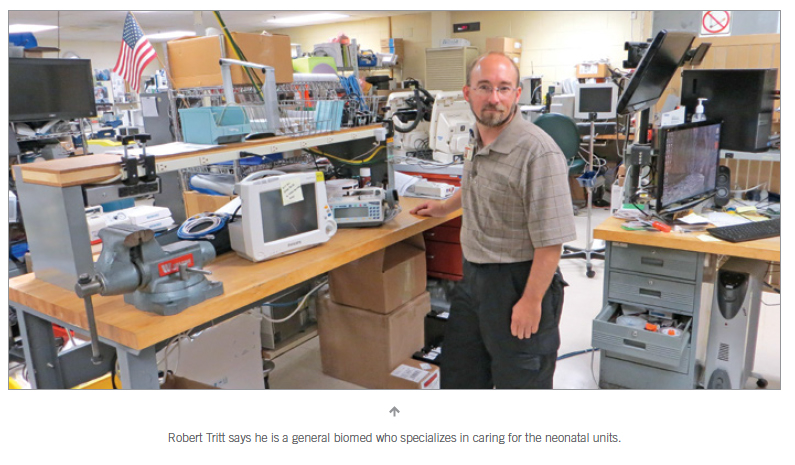
“The areas that I cover have changed throughout the years, and (the) one I have kept since the beginning is neonatal ICU,” he says.
In addition to PMs and repairs, two duties Tritt has had since the start, is being the lead tech on equipment integration to the EMR and the point person for a campuswide bedside monitor installation for MUSC Health. He is also the point person for the campus-wide asset tracking system.
Tritt is well thought of by his co-workers.
“Robert exceeds the expectations of his biomedical responsibilities at the hospital,” says Tritt’s colleague, Jake Silver, BMET. “He is a role model for all biomeds in my opinion. He is definitely the go-to guy.”
Taking on Challenges
“A lot of the nurses in my areas call me ‘Boots.’ And, a lot of people in the hospital only know me by my boots. I have worn cowboy boots to work since I started,” Tritt says.
Once Tritt’s boots were in bad shape and he had to order a new pair. He had to wear different shoes while he was awaiting the delivery of his new boots.
“As I was waiting for them to arrive, I wore sneakers and was later told by the nurses not to wear them again,” Tritt says. “They could not hear me when I walked my units and didn’t know I was there. The nurses in the nurseries got used to the sound of my boots, when I walked around checking on things. If there was a problem and they didn’t have time to page me, they would stop me or find me in the unit because they heard me walking around.”
In March of 2013, Tritt seized an opportunity to visit Tanzania, Africa for a week. The purpose of the trip was the installaition of bedside monitors that MUSC had donated to an organization called Madaktari. Preparations for the trip took about a year. Also going on the trip were Dr. Scott Reeves and his daughter. Reeves was the impetus for donating the unused monitors. Madaktari takes a “teach it forward” approach to bringing doctors to east Africa to teach local doctors, who then spread the knowledge.
Tritt had to get everything organized with the monitors, and crate them with destinations at hospitals in three different cities in Africa. The arduous task was complicated by getting the equipment through customs, but it arrived at the hospitals in October of 2012. When Tritt arrived in March of the following year, he installed four monitors at Bugando Medical Center in Mwanza and six at Muhimbili National Hospital in Dar es Salaam.
“They only had four monitors in the ICU and we added six before I left,” Tritt says. “I also trained the biomeds on how to install and service them.”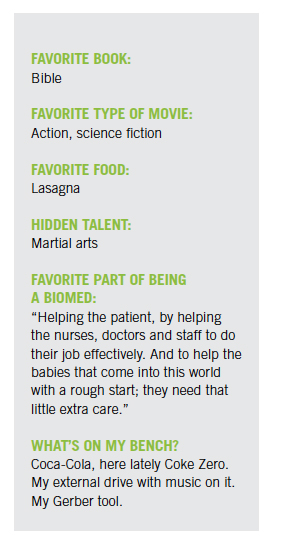
It wasn’t all work. Accompanied by Dr. Reeves and his daughter, Tritt took a safari through the Serengeti. He had the chance to see a lot of animals in the wild including zebras, giraffes, wildebeests and lions. The only thing more exciting than going on an African safari was the chance to meet the president of Tanzania. The president wanted to thank the Americans for the work they were doing there.
Recognition
Tritt says he is a general biomed, but there are a couple of areas that he considers his specialties; “caring for the neonatal units and ‘IT’ within biomed,” he says.
It’s a challenge trying to handle everything at one time. Tritt stays busy with various projects. He said it can be difficult to keep up with PMs and repairs while also focused on the many different projects.
His good work hasn’t gone without recognition. Tritt won the Employee of the Month Award for June of 2013. Another award included some publicity. He won the Health Care Hero Award for Health Care Engineer, given by the Charleston Regional Business Journal in November of 2013. That award recognized the work he did in maintaining the neonatal and pediatric biomedical equipment at his hospital.
