



By K. Richard Douglas
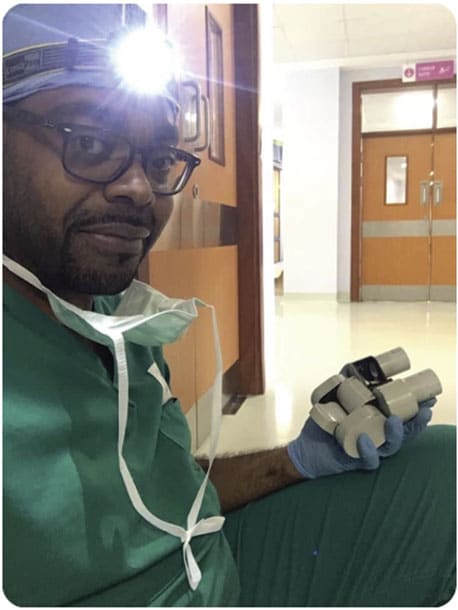 For every biomed who decided early in a technical school or in the military what they wanted to do as a career, there is another biomed who took a more indirect route to healthcare technology management (HTM).
One HTM professional who took a more circuitous route is Brian Gore, an engineering specialist in cardiovascular services at Duke University Health System. Gore had planned to help patients in the nursing profession after working as a heavy equipment operator.
“Honestly, I did not know that this field existed. It was never mentioned as a career option in high school. Growing up, I didn’t know anyone in the field. As a heavy machine operator, I decided to continue my education and pursue another trade. Registering for college, I chose nursing as my major because I wanted to help people and my friends and family had always reminded me of my caring nature,” he says.
Gore remembers going to a friendly gathering and someone who was attending college, and in the biomed program, introduced him to field.
“He told me that I’ll be in healthcare and I get to fix things. These are the two things that fit me perfectly; fixing stuff and helping people. I changed my major the following Monday,” he says.
He graduated with an A.A.S. in biomedical equipment technology and networking certified at Caldwell Community College & Technical Institute (CCC&TI).
“I am currently pursuing my B.S. in biological and biomedical sciences at North Carolina Central University (NCCU),” Gore says.
He has spent his entire 13-year biomed career at Duke University Health System.
“Over the years, I have been part of multiple teams across the clinical engineering department. Mostly, spent as a biomedical equipment specialist in the OR setting. I am now the engineering specialist for the heart center in the catheterization and electrophysiology labs,” Gore says.
HUMANITARIAN FOCUS
Challenges for a biomed can come with big projects or vexing repair problems, but also life events that have nothing to do with work.
“Challenges come in different shapes and sizes. They are not always work related to affect your work. I suffered and recovered from a stroke (in 2016). By the grace of God, my major motor skills were not affected. Just a slurred speech. My memory was also affected. Reading aloud and reading comprehension exercises helped me tremendously. The deaths of my mother (2017) and my wife (2015) were big challenges. Yes, these are events that are not related to my career, but they impacted my ability to provide high quality service that I am known for. A good support system, and having someone to talk to, helped me navigate through these challenges,” Gore says.
He says that society has a stigma that a man showing vulnerability is a sign of weakness.
“I believed this until I learned how stress can affect your body’s physiology more than anything else. Suppressing your emotions and feelings are never good. From a man to another man, talk to someone; anyone,” he says.
Gore is also involved in providing healthcare in underprivileged countries.
“I have been on seven missions to Kampala, Uganda and Tegucigalpa, Honduras. In these trips, I am the engineer for the traveling team. I will work with the biomed team in the country to collaborate and teach the staff. The mission is to provide a service to fulfill a need in a community and to teach them the skills so they could become self-sustainable,” he says.
While Duke University is known for its exceptional academic and athletic programs, it also gives back to the community locally and globally.
“I am involved in an initiative called ‘REMEDY at Duke.’ REMEDY at Duke University is an all-volunteer program run by Duke staff and students who have an interest in global health, environmental sustainability and community service. It reduces waste and promotes resource sustainability through the recovery and recycling of usable surplus medical supplies, reduces disparities in global health care through the donation of medical supplies to areas of need, and promotes awareness of global health issues within the Duke and greater Durham community. As of 2025, REMEDY at Duke has made over 300 donations to 50 different countries,” Gore says.
He has been nominated twice for TechNation’s Humanitarian of the Year (2024, 2025) and is a Marquis Who’s Who Honorary Listee (2024).
In addition to volunteer work off the job, Gore enjoys reading, fishing, camping and hiking.
“I draft and build things. I have a townhome. Currently, I have drawn up a mirror/medicine cabinet for my bathroom and shelving for my pantry closet. I am also renovating my townhome myself. There are things outside of my toolbox that I have to hire professionals for – plumbing; I don’t do plumbing LOL – but it’s me for the most part. I dab a little in photography,” he says.
Gore describes himself as an “genuine individual” who tries to treat everyone the same.
“What drives me is the human side of biomedical technology. Behind every device or system is a patient, a clinician, or a family member, and I try to keep that front and center in the work I do. I care deeply about the science, but I care just as much about the people affected by it,” he says.
He is driven by two things: advancing biomedical technology and serving the community.
“I see them as connected. When we understand community needs, we provide better, more meaningful healthcare solutions. My goal is to provide a service that clinicians trust and patients never have to think twice about. I try to approach biomedical technology with a service mindset – building tools that improve care while also staying connected to the communities affected by them. That balance keeps my work purposeful and grounded. At the end of the day, I’m just someone who cares about using biomedical technology to help people. If it makes healthcare a little better, or a little more human, I feel like I’m doing something right,” Gore says.
It’s the human element that Gore brings to the job and to volunteering that betters the lives of those he comes in contact with.
BIOMETRICS
Favorite book:
“Things Fall Apart” by Chinua Achebe
Favorite MOVIE:
“Forrest Gump”
Favorite FOOD:
Cake
Hidden talent:
I can pat my head and rub my belly (and vice versa).
Favorite part of being a biomed?
The gratification of fixing something. That moment when you’re diligently working on something and you turn it on to see if you fixed it, then it lights up and works as it should. Pure bliss.
Why do you read TechNation?
I read TechNation to stay up-to-date and in the know of new technologies, concepts, and ideals in the HTM industry. Sciences advance so quickly that if you don’t stay read up on things you’ll get left behind.
Professional of the Month Nomination
