




 Healthcare technology management (HTM) is among the many healthcare professions that faces a staffing shortage. An added challenge for the HTM field is that many individuals do not know about the career option. It is basically unknown when compared to the popularity among children who want to grow up to be doctors and nurses.
TechNation interviewed thought leaders regarding HTM employment and recruiting for this month’s roundtable article. Insiders shared tips and trends they see in the industry as well as ways that candidates can make themselves stand out to recruiters and hiring managers.
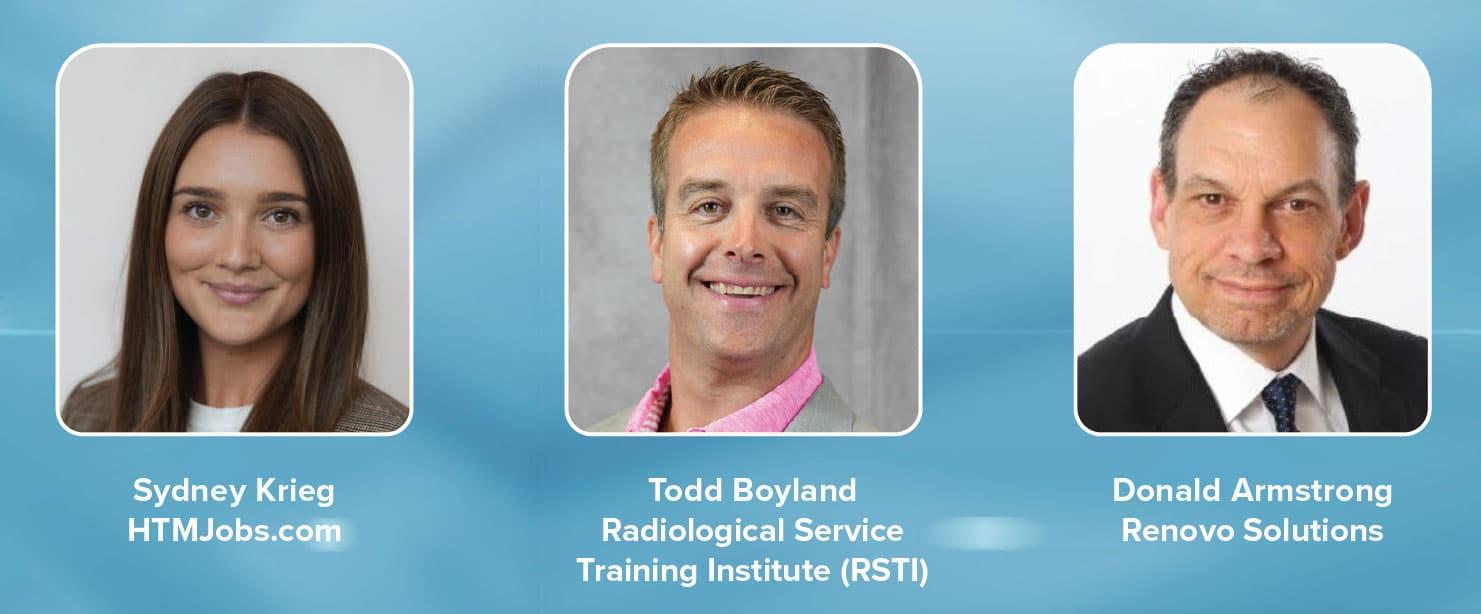
Participants in this month’s roundtable on HTM employment and recruitment are:
- HTMJobs.com Recruiting Specialist Sydney Krieg;
- Radiological Service Training Institute (RSTI) President Todd Boyland, CRES, CPSM; and
- Renovo Solutions Technical Training Program Manager Donald Armstrong, CBET, CHTM, CABT, CRES.
Q: WHAT SKILLS AND QUALIFICATIONS ARE MOST IN DEMAND FOR HTM PROFESSIONALS IN 2026, AND HOW HAVE EXPECTATIONS EVOLVED IN RECENT YEARS?
KRIEG: Employers are prioritizing soft skills now more than ever. While technical training, years of experience, and required degrees or certifications remain important, a candidate’s interpersonal abilities often set them apart in today’s job market. The ability to communicate effectively, collaborate with others and adapt to changing workplace demands can make a candidate truly stand out.
BOYLAND: In 2026, employers seek HTM professionals with strong electrical and mechanical fundamentals, sound computer-based skills as well as advanced system-level knowledge. Imaging systems are highly integrated with networks and software, so technicians must understand DICOM, PACS and cybersecurity basics in addition to hardware troubleshooting. Expectations have shifted from reactive repair to proactive system performance and uptime optimization. Critical thinking, independence and multi-modality capability are increasingly important.
ARMSTRONG: For me, the short answer starts with understanding the difference between skills and qualifications. Skills are things you can do, abilities where you’ve demonstrated proficiency. Over the past several years, these have become increasingly important. While qualifications matter, they don’t fix equipment or help with communication in the field. Qualifications – such as degrees, certifications and credentials – are what you have achieved. They are important and help meet HR requirements and minimum standards, but they don’t always demonstrate what someone can actually do as an HTM professional. Beyond the technical background, I also look for interest, engagement and the right attitude – things like teamwork and a willingness to learn. I often say the best biomeds are both confident and humble. In terms of specific skills, the ability to communicate effectively and think critically are two of the most important qualities we look for today. There’s a phrase many of us have heard: “hire for culture and attitude and train for skills.” In many ways, that’s proving more true than ever. If someone has the right attitude and communicates well, we can train them to become excellent biomeds.
Q: HOW IMPORTANT ARE CERTIFICATIONS (CBET, CABT, CRES, ETC.) IN HIRING AND CAREER ADVANCEMENT, AND ARE EMPLOYERS PRIORITIZING ANY NEW OR EMERGING CREDENTIALS?
KRIEG: While certifications can support professional development and demonstrate a commitment to career growth, they are not always essential qualifications. For entry-level technicians, certifications can help offset limited hands-on experience. However, from our employers’ perspectives, degrees in relevant fields combined with demonstrated troubleshooting ability and practical, real-world experience often provide a stronger foundation than certifications alone. Ultimately, hiring managers tend to prioritize well-rounded candidates who balance education, hands-on experience, technical skills and a clear commitment to the field when determining the best overall fit.
BOYLAND: Certifications such as CBET, CABT and CRES remain highly respected and demonstrate professional commitment. They validate core knowledge and can strengthen hiring and advancement opportunities. However, employers are placing greater emphasis on modality-specific education and documented hands-on experience in advanced imaging. Proven competence on complex systems often carries equal or greater weight.
ARMSTRONG: You might be asking the wrong person here, as I’ve been teaching the CBET review course since 2020. That said, I strongly believe obtaining any of the four AAMI certifications is an important accomplishment and can play a meaningful role in career advancement. When I was a hiring manager, seeing CBET, CHTM or CRES behind someone’s name did carry considerable weight. In many ways, it naturally created two piles of candidates. It’s not that certifications tell you everything about a person’s ability to be a great HTM professional, but they do show a level of engagement in their own career and commitment to the profession. We’re also seeing growing interest in newer certifications like CABT, which can be a great entry point for technicians early in their careers. It helps establish a baseline of knowledge and shows a willingness to start investing in the profession from the beginning. At the end of the day, certifications demonstrate that someone is willing to invest the time and effort to deepen their knowledge and validate their expertise, and that kind of dedication is something many employers value when considering candidates for both hiring and advancement opportunities.
Q: WHAT ARE THE MOST EFFECTIVE WAYS FOR ENTRY-LEVEL CANDIDATES OR RECENT GRADUATES TO GAIN MEANINGFUL, HANDS-ON EXPERIENCE IN HTM?
KRIEG: Internships and externships provide entry-level candidates a valuable opportunity to gain experience in the HTM field. Many employers bring on interns or externs with the intention of training them and potentially transitioning them into full-time roles within their organization. Additionally, the MD Expo hosts H.O.T. Workshops at the beginning of each conference, offering attendees the opportunity to receive hands-on training while learning the ins and outs of servicing a variety of medical equipment.
BOYLAND: Hands-on experience is essential. Entry-level professionals should pursue internships, assistant biomed roles or structured programs that provide access to live equipment. While simulation has value, working on real systems builds technical confidence much faster. Engineers can’t be afraid to jump in and try. Focused imaging training can accelerate the transition from general biomed to advanced modalities.
ARMSTRONG: One of the best places to start is through internships or volunteer opportunities. Getting hands-on exposure in a hospital or clinical engineering department can give someone a real feel for the profession and help them start building practical skills. I would also encourage people to look into local biomed or biomedical equipment technology programs. These programs provide a strong foundation in electronics, medical devices and troubleshooting, which are essential skills for entering the field. Another option is to connect with the many biomedical service and repair companies across the country that are often looking for entry-level technicians or trainees. These organizations can be a great way to gain experience, learn from seasoned professionals and start building a career in HTM.
Q: WITH A SIGNIFICANT PORTION OF THE HTM WORKFORCE APPROACHING RETIREMENT, HOW CAN ORGANIZATIONS APPROACH SUCCESSION PLANNING AND KNOWLEDGE TRANSFER?
KRIEG: Organizations should invest in mentorship programs and technical training opportunities for employees who are just beginning their careers in the field. In addition to training, clearly outlining what growth and advancement look like within the organization helps employees understand their career path and the goals they can work toward. It is also important to identify key roles that may need to be filled as retirements approach and begin preparing for those transitions early. Planning ahead, whether by promoting from within or sourcing qualified candidates, helps ensure a smooth transfer of knowledge and responsibilities.
BOYLAND: Succession planning must be proactive, often years in advance, as it takes time to build competence and confidence that organizations are looking for. Organizations should identify high-potential team members early and invest in progressive technical education. Structured mentorship between senior technicians and developing professionals is critical for preserving knowledge. Strategic training partnerships help ensure readiness before experience gaps impact operations.
ARMSTRONG: The key is to start early by identifying potential candidates right out of college, or even high school in some cases, and exposing them to the HTM field. Certifications like CABT are also a great entry point and show a baseline level of knowledge that many managers value. I also think the talent pool is larger than we sometimes realize. Many people would make great biomeds but don’t have the traditional education or experience to get started. Fortunately, many ISOs and in-house programs are beginning to adjust job descriptions to open up those entry-level opportunities. Finally, I’m a firm believer in promoting from within with the right training and mentorship to help transfer knowledge as more experienced professionals retire.
Q: WHAT EMERGING TRENDS ARE SHAPING THE FUTURE OF HTM CAREERS AND HIRING NEEDS?
KRIEG: From a recruitment perspective, AI is making hiring faster and more data-driven through the use of applicant tracking systems (ATS) that scan resumes and identify candidates whose skills best match a job description. Because of this, candidates often need to tailor their resumes to align with the language and requirements in the posting to ensure they reach recruiters. As healthcare technology continues to evolve, employers are prioritizing candidates with a combination of technical expertise, IT knowledge, problem-solving skills and relevant certifications or training.
BOYLAND: AI-enabled imaging, predictive maintenance and remote diagnostics are reshaping HTM roles. Professionals must understand both hardware and the software ecosystems driving modern systems. Cybersecurity awareness is now a baseline requirement. The future HTM professional will be adaptable, analytical and comfortable in highly connected clinical environments.
ARMSTRONG: Many of the emerging trends, like AI integration, cybersecurity and remote diagnostics, are opening the door for new people to enter the HTM field. We’re seeing more professionals with networking and IT backgrounds becoming part of the clinical engineering team, which is a natural fit as medical technology becomes more connected. I also think there’s a big opportunity for second-career professionals to transition into HTM and bring valuable experience with them. Once people learn what an amazing profession HTM is, many are immediately interested. That may not be a new trend, but it will be an important part of how this profession continues to grow and sustain itself.
Q: WHAT ELSE SHOULD TECHNATION READERS KEEP IN MIND REGARDING EMPLOYMENT AND RECRUITING?
KRIEG: Our industry offers so many valuable resources and opportunities for career growth within HTM! Whether it’s attending conferences, participating in hands-on training, or exploring job boards and career fairs, I always encourage technicians to take advantage of the many tools available to them. One of the things that makes our industry special is the strong sense of community – people genuinely want to build relationships and support others who are entering the field or looking to grow within it. Leaning into the people, events and opportunities our industry provides can make a real difference when navigating your own career path.
BOYLAND: The workforce challenge is real, but so is the opportunity. For more than 40 years, RSTI has trained over 15,000 imaging service professionals from more than 50 countries in a 40,000-square-foot facility using real, functional systems. Expanding recruiting pipelines to include military transition programs such as DoD SkillBridge and GI Bill approved training brings disciplined, technically skilled professionals into HTM. Organizations that invest in structured education and long-term development will build the next generation of industry leaders. Everything starts with a solid foundation in principle knowledge. Do not skip developing a solid foundation of knowledge necessary to maximize product-specific experiences.
ARMSTRONG: Don’t limit yourself to only hiring experienced techs for entry-level or BMET I positions. At Renovo, we’ve had several success stories bringing in second- and third-career professionals who, with some internal training, have gone on to become high-performing HTM professionals. For prospective biomeds, make sure your resume clearly lists your skills and accomplishments, and keep it updated and ready. Even jobs like dog walking, cooking or other customer service roles demonstrate responsibility and people skills, which are important qualities in this profession.
