


By K. Richard Douglas
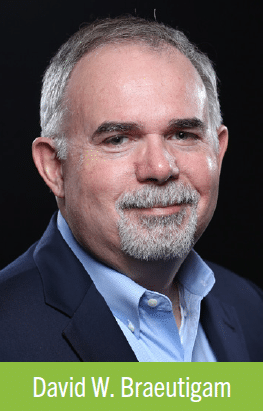 After working in leadership for a major health system, one HTM professional discovered that there can be a second phase to a biomed career.
David W. Braeutigam, president of Braeutigam Enterprises LLC in Arlington, Texas, has parlayed his years of HTM knowledge and a love for writing into a fulfilling calling.
“I decided to start a consulting company to utilize my many years of experience in the HTM field. Not knowing how to consult or how to start a business, I bought numerous books on the subject. Those books, along with talking with other consultants, helped me start my business. My local consulting friends recommended an attorney and a CPA for my business. They are the ones who walked me through the process of getting the tax identification and set up with the government,” Braeutigam says.
He says that he does consulting for hospitals, businesses and AAMI on topics such as leadership development, regulatory compliance, staffing analysis, budget design and analysis, benchmarking, equipment assessment, strategic planning, cost analysis and contract analysis.
“I developed a website just for my business, http://BraeutigamEnterprises.com, that goes into detail on all of these areas,” he says.

Braeutigam says that going solo continues to have its ups and downs.
“You are responsible for developing your website, your business cards, developing a logo for your business, your brochures, paying for conferences and memberships, and finding customers that could use your expertise. It is a slow process and you always have to be looking for new business when you finish projects,” he explains.
He says that he has decided to write a book on how to be an HTM consultant.
“I’ve had numerous people approach me at conferences to ask me how to get into consulting. So, I think the book can help those looking for a new career change. I have several people reviewing it now, so I hope to have it done in a couple of months,” Braeutigam says.
To stay current on information for his business, he attends AAMI and MD Expo conferences and joined several organizations such as The Joint Commission, ACCE, ACHE and ASHE. He also reads numerous magazines and articles that cover the HTM field.
“I stay active with our local HTM organization and speak at the conferences when I can. I also sit on several committees with AAMI so that helps me network and stay on top of the latest issues and concerns. I also stay in contact with other consultants and HTM leaders to share ideas and expertise. It has really been a life changer from working a typical corporate job and the benefits of the flexibility to set my hours has allowed me the extra time to write,” he adds.

Tales from the Trenches
In 2017, Braeutigam published his book “Tales of the Biomed: A Collection of short stories from biomed techs from around the world as told to the author.” He also started a companion website to the book; TalesoftheBiomed.com.
“We all have stories we like to tell at conferences, at parties and at work about our field. I especially like the funny stories and decided I should write a book about it,” Braeutigam says.
“I contacted lots of my friends and they added to my stories in the book. I was on LinkedIn one day and saw a posting of a funny sticky note attached to a piece of equipment. I had forgotten that everyone gets these notes on their equipment. So, I went about contacting others to share those funny sticky notes and added it to my book, Tales of the Biomed,” Braeutigam adds.
How does someone add “author” to their repertoire of skills after several years in the HTM profession?
“I love to read and I read a book several years ago about funny stories that reporters could not tell during WWII. After I read that book, I decided to do the same with the biomed ‘war’ stories we all have,” Braeutigam says.
“I have also published (self-published) two books on World War II. One book is on my second-cousin, SSG Elgin Luckenbach, who was missing in action in the Pacific in April 1944. They found his plane in 2002 and, after recovery and identification; he and his crewmates were buried in the United States in 2006,” he says.
Braeutigam shared the story with friends and they were insistent that he write a book about it.
“During the research of that book, I came across a diary of a first-Lieutenant who was a bombardier in the same outfit as my second-cousin. I got permission from the family to publish the book and just finished it in April of this year,” he says.
Publishing a book can be a complex, involved process that relies on publishing companies, literary agents, illustrators and marketing campaigns. Braeutigam did his homework and chose the road of least resistance.
“I researched the Internet for lots of ways to publish books. Most are expensive and involve purchasing lots of inventory. Amazon has a self-publishing company and you write the book, develop the cover and upload it to them for publishing. They tell you the minimum price to charge and you decide if it is just for the United States or everywhere. You select the paper, design the cover and determine if you would like to print in black and white or color. They assign the ISBN to the book also. You do not purchase inventory — unless you want to have books to sell at conferences — since the books are print on demand. If you never sell a book you are only out the time and effort you put into writing the book. There is no inventory to be concerned with,” Braeutigam explains.
He says that beyond this, he did have to go online to determine how to lay a book out with page numbering, developing a table of contents, inserting references, etcetera.
“I also looked at lots of books for examples of the layout,” he says.
Braeutigam says that another important factor, when self-publishing, is to self-promote.
“I created a webpage for my books https://BraeutigamPublishing.com for a central place to see what books I have completed and others I am working on. I even ‘advertise’ what conferences I will be at so I can bring books to sell and sign. I usually give a book away anytime I speak at a conference. I have also created Facebook pages for my books and post on several Facebook pages that are of special interest,” he says.
Braeutigam says that he created a webpage so people can send funny stories, amazing stories and funny pictures for future books, (http://TalesOfTheBiomed.com).
“I even designed a business card to hand out at AAMI and MD Expo so people have a way of easily contacting me to have their stories or pictures featured in a new book. A good friend of ours developed the logo,” he says.
Projects on the Horizon
“I also enjoy researching and writing about the 408th Bomb Squadron during World War II. During my research on the book about my cousin, I determined my wife’s second-cousin’s husband was the navigator on the same plane as my 2nd cousin that crashed. What are the odds of that?” Braeutigam asks.
He says that he recently found out that the day his second-cousin went down in the New Guinea jungle, that about 35-50 other planes went missing along with the men.
“They called it ‘Black Sunday.’ Some have been found, but most are still missing. I found a plane that was flying next to my second-cousin’s plane, which was damaged by the storm they encountered, so the men parachuted from 18,000 feet into the jungle. Of the 10 men that jumped, eight men made it out alive. One took almost a month to get out. That is my next book to write on the 408th. That is another amazing story,” Braeutigam says.
Writing and consulting aren’t enough for Braeutigam. He is thinking of adding another line of business.
“I have almost thought that maybe I should start a company to develop websites. I do the one for our local HTM group, my family history, my consulting business, my publishing company, the one for ‘Tales of the Biomed’ and I am working on one for my brother-in-law on his new energy consulting business,” he says.
Has writing books revealed anything about the HTM profession to Braeutigam?
“I guess writing the book helped me realize how many funny things happen in our field. But, of course, we have our share of ‘hero’ moments when the BMET or CE comes in and saves the day. That is another book I am working on that will highlight the incredible stories of HTM. I have decided to call it ‘Incredible Tales of the Biomed,’” he says.
There is life after the more traditional work of a biomed system director. The HTM field offers a part deux for those willing to use their resources.
