




By Ted Lucidi
Whether it’s an ultrasound probe, MRI coil, IV pump, invasive pacemaker or other Class II medical device, certain devices just aren’t designed to be repaired in-house. It’s not due to a lack of talent or ability, but typically from lack of availability of replacement parts, a need for specialized test and repair instruments, a detailed knowledgebase, clean rooms, documentation or a highly specialized design.
In some instances, devices may be returned to the OEM using a “repair and return” model. Other times, they may be exchanged by the OEM for another identical device from their finished goods inventory. The OEM refurbishes the client’s defective device, and then places it in their finished goods inventory to be re-exchanged with another client. Both the “repair and return” and exchange models for medical devices have existed for decades. These models have also been used by independent service organizations (ISOs), but with several challenges as well as a few enhancements. Let’s take a look at the details using an ultrasound probe as an example.
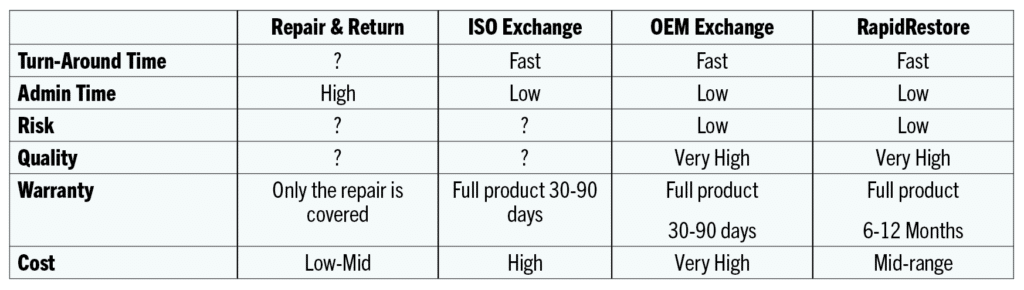
Turn-Around Time
You can’t beat the turn-around time using an exchange model. Most times, the end-user has a solution in-hand next day. The replacement is delivered, and the service technician returns the damaged product to the supplier. Many ISOs, using the repair and return model, provide loaners which greatly increases uptime and end-user satisfaction. Even though a loaner has been provided for next-day delivery, the client still has a variable lead time until their asset is returned.
Admin Time
There might be considerable additional admin time associated with a repair and return model when compared to an exchange model. These days, many HTM teams work using a centralized model. Service techs may have to drive an hour to a remote site, one way, to deliver and test a loaner/exchange, as well as retrieve and package their product. Double or triple that when using the repair and return model. Not only is there both travel to and from the remote site, but there’s additional time required to locate the loaner, possibly wait for the users to complete a study and then clean the probe.
Risk
One of the potential pitfalls with using a loaner is associated with damage. There’s always hope that the loaner doesn’t encounter any misfortune, but accidents happen. Preventable damage can be a very costly reality. Some of today’s high-tech TEE probes cost over $25,000. Not only is there a cost for the repair, but also an additional cost to address a damaged loaner.
There are also risks associated with an exchange model. Typically, aftermarket exchanges are not new. They’re used. Many ISOs use a harvesting model, which exists in many industries, not just medical. Within the ultrasound modality, dealers purchase entire systems in bulk, including probes. The systems are broken down into smaller units, and the parts and probes are sold at a profit. It raises a few questions. Where did the ISO acquire the device? How old is it? What work has been performed on it? How long will it last? You get the idea.
Warranty
Along with the risks above, is the warranty. How long is the warranty and what does it cover? Using the exchange model, the entire product is covered under warranty … but coverage almost never includes preventable damage. In a repair and return model, only that which was repaired is covered under warranty. If a strain relief was repaired two months ago, and now there’s a wiring failure, the warranty will not cover the wiring repair.
There are no standard warranty periods in the ISO market. Some providers only offer 30 days, others 60 or maybe 90 days. They’re highly variable. Innovatus does provide the longest warranty periods in the industry: 12 months on all standard probes and 6 months on all specialty (3D and TEE) probes. The length of a provider’s warranty period should provide a good indication of the level of confidence in their offering.
Costs
Generally, costs associated with repair are much lower than that of an exchange. Repair costs are associated with only addressing failed components. That being said, repair costs are highly variable based on the specific ISOs approach to repair. With the exchange model, the ISO must assume worse case, up to and including the device being a total loss. The result is the exchange cost being much higher than that of repair.
Best of Both Models
What if someone could offer the speed, efficiency, and tip-to-tail warranty of the exchange model, the minimized risk and high quality of a like-new replacement, and do so at the cost of the repair and return model? Well, we’ve been doing just that since 2008! Back then, our legacy companies launched TotalRepair and it changed the ultrasound probe repair market. We were the first to offer the “swap at the repair price” program that others have attempted to mimic.
The program enabled clients to take ownership of a like-new probe from finished goods inventory (next-day), for just the cost of repair … not the market exchange price. We started with only 30 probe models but expanded to over 140. We also published a list of fully repairable probe models, something few, if any, others would even consider. Because we had full-repair capabilities on these probe models (including the array), there was minimal risk to Innovatus, and we passed the savings onto our clients. That original program from 2008 has evolved into RapidRestore. Now, almost any probe model qualifies for “swap at the repair price.”
For more details into the RapidRestore program and how it can improve your budget, uptime, efficiency, patient care and flow and clinician satisfaction, visit innovatusimaging.com/ultrasound-rapidrestore. If you want to arrange for your RapidRestore replacement, contact the Innovatus customer care team at customercare@innovatusimaging.com
For more information, email at TedL@innovatusimaging.com or visit www.innovatusimaging.com/ultrasound.
-Ted Lucidi, CBET, is a clinical, technical and commercial specialist at Innovatus Imaging.
