


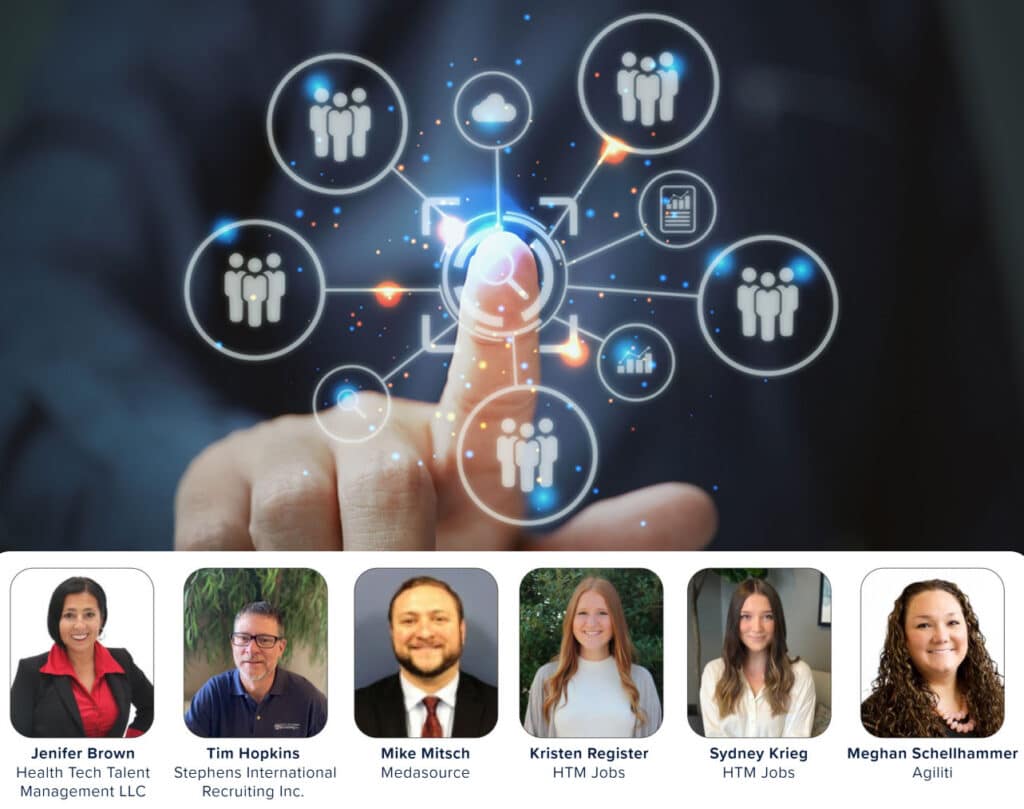
This month the roundtable article is focused on a hot topic – employment. TechNation asked experts about all things employment to help healthcare technology management (HTM) professionals prepare for their first or next job. Participating in the roundtable article on employment are Health Tech Talent Management LLC President/Owner Jenifer Brown; Stephens International Recruiting Inc. Vice President of Operations Tim Hopkins; Medasource Director of Clinical Technology and Cybersecurity Services Mike Mitsch; HTM Jobs duo Sydney Krieg and Kristen Register; and Agiliti Vice President of Clinical Engineering Service Solutions Meghan Schellhammer.
Q: What do employers find to be the most important elements of a resume when reviewing potential candidates?
Brown: Detailed work history to include the modalities of medical equipment serviced. As well as list any medical equipment training schools attended. Also, the length of time held in a position is closely reviewed preferably at least two years in each position. Employers are hesitant to consider a candidate who “moves around a lot” even if they are at the management level.
Hopkins: Most clients are looking for a resume that is concise and contains a stable job history. Style can vary from resume to resume, but it is important to use the same layout throughout the resume. Also, do not forget to add any training or certification to the resume. It is not uncommon for me to find out later from a candidate that they have completed a certification that is not listed on their resume.
HTM Jobs: It is important for candidates to match their credentials with those listed in a job description. Employers typically look at an applicant’s experience and qualifications right off the bat. They want to make sure that the candidate can perform the necessary tasks for the job. We also think it’s important to show off your personality in your resume. Including volunteer experience and extracurricular activities shows employers that you are a well-rounded candidate.
Mitsch: This is obviously subjective to the skill set in question; however, general elements of a desirable candidate’s background would highlight their ability to: 1) Adapt when required 2) Communicate effectively 3) Trustingly work independently. Employers want to see that a potential employee will be willing and able to take on variable circumstances of a job which may not fall within the written job description. As well, a candidate being able to effectively and respectfully communicate with team members, management and third-party agents garners trust and reliability. Lastly, the ability to work independently relies heavily on the first two elements. Employees must seek to gain trust from their employers that they will be resourceful and mindful when working on their own.
Schellhammer: While specific equipment and system experience can be a differentiator for a candidate, the most important thing is that the resume conveys a willingness to learn, troubleshoot and look beyond the problem at hand. Medical equipment is now connected to the broader health care ecosystem, so genuinely solving a problem often requires thinking about more than the single piece of equipment in front of you. We value technicians who know how to collaborate with other departments and solve hidden issues that impact the turnaround time and time to repair. Most often, we find the best technicians are those who help implement more innovative equipment management practices that affect the broader flow of biomed equipment through a facility.
Q: What are some tips for creating a succession plan?
Brown: For employers they need to have a defined career ladder established from a BMET I level all the way to a CE/HTM manager. This should include detailed job descriptions for each level such as years of experience, specific modality skills needed and/or certifications.
Hopkins: Communication and follow up within the organization. If you are a manager and have identified a successor, it is important to let them in on the plan. They may not be interested in taking the next step or lack the educational requirements for the position. Not all technicians want the extra responsibility of managing a team. If the candidate needs additional education or training, use internal resources to help fill the educational gaps.
HTM Jobs: A fatal hiring flaw is waiting until the need is immediate rather than creating a succession plan. Many employers reach out to HTMjobs.com with the same concern of, “I needed someone like yesterday!” Providing a path for employee development within the company prevents high turnover and longer time to fill. Being in communication with the human resources department and providing timelines and resources reduces a short turnaround to fill the position.
Mitsch: A good start would be to survey the skill sets your senior team members possess and create an incentivized action plan for mid-level resources to be trained on these skills. As we look to hire future generations of talent you may also consider the technical savviness they possess. With a targeted recruitment approach, it is possible to create a succession plan which upskills green, or mid-level, resources in a timeframe much shorter than it may have been previously.
Schellhammer: This is crucial because we are dealing with a shortage of skilled workers (across all industries). An excellent first step is to build a good bench of technicians who are critical thinkers and show either an aptitude or an expressed interest in becoming a leader. Once these candidates are identified, it’s best to offer them opportunities to develop skill sets around understanding budgeting, staffing and analytics-driven approaches to optimizing cost and performance. It’s also essential to provide a clear path for biomed technicians to expand their skills, progress through BMET roles and potentially imaging roles as well. By outsourcing your low-end equipment, which accounts for up to 90% of medical equipment inventories and demands the majority of time, you can create more advancement and growth opportunities for your new talent.
Q: How important are certifications?
Brown: CBET and CHTM certifications still carry weight in the industry and can assist in obtaining that higher level of position and/or salary. Also, any additional IT certifications in networking and cybersecurity is a plus for a BMET. For CHTM candidates, additional certifications in project management (PMP) is a plus though higher education like an MBA degree carries even more weight.
Hopkins: In most cases, lacking a certification is not a deal breaker, but it will put you ahead of the competition. Candidates that invest time and money in training are a step above the competition on paper. One client insisted on candidates possessing a CBET to qualify for a level II position, they passed on some very good candidates who didn’t have it.
HTM Jobs: Certifications are critical for HTM professionals, especially when looking to make a career change. Oftentimes, certifications play a role in employers deciding position titles, salary ranges, and key responsibilities for an HTM professional joining their organization. These accreditations show a professional’s level of commitment and dedication to advancing in their personal and professional growth.
Mitsch: There is no doubt certifications can be a good indicator of process and operations knowledge. However, in an industry of evolving smart technology, increased regulations, and broadened scope of operations, the CBET or similar type of certification may no longer be the benchmark. As industry scope continues to overlap more with IT and security, we might rather look at general education/training for biomed operations as a baseline (certification or no) and emphasize more greatly certifications in IT, cybersecurity, clinical applications, etc.
Schellhammer: Certifications are important and highly encouraged. They can be a differentiator when multiple candidates are applying for a position. But candidly, we often place a higher value on experience and other attributes when reviewing candidates. As noted in earlier questions, the ability to take a holistic view, and the desire to learn and activate leadership skills are typically more important. They’re so important in fact, Agiliti offers a wide variety of opportunities for on-the-job-training and classroom career development for those interested in exploring biomed roles.
Q: How can a recent graduate obtain hands-on experience?
Brown: Hopefully, most biomed programs have “hands-on” lab training in their curriculums with an internship as part of their AAS degree. If not, I would suggest volunteering on your own at any nearby hospital or medical facility.
Hopkins: I advise visiting your local hospital’s biomed shop with a resume in hand to give to the management team. It’s a great conversation starter, part of that conversation can be your willingness to gain experience by volunteering. Biomeds are always willing to help one another and making one contact could lead to an opportunity that you were not aware of.
HTM Jobs: Internships and externships are always a great way to gain hands-on experience. So many employers take students or entry-level biomeds under their wing to train them and set them up for success later in their career. Many also extend full-time positions to their interns when their internships are completed.
Mitsch: A graduate with no experience will be best suited to find an employer which will first and foremost grant them access to devices. This may be via contract, internship, apprenticeship program, etc. There are many companies out there, Medasource being one, which have opportunities for green candidates to take their first steps into the industry. Realize the opportunity for growth in any opportunity which puts you in the environment you want to work.
Schellhammer: For students who are still in school, developing technician skills in a general office or manufacturing setting is beneficial and can provide relevant hands-on training opportunities. Internships are available in health care and hospital settings, which allows recent graduates to explore potential career paths, learn about different technologies and equipment types. It’s also important to develop a natural curiosity about technology and connected ecosystems.
Q: How has COVID-19 impacted employers’ preferences and expectations?
Brown: In today’s market, almost all employers – such as health systems – require employees to be COVID vaccinated. Even most third-party service organizations also require this because their clients are the health systems or affiliates. However, some do offer a “religious exemption” but do require proof of that.
Hopkins: COVID added another challenge to the industry that is already struggling for talent. Mandatory vaccines have pushed many experienced engineers out of the field. In some cases, religious or medical exemptions are accepted by the organizations, but this is not a guarantee.
HTM Jobs: COVID-19 has left so many organizations in our industry incredibly understaffed. Current employees are overwhelmed with the workload and many biomeds have had to take on responsibilities below their paygrade. This has caused employers to become more lenient with their hiring criteria and bring on more entry-level candidates for the job. They often provide onsite training for specific modalities in order to get their employees up to the skill level they need for the job.
Mitsch: COVID-19 pushed the limits of many industries; none more than health care. I look back at the support teams we deployed at many field stations in highly impacted areas. Some ops running with an inexperienced staff and looking to any avenue of support they could find; the pandemic has since shaped the expectations of employers to look for candidates willing to “do what needs to be done.” This may mean they work longer hours, learn new skills, train new employees, etc.
Schellhammer: Since the onset of the pandemic, health care providers have experienced sharp increases in stress and burnout. This macro-trend, which was exasperated by the pandemic, coupled with a tightening labor force, has led many employers to change their recruitment and employment practices. In some of the best-run organizations, this includes eliminating time spent on non-value add activities, providing more career path opportunities and intentionally training technicians on more complex high-end technologies to expand their skill sets. Organizations that did not change and remained focused on the same old management and training practices are losing talent and struggling with both quality and productivity.
Q: What is the best way to prepare for the large percentage of biomeds retiring from the industry?
Brown: Having a succession plan in place with the career ladder established like I mentioned above, can offset the vacancies of positions. Also being open to hiring entry-level BMETs from the biomed programs and continue to move everyone up the ladder. This plan should also incorporate a strong internal mentorship program.
Hopkins: Start recruiting early and stay engaged with candidates. It is not uncommon for candidates to have multiple offers during their job search. I would also advise gathering compensation surveys to justify additional compensation for current employees as well as staying competitive in the market.
HTM Jobs: As we know, 50% of the HTM field is over the age of 50 and nearing retirement. With this large wave of retirees, it is important to bring awareness of the HTM profession to the next generation of talent. Connecting with colleges, tech schools and military personnel is crucial to replenish the aging workforce. Upper-level technicians have the opportunity to mentor and pass along valuable knowledge to the next generation to sustain their departments and the HTM field as a whole.
Mitsch: I refer back to the questions regarding elements of a resume and succession planning. Take a survey of your senior biomeds’ skill sets and prepare to train and promote at the mid-level, hire and train at the entry level. Expand your skill set range of applicable candidates you would hire and consider various avenues for upskilling which may not be your traditional path. Look to your vendor partners for interim support or long-term hiring solutions. Be non-traditional in your approach.
Schellhammer: We see some of the leading in-house clinical engineering programs rethinking the old employment models. One important change is considering vendors as an extension of your internal team. Identifying strong partners and finding quality service organizations that can work alongside your in-house team is important – helping you meet the historic and emerging demands of a clinical engineering team. It’s also increasingly important to offer more entry level positions with clear career paths. This can make your organization a place where good workers want to stay and grow. Finally, it’s also a good idea to get technicians focused and working on high-value equipment and connect that work to the organization’s mission.
Q: What else do you think TechNation readers need to know about employment?
Brown: When all the economic changes that occurred when COVID happened as well as the shortage of good technical talent, other industries started tapping into our industry’s talent pool. Industries like manufacturing, IT and even truck driving were hiring in droves with high salaries. However, don’t be tempted to leave our industry because many of them who did leave, now regret it due to no work/life balance or job enjoyment or satisfaction.
Hopkins: The demand for HTM professionals is not going away anytime soon. Employers need to be patient and resourceful when finding qualified candidates. Those looking to make a change within the industry need to position themselves to standout by obtaining higher level degrees and certifications.
HTM Jobs: With employment changing so much over the past few years, candidates are in an optimal position to make a career change. Many companies now offer generous sign-on bonuses, relocation assistance and incredible benefits to potential hires. We have also seen employers place a higher value on company culture than maybe they did before this hiring shift. Most make a conscious effort to foster employees’ work/life balance and happiness which in turn creates employee longevity at the organization.
Schellhammer: This is an amazing time for job seekers and those interested in technical roles that fit into the connected future of health care. Health care technologies are advancing quickly and rapidly, improving patient outcomes and patient experiences. Smart, hardworking and technically skilled people are needed to deploy, manage and repair these connected technologies. As mentioned earlier, retirements are accelerating, and about 46% of the current workforce is 50 or older. Many younger workers want different things from their jobs than previous generations. They prioritize contributing to the common good and identifying clear career growth paths. They often value these things as much as or more than salary. If you can successfully connect technicians’ work to measurable improvement in patient care, you will likely experience better recruitment and retention rates. We’ve done this at Agiliti and regularly promote our core brand belief: “Every interaction has the power to change a life.”
