



By K. Richard Douglas
Biomeds will always benefit by leveraging the training, networking and other resources available through national biomed organizations, local and state biomed organizations, professional organization expos and conferences and technical training through OEMs and ISOs.
Along with the approximately 24 state and local biomed associations and societies in the U.S., there are organizations like AAMI, ACCE, MD Publishing and the VA that all provide training, educational sessions and webinars. The military has its own training to advance a biomed’s vocation as well.
This supplemental training can help boost a biomed’s career by a value-add formula and the potential for specialization. Also, with the advent of hybrid-type positions in the field, additional training allows a biomed to move into a more specialist area, including IT, cybersecurity or networks. This can allow biomeds to gain certifications in these areas.
The training available includes degrees, certifications, continuing education credits and other credentials. For rookie biomeds, this can also include the BMET training that leads to the CABT certification, issued through AAMI.
Additional training, along with experience, can allow a BMET I to work their way to a BMET II and continue on a career progression. Certification also aids in career advancement.
Some of the most valuable training for a biomed is technical training, often hands-on, which has an immediate real-world application. While much of this training has been provided by the OEMs and ISOs, as mentioned previously, there are opportunities for technical training at expos, conferences and state biomed symposiums.
Attendance and training at these events can be very beneficial to a biomed’s foundation of knowledge as well as for career development. More technical training at these events would supplement OEM and ISO training and provide those in the HTM profession with more opportunities for growth.
Some of the offshoots of biomed require additional training.
While most any form of training provides benefits, it is the technical training with the most direct application for biomeds. This sub-set of course offerings will continue to gain more momentum.
MD Expo Education
The New England MD Expo in October will offer many educational opportunities. Check out the education at MDExpoShow.com.
MD Expos have included a broad cross section of training topics from the testing of gas modules and anesthesia monitors to service contract management strategies and certification preparation. The course content has taught biomeds soft skills, technical skills and prepared them for management positions.
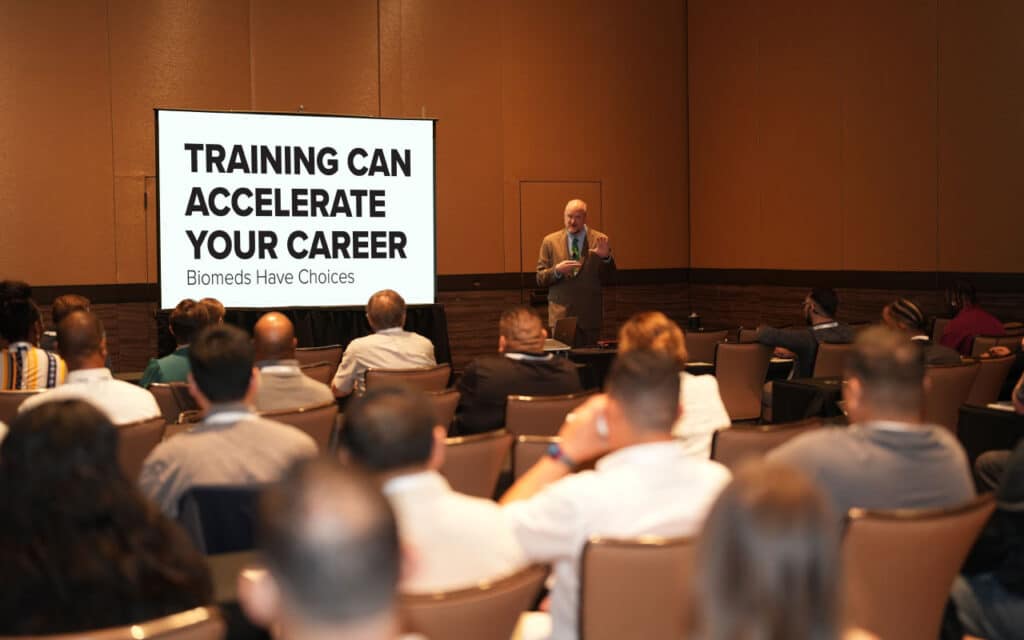
The benefits for career growth from participating in these educational sessions, and in continued training in general, became the topic for one course offering.
The presentation “Role of Professional Organizations in Promoting Your Biomedical/Clinical Engineering Career” addressed the importance of professional organizations in the life of a biomed and the role they play in career growth. It was presented by Arif Subhan, MS, CCE, FACCE, AAMIF, chief biomedical engineer with the VA Greater Los Angeles Healthcare System.
His session also pointed to the many benefits of participation in professional organizations like AAMI, ACCE, BMES, CMBES IFMBE, AIMBE and IEEE-EMBS, as well as state organizations. Subhan says that participation in professional organizations aids in the promotion of the HTM profession.
He also pointed out that participation in these organizations can help promote a biomed’s career. Subhan’s message was that professional organizations provide valuable resources for career development by providing access to networking, professional development, advocacy and resources.
AAMI Course Offerings
One of the primary providers of training opportunities in the HTM realm is AAMI.
The 2024 AAMI eXchange offered over 80 training sessions and workshops. The eXchange included three sessions devoted to technical training with the promise of more in the future.
“Yes, given the positive reception that AAMI technical trainings had at last year’s eXchange and the number of registrants for technical training at the upcoming 2024 eXchange, we intend to offer training courses next year and expand our offerings into new areas,” says Danielle McGeary, CHTM, PMP, vice president of HTM at AAMI. (Note: She was interviewed prior to the 2024 eXchange.)
She says that at the recent eXchange in Phoenix, there were technical training sessions highlighting infusion pumps, ultrasound and MRI.
“We thank Fluke Biomedical, RSTI and Innovatus Imaging Corporation for working with us to offer these trainings at a very low cost,” McGeary says.
It has been ISOs who have been the traditional providers of technical training, along with OEMs, for thousands of biomeds. The benefits of technical training can include career advancement and specialization.
AAMI has certainly seen this with attendees of its courses.
“Feedback from the HTM professionals who have taken our technical training courses has been overwhelmingly positive. The hands-on experience and access to industry subject matter experts were both cited as positive aspects of the training. HTM students also love our technical training offering as it gives them the opportunity to gain additional skills and work with industry experts,” McGeary says.
She says that since AAMI’s technical training is offered at a very low cost, it gives BMETs access to training they may not have otherwise had.
“Service schools can be cost prohibitive to healthcare delivery organizations; especially given the economic climate the health care sector is facing. Our goal was to ensure technical training was as accessible as possible. Additionally, by making the technical trainings separate events, folks can just come to a specific class and not have to commit to being at the entire eXchange,” McGeary says.
She says that additionally, AAMI’s technical trainings offered at the eXchange come with a pass to the expo hall so attendees can stay and explore the latest and greatest technologies being showcased by AAMI’s exhibitors.
With more emphasis being put on the practical benefits of technical training, AAMI will continue to offer it among its course offerings.
“The goal of AAMI technical training is to ensure that HTM workers have access to cost-effective, hands-on courses that provide the latest information and strengthen their ability to perform in their roles. It is also an opportunity for HTM professionals to earn CEUs to maintain their certifications,” McGeary says.
She says that with the ageing HTM workforce, AAMI is committed to making sure new and mid-career HTM professionals are well trained to ensure the field’s workforce of the future is strong.
“Given this goal, expect new offerings in the future based on hot topics in HTM and feedback from course attendees. AAMI is always open to suggestions. Please email HTM@aami.org with feedback or questions,” she suggests.
State Associations and Third-Party Providers
In addition to the many course offerings through AAMI and MD Expo, there are continuous training opportunities available through state biomed associations or third-party providers.
There are approximately two dozen state biomed associations in the continental U.S. Those state biomed organizations are supplemented by student organizations and organizations affiliated with the American Society for Health Care Engineering (ASHE). These organizations provide training opportunities to their memberships also.
State biomed associations offer members a laundry list of benefits. Besides the camaraderie and the relationships established through these organizations, training is often a centerpiece of each group’s offering. This training is most often offered through ISOs or third-party providers.
Recent symposium course offerings through the North Carolina Biomedical Association included “Learning from Cybersecurity TTE as an HTM/CE-IT Professional to Achieve 3C’s Effectively,” “Using Augmented Reality (AR) to Virtually Disassemble CARESCAPE ONE” and “Alaris Pump Repair.” The group’s 2024 symposium offers a number of classes for the advanced BMET, imaging professional, management, IT and regulatory.
On the opposite coast, the California Medical Instrumentation Association’s 2024 Connect Conference included “Challenges of Providing Remote Support Outside of a Hospital Setting,” “From Tech Expert to Inspirational Leader: Mastering the Art of Confident Leadership” and “Using Artificial Intelligence (AI) in Health Care for Health Technology Managers and Biomeds,” as just some of the day one conference course offerings.
This sampling of courses points to the enormous cross-section of topic areas provided through biomed association symposium sessions and seminars. Continuing education credits are often the icing on the cake.
There are many other organizations solely focused on training. These organizations include private schools, technical training schools and formal college courses.
Third-party training sources have always played an important role in specialized training. There are companies like Avante Solutions, College of Biomedical Equipment Technology (CBET), Elite Biomedical, Fluke Biomedical, FSI Inc., Maull Biomedical Training, NVRT, Richardson Healthcare, Rigel Medical, RSTI, Tri-Imaging Solutions, USOC Medical, and others; known for their training courses.
The opportunities for a biomed to grow their career are plentiful and the offerings for technical training, soft skills, specialist knowledge and management training come from many sources. The incentive to become a part of many industry professional organizations is due, in large part, to the ongoing training opportunities available. These organizations, conferences and special events can play a big role in advancing a biomed’s career.
