



By K. Richard Douglas
Artificial intelligence (AI) has rapidly transitioned from a futuristic concept to a transformative force reshaping industries worldwide, with its impact being particularly profound and personal within healthcare.
This technology refers to the ability of machines to perform tasks that typically demand human intelligence, such as learning, reasoning and problem-solving. AI utilizes computers and machine processes to simulate human thought and execute complex automated tasks.
Crucially, AI-enabled systems are capable of exceeding human capacity in specific ways, primarily by efficiently sifting through immense volumes of big data to identify patterns, anomalies and trends.
AI is an umbrella term covering several specialized technologies frequently used in medicine, including machine learning (ML), deep learning (DL) and natural language processing (NLP). ML involves training algorithms on datasets, such as health records, to create models that predict outcomes.
DL, a subset of ML, uses extensive data and multiple layers of algorithms to form neural networks capable of more complex tasks. Furthermore, NLP enables machines to interpret human language, helping to analyze and understand clinical notes, reports and published research.
AI APPLICATIONS TRANSFORMING HEALTHCARE
The integration of AI is changing how healthcare professionals provide care and how patients receive it, offering a wealth of opportunities to enhance common medical processes. Researchers view AI not as a replacement for healthcare professionals but as a supportive force designed to improve their work.
One of the most mature areas for AI innovation is medical imaging and diagnostics. AI algorithms analyze complex medical scans like X-rays, CTs and MRIs to identify anomalies, acting as a second set of eyes for radiologists.
These systems enable faster, more accurate diagnoses; for instance, some AI systems have achieved 94 percent accuracy in detecting lung nodules and 90 percent sensitivity in breast cancer detection, often matching or exceeding human performance when used as a complementary tool.
AI is also central to precision medicine, helping to produce personalized treatment plans that account for factors such as a patient’s genetic makeup, medical history, lifestyle and environmental factors. Predictive analytics powered by AI models can assess patient data to forecast health risks, such as the likelihood of cardiac arrest, allowing medical teams to intervene earlier and improve survival rates.
In the operating room, AI enhances robotic surgery by providing enhanced precision and control. Robotic surgical equipment outfitted with AI can help surgeons perform better by decreasing physical fluctuations and offering updated information during the operation. Beyond clinical applications, robotic process automation (RPA) uses AI in computer programs to automate administrative and clinical workflows, improving daily facility functions and managing massive volumes of data efficiently.
To ease the burden on doctors, AI-based ambient listening can reduce the time it takes for physicians to dictate notes of patient interactions.
AI IN HTM
With all AI can do to aid clinicians in the diagnosis and treatment of patients, it also has a place for those who support the clinicians.
For some HTM professionals, AI is viewed as a critical part of proactive service strategies. AI acts as a force multiplier for biomed, supercharging a technician’s abilities to make repairs faster and diagnostics more accurate.
“I’ll start by saying I think AI is the new buzzword. There’s this thought process that AI will fix all that ails us in HTM, but the reality is it will always be a reflection of the core data. Just like with any CMMS, if you put garbage data in, you’ll get garbage data out. I truly believe AI needs to be leveraged as a tool, with a watchful eye, and not as cure,” says Josh Virnoche, MBA, AAMIF, CHTM, CBET, director, Clinical Engineering at UT Southwestern Medical Center.
The perspective that AI is a tool that is only as good as the data it depends on is a good reminder of the cautious approach required as the technology becomes more prevalent.
“Artificial intelligence is everywhere in healthcare conversations. For healthcare technology management professionals, it’s not about robots replacing engineers or technicians, it’s about using smarter tools to enhance patient safety and operational efficiency. Think of AI as a second set of eyes: from predicting when a ventilator or CT scanner might fail, to streamlining workflows across departments,” says Salim Kai, MS, CHTM, CBET, visiting faculty, Miami University-Teaching in Clinical Engineering and Hospital Instrumentation.
He says with AI innovation comes a catch.
“If the data is biased or incomplete, AI can mislead. That’s why HTM professionals play a critical role: validating algorithms, ensuring service data accuracy and advocating for transparency. In short, we are the ones who make sure AI is safe for patient care before it ever reaches the bedside,” Kai says.
These AI applications are not futuristic. They’re already beginning to shape HTM practice. Kai says that HTM’s responsibility is to be certain that AI applications in medical equipment and clinical technology are safe, ethical and effective.
AI’s ability to analyze vast streams of operational data offers HTM teams leverage in several key areas:
• Optimizing Operations: AI contributes to the efficient management of equipment within healthcare facilities. Platforms can optimize operating room schedules by accurately predicting case duration and improving resource allocation, which may lead to five to 15 percent reductions in operational costs.
• Boosting Productivity & Addressing Staffing Gaps: The U.S. faces a critical shortage of skilled biomedical equipment technicians. AI helps bridge this gap by enabling diagnostics and streamlining workflows, allowing technicians to service more devices in less time, thereby reducing the need for a larger workforce and cutting repair backlogs. Furthermore, embedding AI into workflows shifts technician time away from administrative tasks and toward more strategic and complex work.
• Proactive Planning: AI-driven predictive services ingest live telemetry, error logs and service histories to forecast component failures days in advance. This shift from scheduled or reactive maintenance to predictive maintenance reduces unexpected device downtime, prevents costly emergency repairs and can extend equipment lifespan. For instance, certain AI tools can predict a CT tube failure at least 72 hours before it occurs.
Virnoche has been actively working on training an AI model to review work orders for quality documentation.
“Big picture would be that on a periodic basis, an automated workflow pulls the team’s work orders from a defined timeline, runs them through the trained AI model and provides letter grade feedback on the quality of the documentation on work orders. Right now, this would be a reactive process, only catching issues after the fact, but would provide actionable insights on how to improve documentation in the future,” he says.
Virnoche adds that on a longer timeline, he would love to see this integrated into the CMMS to give real-time feedback as the documentation is being completed.
“Like I said earlier, the key here is getting the core data right. I need to focus heavily on training the AI to specific, well-defined quality measures like ISO9001/ISO13485 and good documentation practices to ensure it’s not being biased to my own preferences,” Virnoche says.
He says that this is a pet project, but points out that it is a great use case of how AI can provide unbiased feedback to improve quality rather than completely replacing the process itself.
 AI IS NOT AN OPTION IN HTM
At least one engineer, who has given presentations on AI and HTM, finds the emerging technology indispensable.
“AI is no longer optional for HTM – it’s becoming essential. When Norton Healthcare transitioned to an ISO 13485-based Quality Management System (QMS) in 2021, we anticipated the FDA’s upcoming Quality Management System Regulation (QMSR) requirement for manufacturers and third-party servicers in 2026. That shift created a need for smarter tools to manage compliance, documentation and risk. AI has filled that gap,” says Mark Cooksey, CLSSMBB, MBA, DME quality engineer and ISO 13485 quality management system leader in the clinical engineering department at Norton Healthcare.
He says that he first presented on the topic to a full-capacity audience at MD Expo New England in 2024 and more recently to a packed audience at AAMI eXchange in June 2025. Since then, he has seen AI adoption grow exponentially.
“For Norton Healthcare’s Clinical Engineering, AI streamlines ISO 13485 and FDA-compliant documentation, accelerates risk assessments and enhances audit readiness. It also delivers measurable financial impact. This year alone, I’ve used AI to evaluate third-party service contracts and draft negotiation responses, saving hundreds of thousands of dollars through AI-guided communications and strategy. When integrated securely, AI improves efficiency, compliance, and cost control, making it one of the most practical tools HTM leaders can deploy,” Cooksey says.
He offers these applications of AI within HTM:
• Streamline Compliance & Documentation: Documentation of your QMS can be overwhelming. AI simplifies ISO 13485 and FDA-compliant documentation – generating policies, procedures and checklists while reducing complexity by over 80 percent.
• Accelerate Risk Assessment & Decision-Making: AI performs statistical trend analysis and can evaluate risk when changing from an OEM PM schedule to an AEM or even a repair as needed (RAN) PM for low-risk medical equipment. Using AI to calculate risk via risk priority numbers (RPN) has guided us in evaluating preventive maintenance changes, enabling data-driven decisions.
• Enhance Audit Readiness: AI drafts corrective action plans (CAPAs) that meet ISO 13485 requirements, helping close gaps faster and maintain accreditation.
• Boost Productivity &Deliver Real Cost Savings: AI automates tasks like creating presentations, analyzing large datasets and generating control charts – cutting hours of manual work down to minutes.
• Improves Communication & Training: AI helps create more effective training materials, job aids and interactive content for CBET education, supporting workforce development without adding administrative burden.
USED WITH VR/AR
Combining AI with virtual reality provides a whole new set of tools.
Natural language tools help techs digest OEM manuals, service bulletins and regulatory changes in real-time during on-site repairs. Additionally, advanced AI tools in the field include augmented reality (AR) headsets that provide hands-free repair guides overlaid in real-time.
With real-time AI guidance and AR overlays, even new hires can perform sophisticated tasks earlier in their careers, reducing the burden on senior staff and enabling faster training across teams. AI can also remotely identify issues, allowing centralized teams to provide assistance without deploying a technician for every call.
CHALLENGES TO CONSIDER
Kai says that there are some potential challenges with adoption.
“Of course, every opportunity comes with responsibility. For AI in HTM, the challenges are as important as the benefits,” he says.
Kai notes the following examples:
• Algorithm Bias: If training data lacks diversity, AI may misinterpret results for certain patient populations. For example, adult patient equipment data versus pediatric patient equipment data, or differences between hospital and home care environments.
• Transparency: Some AI models operate as “black boxes,” making it difficult to understand how decisions are reached.
• Validation: AI must be tested in each hospital’s environment, not just in a lab setting, to ensure reliability.
• Data Quality: “Garbage in, garbage out.” Poor service log documentation or inaccurate equipment validation trends can lead to misleading predictions.
Virnoche says that as his team starts to expand internally, they will work to leverage AI in their inventory management systems, allowing them to forecast parts needs based on historical parts usage for PMs.
“Longer term, I’d like to start using AI to grade supplier performance in terms of delivery, quality return rate, cost effectiveness, to create a mechanism to remove technician bias from parts orders. Best part at best value, regardless of vendor relationship. We’ll also explore using AI to streamline our PMs and ensure we have the right technician in the right place at the right time and maybe explore some technician escalation paths based on skill sets defined in our CMMS,” he says.
Virnoche says that finally, a big one for him is going to be contract management.
“Using AI to analyze contract performance metrics and help determine what the best coverage levels are based on historical need, current need, equipment age and any other detailed data we may find, all while determining whether it’s a better value to the organization to maintain the service contract or in-house items,” he says.
A NEW & POWERFUL TOOL
Ultimately, AI is a tool designed to augment human knowledge and abilities, ensuring that medical equipment remains functional, safe and ready when patients need it most, even as devices become more complex.
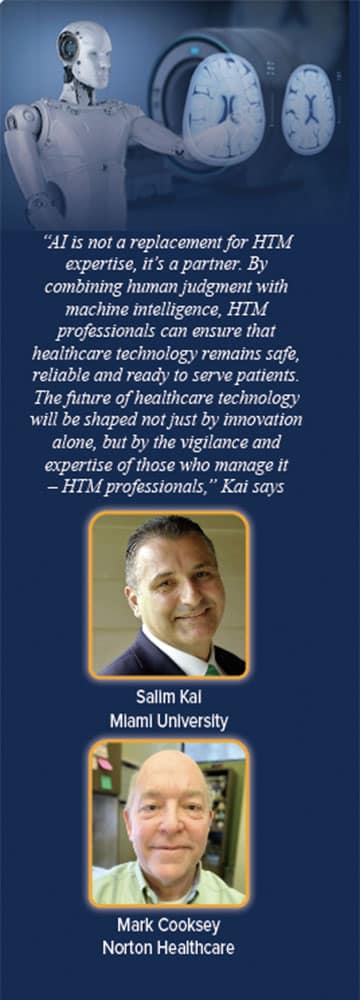
“AI is not a replacement for HTM expertise, it’s a partner. By combining human judgment with machine intelligence, HTM professionals can ensure that healthcare technology remains safe, reliable and ready to serve patients. The future of healthcare technology will be shaped not just by innovation alone, but by the vigilance and expertise of those who manage it – HTM professionals,” Kai says.
Cooksey says that the key to effective AI use is through improved prompting: to provide context, set clear expectations and validate outputs.
“AI is a powerful assistant, not a replacement for human expertise. When integrated securely (e.g., Microsoft Copilot for HIPAA compliance), it enhances quality, safety and operational performance across HTM,” he says.
If the Internet could be described as a “trend” in 1983, then AI could be described as a trend today. What wasn’t fully understood in 1983 is better understood today.
