


By K. Richard Douglas
Far north of the U.S. northern border, high up in Canada and almost to Alaska, are the Northwest Territories. The capital, and largest community, is Yellowknife. It is one of the best places on earth to view the northern lights in the evening, especially in fall and winter.
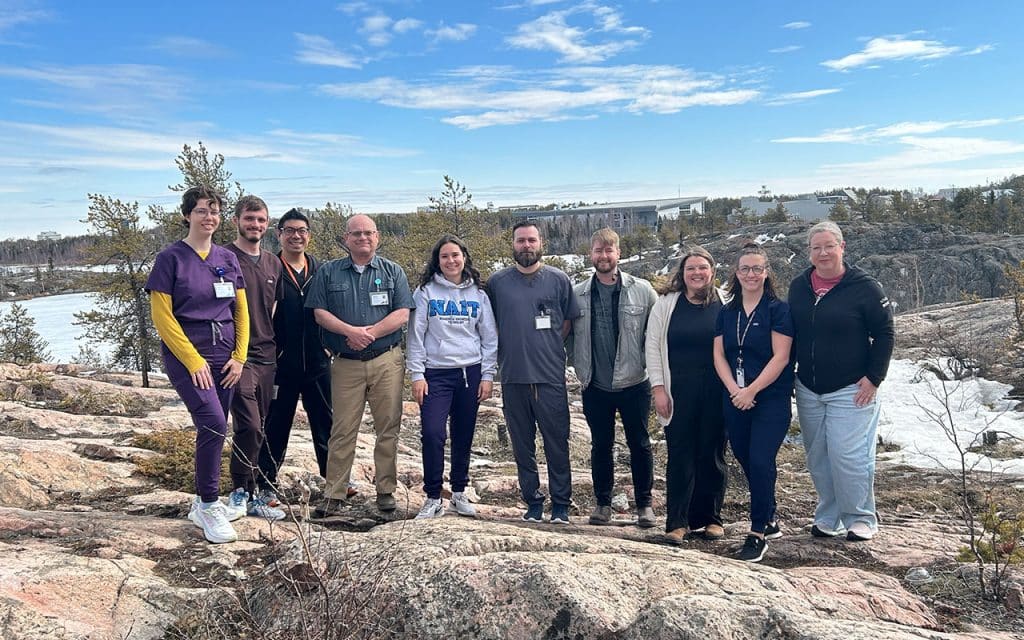
As the largest city in the Northwest Territories, Yellowknife is also the epi-center for the area’s medical care. The region’s HTM experts comprise the Northwest Territories Health and Social Services Authority (NTHSSA) Biomedical Engineering Department.
The biomed team is made up of 11 professionals. The Territorial Manager Biomedical Engineer is Kevin Taylor, PEng.
“Our department includes Chief Biomedical Engineering Technologist Erwin Sumcad, six senior BMETs (Jason Bell, Jillian Tobin, Shane Simms, Alanna Hinchey, Samantha Powell), one Casual Biomedical Engineer (Lydia Sochan, MASc), and two Casual/Term Senior BMETs (Timothy Ebbeling and Sarah Berg). In terms of scope, we service a wide range of technology in-house and off-contract. This ranges from basic technologies such as pulse oximeters, suction devices, infusion pumps, etcetera, to intermediate technologies such as physiological monitors and defibrillators; as well as high-level technologies such as X-ray, anaesthesia, ventilators and mammography,” Taylor says.
He says that the department also budgets and manages all the Government of the Northwest Territories’ (GNWT) health technology service contracts for areas such as CT, fluoroscopy and lab technology.
“Moreover, not only do we support all health technology in GNWT health facilities, but we also support two-thirds of the Government of Nunavut’s (GNU) health facilities (i.e., specifically the Kivalliq and Kitikmeot Regions). Our service area represents a geographic area of about one-fifth of the United States, and more than half of these communities have no road access (i.e. only accessible by air or in the winter by ice road),” Taylor says.
The team provides equipment management support to one 80-bed tertiary hospital in Yellowknife, one 51-bed secondary hospital, two health centers with in-patient capacities with a combined 26 beds, but no OR and three higher-level health centers in regional hub communities. These facilities will have a few doctors each, but no in-patient capacity.
Their responsibilities also extend to 16 standard health centers, which are staffed by two to five nurses, as well as seven health cabins, which are staffed by a first aid trained community health representative.
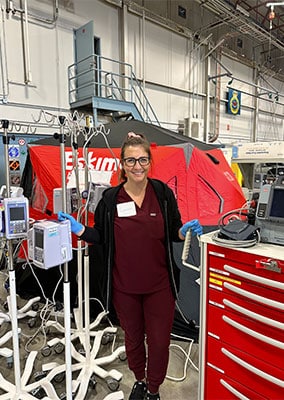 Taylor says that the team also manages medical equipment for two primary care facilities in Yellowknife, eight long-term care facilities, which have a total 183 beds across the territory, 12 health centers in Nunavut and the Yellowknife Fire Department.
Team members are well-trained and future recruits will bring with them a firm foundation.
“The goal is that within two years, all BMETs who are hired are factory-trained on dialysis, anaesthesia, X-ray, physiological monitoring, and ventilators. BMETs in the NWT are specialists in being generalists: they must be able to work in all specialty areas and the NWT invests heavily in that training,” Taylor says.
There is good reason why this group needs to be able to work on nearly everything. Taylor says that “service vendors can spend up to three days travelling to do a 30-minute service call or get trapped in a community for three to five days due to bad weather.”
He says that there have been times when a vendor had not set foot in the territory for a year even with a full-service contract.
Responding to Wildfires
With such a large and diverse geographical area and diversity of facilities, the need for special projects above and beyond PMs and maintenance is an expected reality.
The department has participated in several, including the replacement of a hospital.
“The Stanton Territorial Hospital (i.e., the Government of the Northwest Territories tertiary care facility) was replaced with a new facility in 2019 and Biomedical Engineering, along with biomeds at the Department of Health, played a heavy role in the planning and installation of all new health technology,” Taylor says.
The COVID-19 pandemic challenged biomed departments everywhere and the NTHSSA team was not exempt.
“Biomedical Engineering assisted in the planning, and then purchased, an entire year’s capital budget in medical equipment in just one month at the start of COVID. BMETS from the NWT were also the first BMETs in Canada to volunteer to support the Federal Governments National Emergency Strategic Stockpile and two NWT BMETS each spent a month inspecting incoming COVID medical equipment that was purchased by the Canadian Government to distribute throughout Canada,” Taylor says.
The team really went above and beyond when they were called up to help out with a major evacuation.
“The entire capital city of Yellowknife, as well as the major towns of Fort Smith and Hay River, along with other smaller communities were evacuated in August 2023 due to wildfires (two-thirds of the population of the NWT was evacuated more than 1,000 miles south). Biomedical Engineering supported the mothballing of the tertiary hospital and also participated in setting up evacuation centers for patients. We went so far as to support clinical staff in the care of patients at the military hanger due to limited available clinical staff, as well as the loading of patients onto military transports,” Taylor says.
Because of the team’s broad skills and experience working in harsh conditions, members have helped out with Kosovo after the war in 2000s; Argentina with ORBIS International in the early 2000s; Gambia in the late 2000s; and most recently in Sierra Leone in 2023.
The department is skilled at problem-solving and enjoys working under a unique policy that would be the envy of many U.S. biomeds.
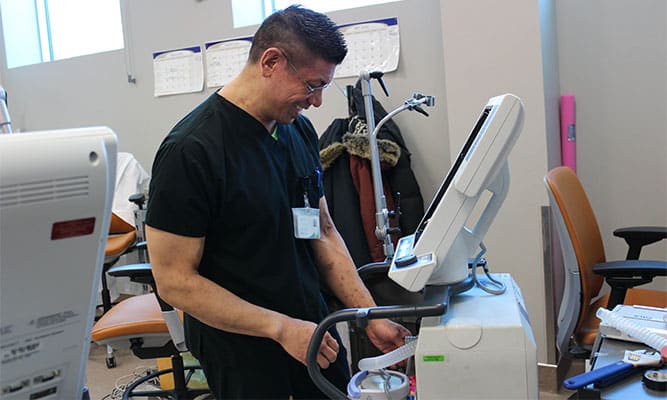
“One of the features that makes our biomedical engineering department unique is our health technology right to repair policy which applies to all health technology purchased for the government of the NWT health facilities,” Taylor says.
He says that the NWT is the first government health system in Canada to have a health technology right to repair policy.
“In short, the policy essentially states that unless there is no clinically acceptable alternative, it is a mandatory procurement requirement that the provision of service manuals, service training, service software, and service parts are all provided at the same level as provided to the original equipment manufacturer service engineers. This policy allows us to best protect patient safety,” Taylor adds.
He says that while the need to ensure patient safety through timely service is true for all areas of North America, because of the remote and rural nature of the team’s territory, sending equipment for repairs can be an incredibly lengthy process, putting patients at risk of delayed care.
“By servicing equipment in-house, we become much more self-sufficient and are able to provide better service to the territory. This policy came out of the challenges faced during COVID-19 and aligns with the Canadian Medical Biological Engineering Society’s (CMBES) Clinical Engineering Standards of Practice and the CMBES position statement on right to repair,” Taylor says.
The team came to the rescue several other times, including during the pandemic when the demand was extra urgent.
Off the job, Taylor is the co-chair of the CMBES’s right to repair committee as well as the national champion on this issue.
“The NWT has presented nationally and internationally on their right to repair program,” he says.
The NTHSSA are a special breed and work far away from OEMs and suppliers. They are highly skilled and take advantage of being able to apply those skills when some biomeds might be blocked. They have shown that, to the greatest degree possible, they are self-sufficient HTM professionals.
In very remote, and often harsh conditions, this team of biomeds reflects the best of the profession.
