



By K. Richard Douglas
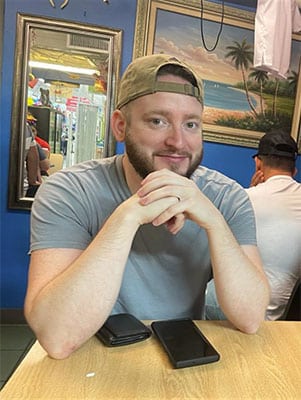 For Benjamin Tinsley, diagnostic imaging support, advanced field service engineer II at Baylor Scott & White Health in Dallas, Texas, the introduction to HTM came out of the realization for the need for biomeds.
“My journey into the HTM field started while I was working with a nonprofit organization in Nicaragua, where I helped coordinate mobile medical clinics. During that time, I noticed that a lot of the equipment we relied on was constantly breaking down – and there was rarely anyone around who could fix it properly. It got me thinking someone out there has to be responsible for keeping this equipment running. That sparked my interest in the technical side of healthcare,” Tinsley says.
He says that when he returned to the U.S., he started looking into how he could get involved in that kind of work and came across the biomedical and imaging technology programs at Texas State Technical College (TSTC) in Waco, Texas.
“I ended up enrolling and earning degrees in both biomed and imaging. That decision set me on the path I’m on today – and I’ve never looked back,” Tinsley says.
While enrolled in the TSTC courses, Tinsley received hands-on training in both fields.
“As part of the program, I also completed an internship with Baylor Scott & White in Plano, which gave me valuable real-world experience working alongside seasoned professionals in a clinical environment,” he says.
After graduation, Tinsley began his career with Siemens Healthineers as an imaging field service engineer.
“That role gave me the opportunity to apply everything I had learned while continuing to expand my knowledge and skills by working directly with advanced imaging systems and supporting healthcare teams in the field. It was a strong foundation that helped me grow quickly in the HTM profession,” he says.
That first HTM job required that he support hospitals and clinics across East Texas.
“After two years, I transferred to the Dallas area, where I continued in the same role for another two years, working on a wide range of imaging systems. After Siemens, I joined Baylor Scott & White Health as a field service engineer. I’ve been with Baylor for the past two years, and earlier this year – in January – I was promoted to an advanced engineer position. In this role, I manage the service and support for the cath, IR, OR, and EP labs at The Heart Hospital. It’s been a rewarding step forward, allowing me to take on more responsibility and support some of the most critical areas in patient care,” Tinsley says.
Today, Tinsley specializes in general X-ray and angiography systems.
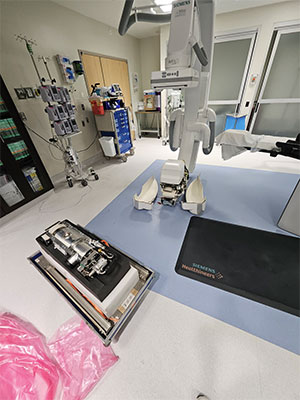
“I’ve focused my experience on keeping this equipment running smoothly. It’s rewarding to know that my work helps support accurate diagnoses and effective treatments,” he says.
Coordinating with Clinical Staff
As many in HTM have come to realize, scheduling maintenance of high-demand medical equipment can be a challenge.
“One of the main challenges I’ve faced in my current role as an advanced engineer is maintaining a consistent preventive maintenance schedule in the cath labs. These labs are high-demand environments where patient care is always the top priority, so finding the right windows of time to perform thorough maintenance without disrupting critical procedures can be quite challenging,” Tinsley says.
He says that to address this, he has had to work closely with clinical teams to coordinate maintenance during off-peak hours or scheduled downtimes.
“It requires flexibility, strong communication and careful planning to ensure that the equipment remains reliable without interfering with patient care,” Tinsley adds.
He says that in addition to these challenges, he has been involved in projects focused on upgrading and optimizing the imaging systems within the cath, IR, OR, and EP labs.
“These projects have included system updates, integration of new technologies, and workflow improvements aimed at improving operational reliability and supporting the clinical teams in delivering quality care,” Tinsley says.
Away from the job, Tinsley enjoys 3D printing as a hobby and has a corgi named Rooster.
As a member of the HTM community and workforce, Tinsley describes himself as a simple guy who enjoys taking X-ray machines apart and figuring out how they work.
“I like the challenge of troubleshooting and repairing these complex systems because it’s rewarding to know my work helps keep critical medical equipment running smoothly,” he says.
When somebody enjoys their vocation, it means that they likely do excellent work. Diagnostic imaging is made that much more precise thanks to this HTM professional.
BIOMETRICS
Favorite book:
Harry Potter books
Favorite MOVIE:
“Star Wars”
Favorite FOOD:
Pizza
Hidden talent:
3D printing
Favorite part of being a biomed?
What I enjoy most about being a biomed is getting to solve problems every day. Whether it’s fixing a piece of equipment that’s critical to patient care or troubleshooting unexpected issues, it’s rewarding to know that my work directly supports healthcare teams and helps keep things running smoothly.
Why do you read TechNation?
My manager keeps a stack of TechNation magazines in the shop. It’s a good read that helps me stay connected with what’s happening in biomedical and imaging repair.
