



Industry experts share insights and advice regarding CMMS in this month’s Roundtable article. TechNation invited several leading companies to participate in the article with questions about unique features, regulatory standards, data analytics and more.
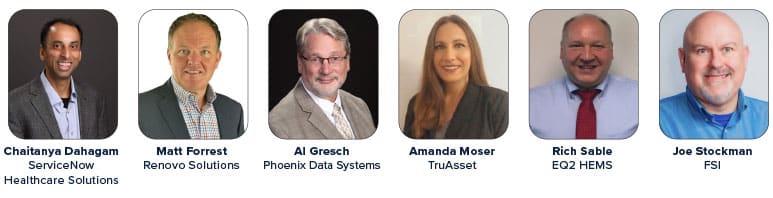
Participants in the Roundtable article are:
• ServiceNow Healthcare Solutions Specialist and Consultant Chaitanya Dahagam, MD;
• Renovo Solutions Vice President of Business Development Matt Forrest;
• Phoenix Data Systems Vice President of HTM Consulting Al Gresch;
• TruAsset Director of Business Development Amanda Moser;
• EQ2 HEMS by TMA Systems Manager, Client Success Rich Sable; and
• FSI Director of Product Experience Joe Stockman.
Q: What makes your CMMS solution uniquely suited for HTM professionals compared to general-purpose maintenance platforms?
Dahagam: ServiceNow’s CMMS stands out because it’s built upon one of the industry leading Enterprise Asset Management apps, including the Medical Asset Workspace tailored specifically for healthcare teams. It empowers HTM professionals with end-to-end workflows for RMAs, recalls, and calibration management, wrapped in powerful analytics like risk scoring heatmaps, asset performance, total cost of ownership and many more. Mobile first features allow field teams to take action, scan, audit, pick, and remediate right from their mobile device. It’s a compliance ready, full life cycle platform that general purpose systems simply can’t match.
Forrest: RENOVOLive, our CMMS is built specifically for healthcare technology management, not adapted from another industry. It supports HTM-specific workflows like device risk scoring, preventive maintenance scheduling by modality, FDA recall tracking, and complete multi-vendor service history. Unlike other CMMS systems, RENOVO built our platform in-house, drawing directly from decades of real-world HTM experience. This means our customers get a purpose-built, turnkey solution that’s intuitive to use and ready to deploy – without the hidden costs or delays of custom development. We also provide complete cost and operational transparency with clear, real-time visibility into asset performance, service activity, and total program costs.
Gresch: AIMS 3 was built specifically for the HTM and HFM industries. Our team has over 300 man-years of direct industry experience and understands first-hand the challenges the industry faces, including regulatory compliance, technician efficiency and productivity, cybersecurity, the need for effective integrations and automation, plus meaningful and impactful reporting for executive leadership. We believe that the work our customers do is critical to the safe and effective delivery of patient care and are committed to being a trusted and capable partner in their success.
Moser: Many CMMS solutions are repurposed from other industries, often requiring workarounds to meet the unique needs of the HTM industry. In contrast, TruAsset was specifically designed for HTM professionals and remains dedicated to that focus with every new feature and upgrade. TruAsset also streamlines compliance with key industry accreditations, including Joint Commission, DNV, CMS, and various state and federal requirements.
Sable: EQ2 HEMS by TMA Systems is designed specifically for healthcare and the unique needs of HTM, while general-purpose platforms lack the specialization required for HTM. HEMS One CMMS offers specialized workflows for managing medical equipment and advanced compliance tools and reports, including AEM program management and everything needed to be ready for the next survey. Real-time business intelligence (BI) dashboards, an automated unable to locate (UTL) process, and straightforward handling of device reactivation or retirement are other standout features. Frequently, HTM departments request that the CMMS become the “hub” of all the applications they work with and HEMS One stands out in this area by supporting numerous interfaces and integrations, while adding new ones all the time. Current areas supported include cybersecurity tools, real time locating services (RTLS), ECRI Institute Alerts and Recalls, oneSOURCE, parts ordering and procurement applications, ticketing systems, and calibration and testing applications, among others.
Stockman: FSI’s CMMS is purpose-built for healthcare environments, including HTM departments. It integrates biomedical asset tracking, compliance workflows, and mobile tools that support technician efficiency and regulatory readiness – features not typically found in general-purpose platforms. FSI’s CMMS also has integrations to other systems commonly used by HTM professionals for parts ordering, automated device testing, security and vulnerability, and real-time locater systems (RTLS).
Q: How does your system help HTM departments stay compliant with regulatory standards like The Joint Commission, DNV or CMS?
Dahagam: The solution helps HTM teams stay inspection-ready by embedding compliance into daily workflows. It supports full traceability of medical equipment from onboarding and maintenance to recalls and decommissioning aligned with requirements from TJC, CMS and DNV. Calibrations are managed with documented quality standards, traceable to each calibration event, supporting ISO 13485 aligned quality management systems. Features like risk scoring and asset heatmaps enable proactive prioritization of high-risk equipment, while audit ready records and real-time dashboards simplify external surveyor reviews and internal governance.
Forrest: Compliance is built in. RENOVOLive tracks all maintenance activities against regulatory standards, flags overdue inspections, and creates audit-ready reports instantly. It also documents AEM programs, OEM procedure adherence, and captures technician sign-offs to provide airtight regulatory documentation.
Gresch: Phoenix is committed to staying up to date with evolving healthcare regulatory requirements by tracking the latest updates, participating in compliance-focused forums, industry events, and sharing best practices with customers. AIMS 3 helps track compliance metrics, provides tools for audit and inspection preparation, and offers dedicated support during these processes. Additionally, I lead several sessions each year through AAMI’s Expert Insights program, titled “Mastering HTM Accreditation Compliance: Stress Less, Achieve More,” where proven methods for using CMMS to achieve compliance are shared.
Moser: Maintaining compliance with regulatory standards is a top priority. TruAsset offers a variety of customizable service codes to track failures, operator errors, recalls and more. With its flexible data filtering capabilities, you can easily generate detailed reports and custom dashboard widgets to monitor key metrics. The streamlined data layout simplifies inspections, providing quick access to historical data, EOC reports and other essential analyses.
Sable: HEMS One enables HTM teams to create manufacturer-specific PM procedures, even with multiple frequencies like inspections and battery replacements. Regulatory compliance dashboards track performance and present data for EOC meetings or audits by the Joint Commission, DNV or CMS. The BI Dashboard shows real-time PM completion and highlights trends, while technicians see outstanding PMs directly on their own individual dashboard. The equipment inventory dashboard shows PM procedure type (OEM or AEM), frequency, next due date and risk classification. Additionally, the AEM Dashboard aligns with client policies as well as standards by the Joint Commission and CMS to manage equipment transitions between OEM and AEM procedures.
Stockman: FSI’s platform includes built-in compliance tracking, automated documentation, and audit-ready reporting aligned with standards from Joint Commission, DNV and CMS. It helps HTM teams maintain inspection readiness and streamline corrective actions. Automated workflows can help with documenting 100% completion by excluding unable to locate medical devices.
Q: What role does data analytics play in your CMMS, and how are HTM professionals using it to improve operations?
Dahagam: Analytics enables HTM teams to shift from reactive to proactive operations. Real-time dashboards track KPIs like availability, MTTR, and failure trends, helping teams prioritize high-risk assets. Calibration analytics allows centralized monitoring of critical assets boosting compliance without missing a single calibration, while failed calibrations allow trigger of fully traceable remediation tasks that ensure compliance with ISO quality standards. Paired with condition assessments and condition scores for qualitative assessments, teams gain visibility into all aspects of asset health, extending equipment life and reducing downtime through smarter maintenance planning.
Forrest: Analytics transform raw service history into actionable strategy. HTM leaders use our dashboards to identify high-cost assets, monitor downtime, and track failure trends by manufacturer, model, or location. Combined with our resolution data, teams can refine training, improve first-time fix rates, and make better capital replacement decisions.
Gresch: We help HTM teams unlock actionable insights through superior analytics and HTM consulting, enabling excellence in operations. We also:
• Uncover trends hidden in large data sets;
• Develop processes to identify and eliminate inefficiencies;
• Standardize nomenclature and practices to drive quality;
• Benchmark against industry norms confidentially;
• Evaluate alternatives to devices and maintenance schedules;
• Motivate teams to reach new levels of performance; and
• Empower leadership with clear, actionable reporting
Moser: Data analytics plays a pivotal role in HTM by offering insights across various areas. It helps identify high-failure items, enabling predictive maintenance, root cause analysis and cost reduction through timely replacements. Life cycle analysis can also be performed to optimize asset management. Additionally, reporting on work order efficiency highlights opportunities to refine workflows for greater productivity. Custom dashboards provide each user with the ability to track KPIs relevant to their role, empowering them to make data-driven decisions and pursue continuous improvement.
Sable: Data analytics in HEMS One empowers HTM teams to drive process improvements and make informed decisions. Leaders can review tracking toward service level agreements (SLAs) and set performance goals based on real-time metrics. The system offers quick access to key indicators like PM failures, work orders for devices in use, and those unable to be located (UTL). The BI dashboard includes valuable insights such as mean-time between failure (MTBF) and cost-of-service ratio (COSR), which help guide budgeting. Overall, analytics in HEMS One enhance departmental performance, compliance, capital planning and strategic planning.
Stockman: Data analytics in FSI’s CMMS enables HTM professionals to monitor asset performance, identify trends in service requests, and optimize preventive maintenance schedules, among other abilities. These insights support better decision-making and resource allocation, including analysis needed for setting up an AEM program.
Q: How has customer feedback from HTM professionals influenced recent updates or new features in your system?
Dahagam: Customer feedback is crucial to the development and evolution of the ServiceNow CMMS solution. For example, customer feedback helps the ServiceNow healthcare and life sciences (HCLS) product development team prioritize key CMMS features (e.g., enterprise asset onboarding, preventive maintenance automation, automated work order assignment and resolution, predictive analytics).
Forrest: Nearly every feature upgrade is a direct result of input from our customers and technicians. Critical device alerts, integration with Power BI, cybersecurity tools and capital equipment planning tools are results from customer feedback. Their insights ensure the system keeps pace with real-world challenges.
Gresch: This year marks our 40th annual User Conference, where we gather feedback and ideas directly from the AIMS Community to continuously improve our products and services. Customers also share best practices and success stories, showcasing how our CMMS helps drive efficiency and improves outcomes.
Moser: TruAsset is committed to gathering client feedback throughout the year, ensuring that upgrades and new features align with user needs. Our top priority is maintaining client satisfaction and continuously evolving to meet the demands of the HTM community. Since TruAsset users rely on the system to ensure patient safety and uphold accreditation compliance, it’s essential that the CMMS solution continues to provide the tools and efficiency necessary to support these critical goals.
Sable: Customer feedback plays a vital role in shaping the EQ2 HEMS One CMMS, as clients offer insights based on real-world use and evolving needs. These suggestions often lead to simplified workflows or entirely new ones that enhance HTM efficiency. Clients also alert EQ2 to regulatory changes from recent surveys, helping the system stay compliant through updated monitoring and reporting tools. When hospital administration assigns new responsibilities to HTM teams, EQ2 adapts HEMS One or its BI Dashboard to support those tasks. This collaboration between users and developers ensures HEMS One continues to evolve with meaningful, practical features.
Stockman: FSI actively incorporates feedback from HTM users into the product roadmap to enhance usability and functionality. Recent updates include streamlined mobile access, configurable workflow automations, and expanded reporting tools – all designed to meet the evolving needs of healthcare technicians.
Q: What advice would you give HTM teams looking to acquire a CMMS?
Dahagam: Modern platforms can automate preventive maintenance, manage recalls and calibrations, provide audit-ready documentation, integrate analytics and risk scoring and now, increasingly, leverage AI to handle more complex and heuristic tasks. Before evaluating vendors, HTM teams should first define their ideal workflows, compliance requirements, and reporting expectations, then look for a platform that delivers those outcomes natively not through add-ons or heavy customization. While there will always be opportunities to expand and tailor use cases, choosing a platform that enables rapid time to value for new solutions is just as critical.
Forrest: Select a platform that understands HTM’s unique needs – regulatory compliance, medical device risk scoring, multi-vendor support, and interoperability with hospital systems. Avoid tools that only “track” work; you need a solution that actively improves decision-making.
Gresch: Most CMMS platforms can help meet compliance requirements and improve efficiency – but will they elevate your department’s visibility and value within your organization? Choose a partner who understands your business, is invested in your long-term success, and is committed to keeping you current with emerging technologies and industry needs.
Moser: Many HTM professionals face the challenge of evaluating multiple CMMS providers, a process that can be both time-consuming and overwhelming. A recommended approach is to start by outlining key pain points that need addressing, identifying must-have features, and noting “nice-to-have” items that would be beneficial but not critical. With this framework in place, you can reach out to potential vendors and narrow down the list to those that most effectively align with your objectives. From there, scheduling web demos with a core group can help further streamline the options. Additionally, reaching out to client references provides valuable insights into the service experience. Once only two or three candidates remain, involve a broader group of staff in the demos and gather collective feedback to make an informed, final decision.
Sable: When selecting a new CMMS, HTM leaders should start by identifying current system shortcomings and desired features. The team should then arrange product demos and narrow down the options to a shortlist of candidates. Separate demos for leadership and technicians help ensure the system benefits all users and fits their workflows. Finally, evaluating vendor support approach (what is the turn-around time on different types of support requests; is the support personnel based in the U.S., etc.) is crucial to ensure reliable assistance, minimize downtime, and maximize the long-term value of the investment.
Stockman: Choose a CMMS that’s tailored to healthcare. Look for platforms that support granular compliance tracking, intuitive mobile functionality, and integration with biomedical workflow tools. Scalability and vendor support with HTM department expertise are also key for long-term success.
Q: Looking ahead, what innovations or trends do you believe will shape the future of CMMS in the HTM space over the next 3 to 5 years?
Dahagam: CMMS solutions powered by agentic AI that helps HTM teams orchestrate work across teams, departments, data siloes and beyond. Smart clinical/medical devices that generate more data (clinical and non-clinical) and that travels to and through the organization’s systems instantaneously and in real-time. Significant security and vulnerability risks for the devices and data that require organizations to have real-time analytics to proactively prevent breaches, downtime, and liability.
Forrest:
• Remote Troubleshooting Integration – CMMS platforms will connect directly with virtual service tools, reducing dispatch needs.
• AI-Driven Predictive Maintenance – Machine learning will anticipate failures before they happen.
• Real-Time Interoperability – Seamless integration with EHR, IoT-connected devices, and hospital data networks will become standard.
Gresch: Phoenix sees AI playing a transformative role in CMMS over the next 3-5 years. Key innovations will include:
• Predictive maintenance and advanced analytics using historical repair data;
• Real-time equipment location, availability and utilization tracking;
• Integration of device data with clinical systems to support care delivery;
• Automated parts ordering and inventory management to reduce stockouts; and
• AI-driven repair suggestions and remote expert access – fully integrated into your CMMS.
Moser: In the coming years, technology is poised to significantly shape the future of CMMS solutions. AI and machine learning will empower CMMS systems to analyze vast amounts of real-time data, potentially identifying failures before they occur, which will enhance patient safety and minimize downtime. IoT integrations connecting medical devices and equipment will feed real-time data directly into CMMS platforms for more accurate monitoring. We can also expect a shift away from internally hosted solutions toward cloud-based platforms, which will be complemented by mobile devices that streamline the preventive maintenance (PM) process by enabling live data entry rather than time-consuming post-task updates.
Sable: Over the next 3 to 5 years, CMMS will evolve with artificial intelligence, transforming how HTM teams schedule maintenance, predict failures and optimize workflows. IoT-enabled medical devices will allow real-time tracking and condition-based maintenance for critical equipment like ventilators and imaging systems. These sensors will help detect anomalies early, reducing downtime and improving patient safety. Mobile CMMS apps will advance with more voice-to-text and barcode scanning functionality, and AR-assisted repairs. All of these innovations will significantly enhance HTM team productivity and efficiency.
Stockman: Expect growth in digital enablement, like AI-driven predictive maintenance, deeper integration with IoT-enabled medical devices, and expanded use of virtual reality for training and facility planning. CMMS platforms will become more proactive and data-centric.
Q: If there anything else you want to share with the TechNation community?
Dahagam: HTM organizations have a tremendous opportunity to focus on what they want their CMMS solution to do instead of limiting their capabilities simply because they can’t find a CMMS solution that does what they want it to do. As such, HTM organizations should conduct internal discovery to determine what their ideal CMMS solution should do. Then, they should work with companies like ServiceNow, who have experience in the HTM CMMS workflows and solutions space, to design, implement, and deploy CMMS solutions that allow them to realize their CMMS vision today and empower them to be prepared for the future.
Forrest: HTM professionals are the hidden backbone of patient care. Our mission is to give them tools built for their world – ones that reduce downtime, ensure compliance and deliver actionable insights. With RENOVOLive and our HTM-specific CMMS, we’re helping HTM departments go beyond “maintenance” and become strategic, data-driven partners in patient care.
Gresch: Don’t just choose a CMMS – choose a partner. Understand the total cost of ownership and the long-term operational and financial value your CMMS partner should deliver beyond implementation and the CMMS.
Moser: Selecting and implementing a CMMS platform requires careful consideration and active involvement. Beyond the selection process, having a reliable and knowledgeable support team is crucial for success after implementation. It takes time to configure the system and establish best practices, but solid support can streamline this learning curve significantly. A well-designed CMMS serves as a powerful tool for managing service requests, preventive maintenance schedules and completion, parts inventory, contracts, and much more. The key to success lies in investing in a solution that balances efficiency for daily users with the comprehensive needs of administration.
Sable: A strong CMMS helps HTM managers and technicians manage assets, work orders, regulatory compliance, and preventive maintenance scheduling in one platform. It streamlines operations, supports patient safety and improves regulatory compliance. Additional strengths include inventory and parts tracking along with interfaces to supply chain vendors and making data-driven decisions, especially with capital equipment planning using the KPIs from your CMMS data analytics.
Stockman: FSI is committed to empowering HTM professionals with tools that simplify compliance, enhance operational efficiency and support the critical mission of healthcare delivery. We welcome collaboration and feedback to continue evolving our solutions.
