


By K. Richard Douglas
Large healthcare systems require a large HTM presence to keep the medical equipment inventory up to peak performance standards and to take on big projects.
The University of Miami Health System Clinical Engineering Department fits that description.
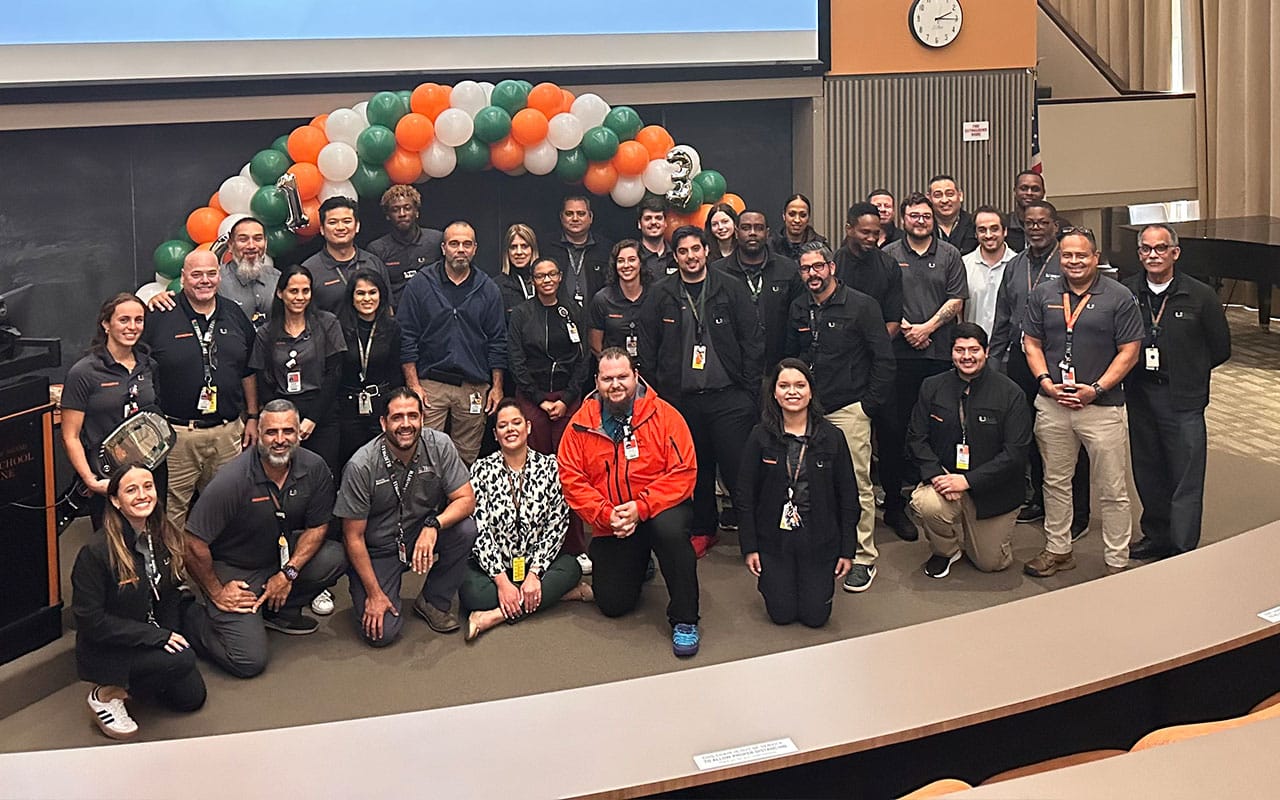
The department includes 53 full-time employees. Executive Director of Clinical Engineering and Facilities Regulatory Quality & Compliance Anthony McCabe, CPSO, CBCP, CBCLA, CCRP, CHSP, CLSO/M, LSSBB, CHTM, PMP, CHFM, leads a talented team.
Leadership members include Director of Clinical Engineering-Biomed Carlos Rivera; Director of Clinical Engineering-Imaging & IoMT Enrique Ortega, MBA, MSHI, MEM, PMP; Manager of Clinical Engineering-Quality Beatriz Hernandez, MBA, CHSP; Manager of Clinical Engineering-Imaging Mayra Becerra, BAS, CBET; Manager of Clinical Engineering-Biomed Robert Kershaw Jr. and Manager of Clinical Engineering-Biomed Jorge Correa.
“The clinical engineering department supports a large academic health system across South Florida, encompassing acute care hospitals, specialty hospitals, ambulatory centers, research facilities and outpatient clinics,” McCabe says.
He says that the core inpatient footprint includes approximately 634-licensed beds across several facilities.
“This includes UHealth Tower, the system’s flagship acute care hospital with approximately 538-licensed beds, as well as dedicated inpatient capacity at Sylvester Comprehensive Cancer Center and Bascom Palmer Eye Institute, which support highly specialized oncology and ophthalmology care,” McCabe says.
Beyond this large inpatient environment, McCabe adds that the department provides support for more than 120 satellite and outpatient sites across the region, including large ambulatory centers such as UHealth SoLé Mia, specialty clinics and research locations.
“These environments range from high-acuity settings like operating rooms, ICUs, cath and electrophysiology labs to high-volume outpatient and procedural spaces with diverse technology needs,” he says.
Supporting this breadth of care delivery requires a flexible, risk-based clinical engineering model that scales across inpatient, outpatient and specialty settings while maintaining consistent standards for safety, reliability and regulatory compliance.
McCabe says that the facilities span five counties in southern Florida with over 40,000 assets that the CE team is responsible for maintaining. He says that the members of the CE team are cross-trained and the department uses a balanced approach that combines specialization with cross-functional coverage.
BRINGING VALUE AND SHAPING GROWTH
Aligning with a standard and equipping a new facility are just a couple of the major projects from the CE team’s calendar over the past year and a half.
“One major special project has been the department’s pursuit of ISO 13485 certification, applying a medical device quality management system within an in-house clinical engineering operation. This effort required formalizing and standardizing processes across the full equipment life cycle, including procurement support, acceptance testing, maintenance, corrective actions, change management and documentation control,” McCabe says.
He says that the team aligned daily HTM operations with ISO 13485 requirements while continuing to support clinical operations, emphasizing risk-based decision-making, traceability and continuous improvement.
“Achieving this certification represents a significant shift in how the department governs quality and demonstrates that an internal clinical engineering program can operate with the same rigor and accountability expected of medical device manufacturers and service organizations,” McCabe says.
He says that over the past year, the department has been deeply involved in several large-scale, high-impact projects that significantly expanded the size and complexity of the medical device environment.
“At the beginning of 2025, we supported the opening of the Kenneth C. Griffin Cancer Research Building, a 12-story, 244,000-square-foot, state-of-the-art facility on UHealth’s downtown Miami campus. Supporting a National Cancer Institute-designated center required close coordination with research teams, facilities, IT and vendors to ensure highly specialized equipment was installed, tested, documented and placed into service under strict regulatory and operational requirements,” McCabe says.
He says that the project demanded a high level of planning around infrastructure readiness, device integration and long-term maintainability in a research-intensive environment.
“We also completed our portion of the opening of UHealth SoLé Mia, a new seven-story, 370,000-square-foot ambulatory care center in North Miami. As the largest ambulatory facility in UHealth’s network to date, SoLé Mia added approximately 3,000 new medical devices to the clinical engineering inventory. The team managed large-volume device onboarding, acceptance testing, CMMS integration and go-live support while working alongside clinical leaders to align equipment deployment with new care models and workflows,” McCabe says.
He explains that SoLé Mia brings together nationally recognized specialty programs under one roof, including the Sylvester Comprehensive Cancer Center, Bascom Palmer Eye Institute, Desai Sethi Urology Institute and a unique collaboration with the Hospital for Special Surgery (HSS).
“Supporting this level of specialty care required careful coordination across diverse technologies ranging from imaging and surgical platforms to outpatient diagnostics and procedural equipment,” McCabe adds.
The department has also proven that it can think outside the box as they have shown with their approach to cybersecurity.
“As more equipment became network connected, we quickly realized that traditional IT patching approaches did not always work for FDA-regulated medical devices. Instead of treating this as an IT problem alone, our team built a risk-based process that brought clinical engineering, IT and vendors to the table,” McCabe says.
He says that the team prioritized devices based on patient risk, worked with manufacturers on approved mitigations and partnered with IT on network controls when patches were not immediately available.
“This allowed us to reduce risk without disrupting clinical operations,” McCabe adds.
Away from the workplace, the department is actively involved in professional association leadership and standards development.
McCabe and Beatriz Hernandez participate in the Association for the Advancement of Medical Instrumentation (AAMI) standards committees focused on quality, contributing to the development and interpretation of industry best practices.
McCabe also serves as an alternate member on the NFPA 1660 Technical Committee, supporting the Standard for Emergency, Continuity, and Crisis Management: Preparedness, Response, and Recovery.
“In addition, Mayra Becerra serves as chairwoman of the South Florida Association for Medical Instrumentation (SFAMI) and as the SFAMI chapter representative for the Florida Biomedical Society (FBS). Through these leadership roles, the department supports professional development, regional collaboration and knowledge sharing across the HTM community,” McCabe says.
With many projects to support, and with their involvement in capital planning and budget management, this is an HTM department that is prepared to take on the big demands of a major health system and deliver the goods.
