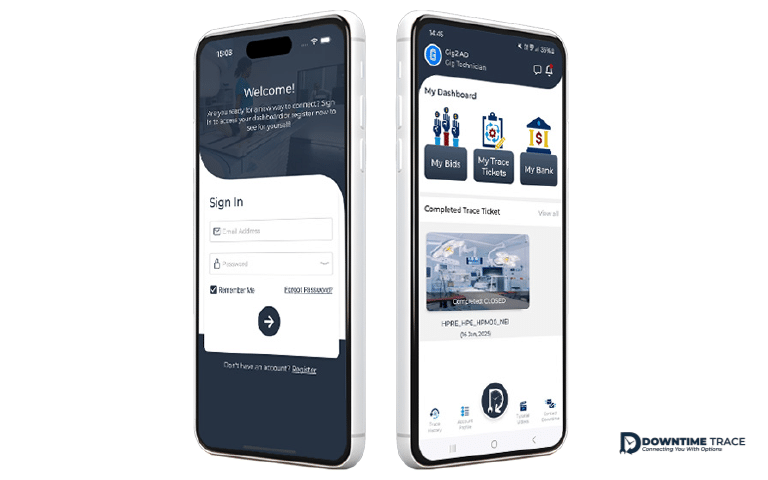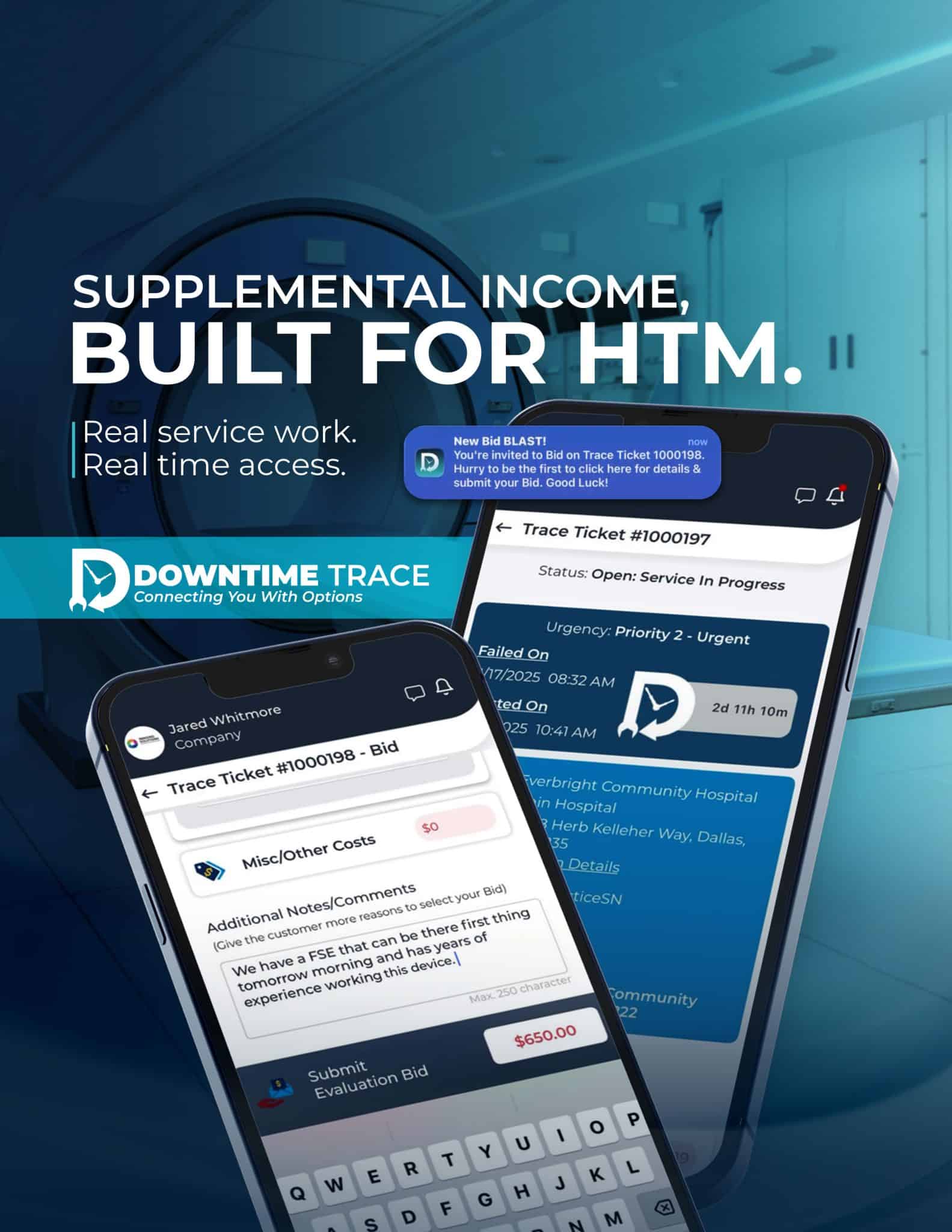
Turn your skill set into supplemental income — on your terms.
For gig technicians earning on the side, and ISOs looking to win work beyond their current network.
Downtime Trace was built for the Biomedical/HTM community that deserves a faster, clearer way to access work.
Founded in 2023 by brothers Danny and Jason Mobley, Downtime Trace came from a real, familiar problem: qualified technicians are out there, ready to help, but it has been hard to access facility requests directly. Jason felt that firsthand while working as a biomed department manager and still picking up side hustles at night to make ends meet. The hospital he worked for paid premium after-hours rates to outside vendors for repairs he could have done himself. At the same time, Jason was delivering pizzas after hours, and the hospital was working with the OEM. That gap sparked the idea: what if medical equipment service work moved the way the rest of the world already moves?
Downtime Trace is a mobile app that works as a service marketplace for medical equipment maintenance and repair. It is designed to connect service providers with work based on their expertise and availability.
For gig technicians, it’s a clean path to extra income on their terms: create a profile that highlights make/model competency, receive instant notifications on service opportunities that match what they are qualified to support, and choose which jobs to bid on based on scope, timing and payout.
No contracts. No gatekeepers. Just service requests matched to their skill set.
For ISOs, it is a way to expand beyond their current network by gaining real visibility into demand and responding quickly with standardized bids, without relying on word-of-mouth, long vendor cycles or cold calls.
The app puts competition in the open. When a service provider places a bid on a “Trace Ticket” in Downtime Trace, the customer who submitted the request can compare the hourly rate, reviews left by other customers and the timeline for when the service provider can arrive. Customers love the control and side-by-side comparison, and service providers love the opportunity to compete for work they did not previously have access to.
Downtime Trace makes reputation part of the workflow. Every service event is reviewed, which means feedback is consistent and performance becomes visible over time. Strong work does not get buried in private relationships or scattered across email threads. It becomes a track record that helps service providers stand out and win future work.
That is especially meaningful for independent technicians. Building credibility as a solo tech has traditionally depended on private networks. Downtime Trace provides a place to build a public reputation through completed jobs, verified certifications and mandatory reviews.
Downtime Trace was also built for flexibility. Service providers can set their service area and adjust it based on where they want to work. If a technician or ISO is open to travel, they can expand coverage. If they are traveling for a period of time and want to earn supplemental income, their service area can move with them so they can see opportunities in the region they are visiting and decide whether a job is worth bidding on.
The result is practical. Downtime Trace gives service providers more access to work, more control over what they take on, clearer expectations during service events, and faster payment, so they can spend less time chasing logistics and more time doing the work they are qualified to do. Which leads to the ultimate outcome, limiting interruptions for patient care across the country.
Service providers can sign up at DowntimeTrace.com. A Downtime Trace team member will guide onboarding from start to finish.
The following Q&A provided by the Downtime Trace team answers the most frequent questions they hear from service providers.
Q: HOW DOES DOWNTIME TRACE WORK?
A: Downtime Trace connects service providers to medical equipment maintenance and repair opportunities through a simple, app-based workflow.
- Create a service provider profile: Service providers build a profile that highlights experience, make/model competency and supporting details such as photos and videos, technical scoring and relevant background.
- Get matched to relevant opportunities: When a facility submits a service request, the platform matches that “Trace Ticket” to vetted service providers who are qualified for the make/model in need of service.
- Receive the Trace Ticket notification: Matched service providers receive the request and can review key details before responding, including scope, timing preferences and other information included by the customer.
- Submit a bid in a standard format: Service providers respond through a real-time bid process. Bids are submitted in a standard format that includes:
- What the provider believes is the likely problem and solution
- When the provider can begin service (estimated onsite arrival time)
- How much the provider will charg.
- The customer compares and selects: Customers view bids side by side and can compare service provider options using the details that matter most: competency, responsiveness, availability, price and performance history reflected through ratings and reviews.
- Complete the service event and close out: Once selected, service is performed and the service event is documented through the platform, so the full experience is tracked from start to finish.
- Get reviewed and get paid: Each service event requires a review, which helps service providers build a visible track record over time. Downtime Trace also serves as the trusted, single point of payment for service events. Approved payments are distributed to service providers and parts suppliers within days, not weeks or months.
Q: HOW DOES DOWNTIME TRACE WORK FOR INDEPENDENT TECHNICIANS VERSUS ISOS?
A: Downtime Trace supports both independent technicians and ISOs within the same standardized workflow, but the impact looks different depending on how they operate. For independent technicians, the platform provides direct access to service requests that match their make/model competency and availability, allowing them to bid on work without relying on private networks or vendor contracts. It creates a structured way to build a visible reputation through completed service events and required reviews, while also enabling payment within days of approval rather than weeks or months.
For ISOs, Downtime Trace serves as a scalable channel to expand beyond their existing network. ISOs can respond to demand with standardized bids, coordinate technicians and manage documentation across multiple service events within one system. The platform provides visibility into opportunity, performance and payment in a centralized format, helping ISOs compete more efficiently and operate with clearer expectations.
Q: HOW CAN A SINGLE STANDARD MAKE SERVICE WORK EASIER?
A: When a healthcare provider chooses Downtime Trace over older methods for ordering and tracking service, it signals a preference for a single, consistent standard. That consistency reduces complexity for both sides of the service event. Instead of navigating different vendor policies, workflows and communication styles for every service relationship, facilities can manage service requests within one platform and measure outcomes using the same set of expectations.
For service providers, a single standard helps reduce the friction that often slows down service events. Clearer service requests, a standardized bidding format and consistent expectations for communication create a smoother experience from the initial request through completion. It also creates clearer performance signals over time. Providers can be evaluated using measurable factors such as response time, downtime and uptime impact, performance against repair estimates, ratings and reviews, and financial information tied to completed work.
Q: WHAT IS ON THE HORIZON FOR THE COMPANY?
A: Downtime Trace has launched, and the focus now is building a healthy marketplace that supports both sides of the service ecosystem. The company is especially excited for independent technicians and ISOs who are gaining increased access to opportunities, supplemental income potential and flexibility, including the ability to choose which jobs they want to bid on.
A healthy Downtime Trace creates more income and freedom for service providers while helping facilities reduce inefficiency, improve equipment uptime and lower spend on device-related issues. The long-term goal is to continue modernizing how medical equipment service is requested, sourced, tracked and paid for by creating a platform that makes service events more transparent, more measurable and easier to manage.
Q: IS THERE ANYTHING ELSE READERS SHOULD KNOW?
A: The best solutions often feel simple. Downtime Trace is a practical step toward the future of service operations, and it reflects a shift that is already happening across industries: technology is making it easier to connect supply and demand, standardize communication and measure outcomes.
The team feels a strong sense of accountability to the service providers and healthcare organizations who rely on these systems. Building a new standard will require patience and adoption from the industry, but the model is designed to work because it aligns incentives. Service providers gain clearer access to opportunity and a more portable reputation. Facilities gain more control, more transparency and better visibility into service performance.
Q: HOW CAN PEOPLE GET MORE INFORMATION?
A: Service providers can sign up at DowntimeTrace.com. A Downtime Trace team member supports onboarding from start to finish. For more detail on the platform and how service providers interface with it, visit Downtime Trace on YouTube, where the team has created commercials and videos that walk through the concept, the workflow and the experience on both sides of a service event.