


By Gay Gordon-Byrne
Our Coalition of repair supporters have been able to pass laws in a dozen states making sure their residents can repair the things they own. Most everything made with high-tech parts is covered by at least one law other than for medical equipment. Right to Repair (R2R) has been introduced in all 50 states, multiple territories and federal versions are being filed for Military R2R, Farm R2R, Auto R2R and most everything else.
Politicians love promoting repair of tractors, cars, cellphones and “consumer” electronics but continue to balk at enabling more competition for repair of medical devices. Why? I suggest that while legislators are now confident that a cellphone or refrigerator repair won’t do great bodily harm – they lack confidence for things they don’t understand or never see.
All a medical equipment manufacturer needs to do is suggest patients will die and political brains freeze.
Legislative brain freeze is hard to fight. It takes time for supporters to meet with legislators and get their attention for two minutes, never mind enough time to fully explain the medical equipment regulatory environment to a disinterested audience. While we know we have a great issue – there are hundreds of other issues demanding attention from the same people. We aren’t fighting OEMs as much as we are fighting for attention on a crowded calendar.
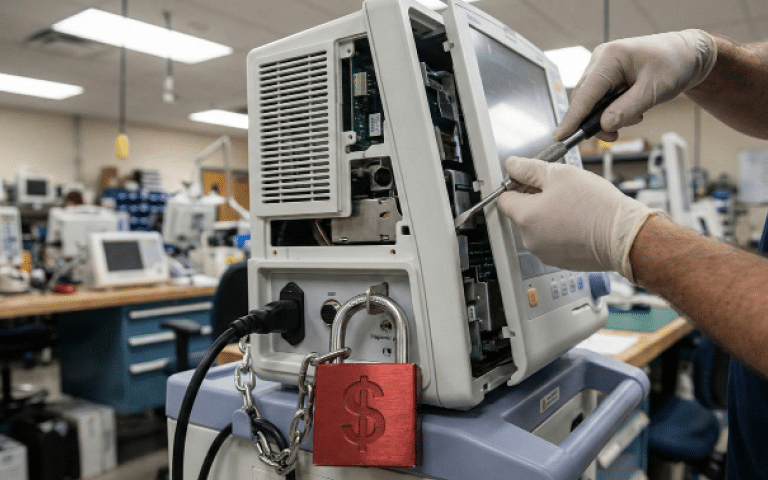
The uphill battle isn’t technical – it’s about money. OEMs tell legislators that price isn’t supposed to enter into medical repair choices, but price needs to be a consideration. OEMs have fought to make sure to promote the idea that any price is acceptable if it comes from the OEM because it is “the best.” A renewed focus on affordability might allow administrators to “sweat” their assets and make sure they get the most out of their scarce technology budgets. Overpriced repair isn’t better repair – it’s just overpriced.
The discussion of money is an advantage for consideration of Right to Reapir, which is why OEMs are so anxious to avoid the discussion. Repairing things not only keeps products in use and out of the dump but reduces the need for buying replacements. We know from the computer industry that late model (n-1) equipment is almost always suitable for years beyond the initial warranty period. Pushing early replacements helps keep new revenue flowing even without any technological advantage.
Even if there were a technical advantage – the choice of what to purchase still belongs to the owner and not the OEM. One of the main reasons that R2R has become so popular is the long-standing rights of owners to control their property.
I met with a legislator last week who runs a pregnancy clinic. She has to buy new ultrasounds every five years in order to get access to maintenance materials regardless of any decline in image quality. The provider should have agency over how often to replace their equipment – not the OEM refusing to sell repair materials. For example – even if well-meaning – states do not allow car dealerships to write requirements that customers must buy new cars every 5 years. The same prohibitions on unfair and deceptive contracts fit perfectly to ban this OEM overreach.
OEMs can then raise repair prices to make replacement purchases attractive relative to repairs ignoring the fact that the initial purchase was not competitive due to trade-ins and other incentives. Acquisition of medical equipment is a rigged game. So much so that the only body powerful enough to break the stranglehold over pricing is the legislature.
There are other factors as well – such as lack of experience with medical equipment on the part of legislators and staffers. Patients don’t see repair techs at work – so the process is more mysterious for constituents than it is for auto repair. I have met only one legislator out of hundreds whose day job was a hospital administrator. He got a bill moving very easily in Illinois because he could explain the rules around making repairs. Once he left office – no one carried the ball. Perhaps a TV show like “The Pitt” will show a repair tech working to fix a ventilator in real time or for an OEM tech being unavailable at any price.
Lack of experience permeates the lobbyist community as well. Lobbyists are hired for the people they know – not what they know. We try hard to make sure our lobbyists are provided with the best background information possible so they don’t have to make stuff up. Biomeds have been able to provide important expert testimony when we can match their schedules to the random schedules of hearings. Most people have never seen or met a BMET because their jobs are behind the scenes.
Lastly, there is the “whopper” factor when OEMs promote ideas that are preposterous with a straight face. For example, we’ve heard testimony that if Right to Repair were to become law, heart patients would fix their own pacemakers. I’m not kidding. The scary part is that legislators in the hearing were not laughing out loud. Medical equipment repair was stricken from the bill in minutes.
Anyone that has a repair story to tell about medical equipment can do so at any time using our advocacy widget. Go to https://www.repair.org/stand-up to use our free advocacy tool to reach your legislators directly. A phone call is even better. Your voice as a constituent and also an expert is powerful. We do not sell our lists and do not want any personal information.
