



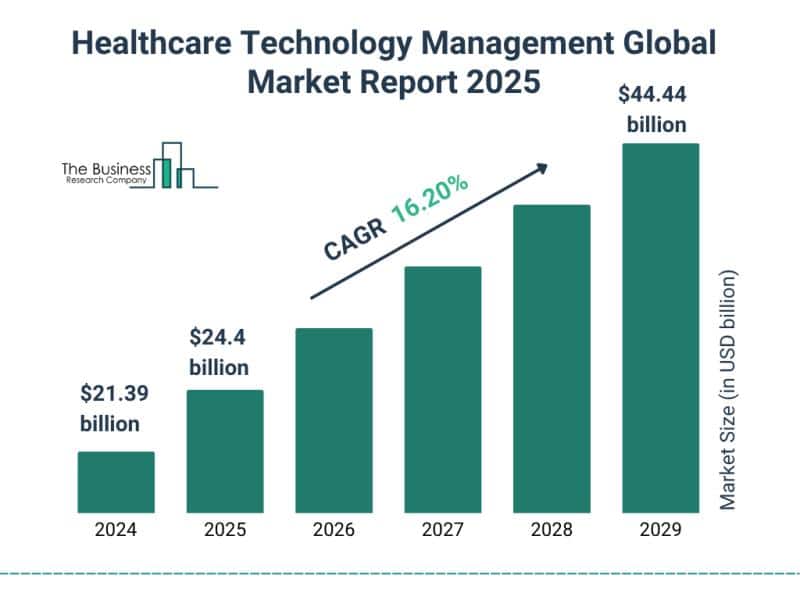
 The healthcare technology management (HTM) sector is poised for significant expansion as digital innovations and regulatory demands reshape the industry landscape, according to a press release fromm The Business Research Group. With hospitals and healthcare providers focusing on smarter, safer, and more efficient technology use, this market is set to experience robust growth through the end of the decade. Let’s explore the market’s growth prospects, leading companies, emerging trends, and segmentation details to understand the trajectory ahead.
The healthcare technology management market is anticipated to grow rapidly over the coming years, reaching a value of $51.52 billion by 2030. This represents a strong compound annual growth rate (CAGR) of 16.1%, driven by various factors. Key contributors to this growth include escalating investments in digital hospital infrastructure, an increasing demand for interoperable healthcare systems, a heightened focus on the cybersecurity of medical devices, expansion of data-centric maintenance approaches, and more rigorous regulatory oversight of healthcare technologies. Future trends likely to influence the market involve greater integration of healthcare technology management software platforms, an uptick in predictive maintenance practices, intensified emphasis on device cybersecurity, broader adoption of asset lifecycle management, and amplified regulatory compliance efforts.
Several prominent companies currently steer the healthcare technology management market landscape. These include ABM Industries Inc., Agility Inc., Allscripts Healthcare Solutions Inc., Athenahealth Inc., InterMed Group, Januarynx Medical Systems Inc., Koninklijke Philips NV, Renovo Solutions Ltd., Siemens Healthcare GmbH, TRIMEDX Holdings LLC, Welldoc Inc., Advanced Ultrasound Electronics Ltd., Althea Group, Aramark Healthcare Technologies LLC, Asimily India Pvt. Ltd., Atlantic Biomedical Co., Clinical Technology Management, Comprehensive Technical Group, Conquest Imaging, DirectMed Parts Services LLC, GE Healthcare, Innovatus Imaging Corp., MasterPlan Healthcare, MedWrench LLC, Metis Medical Services, IQVIA Holdings LLC, Tech Knowledge Associates LLC, and Healthcare Technology Management Company.
Notably, in August 2025, CareCloud, a U.S.-based healthcare technology firm, acquired Medsphere, a provider of electronic health record (EHR) and healthcare IT solutions, for an undisclosed sum. This strategic acquisition is expected to help CareCloud develop a unified healthcare technology platform, improve integrated care delivery offerings, expand its customer base, and strengthen its position within the healthcare IT market.
Innovations in medical technology, particularly in minimally invasive surgical tools, are significantly fueling market growth. Companies are advancing navigation systems that elevate surgical accuracy, improve patient safety, and shorten recovery periods. Navigation systems utilize maps, sensors, GPS, and satellite data to precisely track and guide equipment or individuals during procedures.
For example, in August 2023, Orthofix Medical Inc., a U.S.-based medical device manufacturer, introduced the 7D FLASH Navigation System Percutaneous Module 2.0 aimed at minimally invasive surgery. This upgrade enhances the system’s clinical functionality by integrating implant planning and offering a wider selection of navigated instruments. The product targets the critical minimally invasive surgery (MIS) spine navigation segment and is designed to appeal to diverse healthcare facilities, including teaching hospitals and ambulatory surgery centers.
The adoption of integrated healthcare technology management platforms is growing, enabling providers to streamline maintenance and operational processes. These platforms combine multiple functionalities such as equipment tracking, predictive maintenance, interoperability, and compliance management, thereby improving overall efficiency.
Moreover, increasing cybersecurity concerns around medical devices are shaping market developments. Providers are investing in robust cybersecurity measures that protect patient data and medical equipment from cyber threats. Enhanced focus on regulatory compliance is also driving demand for advanced quality assurance and documentation systems, ensuring healthcare organizations meet evolving standards.
