


An online news item posted on the AAMI website planted a seed in the mind of veteran biomed Philip Camillocci. The idea grew and became a mission for the Technical Training Developer-Biomedical for GE Healthcare. It is a mission that he will never regret.
“My journey with Engineering World Health (EWH) started in August 2014 when I read an article about EWH in an Association for the Advancement of Medical Instrumentation (AAMI) news post titled ‘Inspiring, Educating, and Empowering the biomedical engineering community to improve health care delivery in the developing world,’ ” Philip Camillocci says.
In developing countries there is a lack of skilled biomedical technicians who can install, maintain or repair medical equipment. It is estimated that 40 percent of medical equipment in developing countries is in need of repair or replacement at any one time, Camillocci says.
EWH has a few programs that focus on growing biomedical technicians’ talents in developing countries. There is one program at EWH called the Summer Institute where engineering and biomedical science college students volunteer to go to countries such as Nicaragua, Rwanda and Tanzania to spend the summer immersed in local culture learning and repairing life-saving medical equipment.
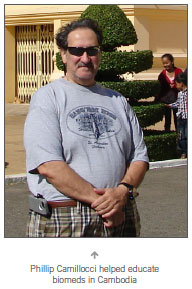 The visiting instructor program allows an experienced biomedical technician or BMET to travel to Cambodia, Ghana, Honduras or Rwanda for EWH and help train biomedical engineering students to service and maintain medical equipment in their country.
“After reading the article and visiting the EWH website to gather more information, I thought about what I could contribute,” Camillocci says. “With my educational background at the U.S. Army Medical Equipment and Optical School and my 30 years of experience working on just about every type of medical equipment both as a field service technician and in-house biomed, I decided to go online to the EWH website and complete the guest instructor application because the program felt like a great fit for me.”
Camillocci explained that Ed Hutton, Chief Operating Officer (COO) for EWH, and an Army-trained Biomedical Technician, approved him for one of the instructor programs in Cambodia.
“I was then put in touch with Steve Goeby, the BMET Coordinator for Cambodia,” Camillocci says. “We exchanged a few emails getting to know each other, and he provided more information about the program. With my 30 years of experience as a BMET, I have had a few opportunities over the years to train other BMETs including as a part-time adjunct professor of Biomedical Electronics at a technical college in South Carolina, where I taught students at night.”
During his 12 years of active duty in the Army, Camillocci also spent four years stationed at a medical research laboratory in Bangkok, Thailand. He had traveled most of Thailand, Malaysia, Singapore, Japan, Hong Kong and Philippines.
The more he thought about the program, the more he wanted to be involved.
“I decided to use what vacation time I had left for 2014 to volunteer for this important program,” Camillocci says.
“Steve and I discussed the program in Cambodia in greater detail. He forwarded me some already developed course material covering electrical safety, suction devices and sterilizers. We created a Dropbox account so that we could exchange files,” Camillocci says. “Steve uploaded the training material he wanted me to review. In my spare time at night and on weekends, I reviewed the material to become familiar with it. I also made some suggestions to update and improve the content of the material, and then I reloaded the lessons to the Dropbox file so Steve would have time to review the updates and get them reviewed by a translator.”
All of the volunteer work paid off.
Lessons are presented in English via PowerPoint, handouts and videos. A translation into Khmer is printed in a student handbook, which is provided during the course. A translator is present in the class during all courses to assist with any English/Khmer translations. The lesson starts with a short history of the technology, terms and definitions. The lesson then transitions into providing more detailed information about the device, like suction units, going over the types of suction units and their operation. Next, the class advances to hands-on learning.
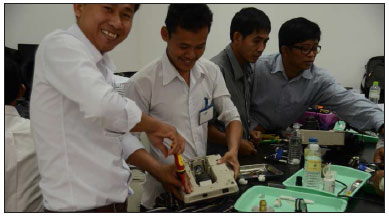
“We then move on to working with actual suction units: taking the suction units apart and learning how they operate, basic maintenance requirements and troubleshooting. We then place faults in the device and let the students do some troubleshooting,” Camillocci says. “At the end of the lesson, the class receives a test to see what they learned and if any areas need to be gone over again. Currently there are two groups of students in the program; Group 1 has 12 students and Group 2 has 28 students.”
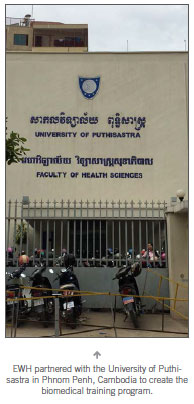
EWH partnered with the University of Puthisastra in Phnom Penh, Cambodia to create the biomedical training program. The university is a private school and helps support the students from rural hospitals. The students are hospital employees from 28 provinces who are sent to attend the biomed program at the university.
The University of Puthisastra also offers a number of courses in health sciences that include medicine, nursing, mid-wife training, dentistry, pharmacy and laboratory tech, to name a few.
Students receive a salary from their hospitals and an allowance from the EWH to help defray living expenses while they study. The course of study is 244 days over three years and students get to return to their homes for the weekends. Upon completion of training, they can return to the health care facilities in their home province and maintain the equipment, reducing downtime and improving patient care.
In October 2014, the inauguration of Cambodia’s first National Center of Excellence (COE) for Biomedical Equipment Technology was launched. The COE, located at Calmette Hospital – the nation’s premier public hospital— was established in collaboration with the GE Foundation. The purpose of the COE is to train, mentor and professionally develop and support technicians from all around the country. The COE will give biomed techs from national and provincial hospitals an opportunity to gain supervised, hands-on experience working with a large variety of medical equipment in a well-managed workshop. Students from the university shadow and train at the COE as part of their training.
Camillocci spent part of the winter in Asia serving EWH.
 “I flew out on Saturday, December 6 to Atlanta and then had a 15-hour Korean Air flight that would take me non-stop from Atlanta to Seoul, South Korean and then, finally, a 5-hour flight from Seoul to Phnom Penh, Cambodia,” Camillocci says. “I arrived at 11:40 p.m. on Sunday, December 7 local time, as we crossed the International Date Line on our trip west. I was met at the airport and taken to the guest house that they use for visitors.”
“My first few days, I was working through the jet lag while teaching,” he adds. “My first group of students started December 8 with 28 students. EWH has a great crew of six people working locally with translators. Three EWH volunteers came in from Australia to help teach English, which was the first course of the day for the students.”
Camillocci was able to meet Hutton in person while he was in Cambodia.
“The EWH COO Ed Hutton was on site during my visit to do a site review and get progress reports from the local team. He also took the time to present a class on mobile X-ray service that included preventive maintenance actions and common equipment faults. I helped with presenting basic electronics, electrical safety, ECG monitoring, suction pumps and sterilizers,” Camillocci says.
The program is very intense and the students are dedicated to expanding their education.
The students start at 8 a.m. and break for lunch from noon to 2 p.m. A two-hour lunch break is the norm in the country. The class returns and continues to 5 p.m. On Fridays, the students received some class material in the morning and take tests on the material they studied that week. At noon, they are dismissed to return home for the weekend.
Camillocci says the experience is one he will not soon forget and he plans to participate again.
“December 26 came with my vacation time ending and I had to return home. My stay was very rewarding; the EWH team was supportive and went out of their way to help me with anything I needed to present the course material,” Camillocci says. “Students were really eager to learn the material and apply hands-on what was taught. I learned a lot about Cambodia, the Khmer people and some of the history of the area.”
“I am already planning for my next visit to support this great program,” he adds. “Hopefully, after you have had a chance to read this, you too will consider donating your time and experience to EWH or another great program either locally as close as your local school or as far away as a developing country.”
