


By K. Richard Douglas
 America has an ally in the Middle East that believes in individual liberties and freedom of the press, with a backdrop of a diverse population. Israel is the home to three major religions, and the only Jewish nation in modern times. The land was once a part of the Roman Empire. Israel declared statehood in May of 1948.
Israel has Jewish, Palestinian Arab and Arab Christian populations living together. The country has the Mediterranean Sea along much of its western edge, offering waterfront resorts and beaches. Israel is bordered by Lebanon, Syria, Jordan and Egypt to the north, east and south.
The country has always been a favorite destination for Americans for a number of reasons. The chance to visit Israel came for one American HTM professional, who was able to go there, in large part, because of his son’s education.
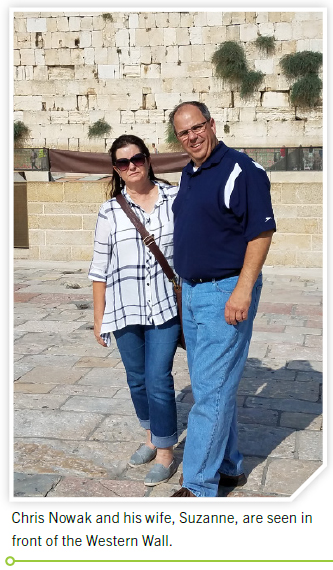
“My son was awarded a scholarship to a Jerusalem university for his studies in international security and Middle Eastern studies,” says Chris Nowak, CBET, CHP, CSCS, corporate senior director of Healthcare Technology Management for Universal Health Services of Delaware Inc. in King of Prussia, Pennsylvania.
“The opportunity to meet up with him in Israel as he completed his studies over the summer was fantastic. He was the tour guide for the visit. After being in the country for a few months, he had the opportunity to know where the good spots were to visit,” Nowak says.
Nowak previously visited Tokyo and Santiago, Chile, but visiting Israel was definitely on his bucket list.
“The 10-hour flight over and the 11-hour flight back in an ELAL Boeing 747 was an experience in itself, as the travelers around me on the flight were as diverse as the religious landscape in the country of Israel itself,” Nowak says.
Ever Present Security
Because of a series of terror attacks over many years, security is tight in Israel, while balancing the movement of visiting tourists. Nowak learned this during part of his visit.
“One day, we visited Ammunition Hill, a memorial site of the 1967 Six-Day War. When we returned to the Old City area, our plan was to visit the Garden of Gethsemane. We exited the public rail system on the Muslim side of the Old City near the Lion’s Gate,” Nowak says.
“The access to the Old City was blocked by Israeli Defense Forces (IDF) and only people with appropriate credentials could pass through. There were a hundred or more men kneeling on carpets in the street near the access point.”
“We managed to get up to the access point staying close together, and I was able to show my Missouri driver’s license (I did not have my passport), and the IDF smiled and sent me and the family on through the checkpoint,” Nowak adds.
“As we walked along the road to the garden, it was eerily desolate,” he recalls. “Very few people were walking on the street. As we snaked our way around the corner on this street, we came upon a mass of Israeli Defense Force personnel. They were restricting all entrance into the Lion’s Gate into the Old City due to violence that happened the day before due to the installation of metal detectors subsequent to the killing of two IDF officers at this gate.”
A large group, who were protesting and being restrained by the IDF, made it questionable if they were going to see the garden. Nowak asked a member of the IDF if it was ok to continue and was told yes.
As they got closer, this area was blocked by the IDF and there were additional protesters behind barriers. This was only a few hundred feet from the garden. They skipped the visit at that time, but made it back later in the day.

Seeing the Sites
Nowak says that getting around to tourist destinations is a combination of walking and catching a bus. There is plenty to do and see, but the requisite security concerns are always a part of the experience.
He says that they saw “the Old City of Jerusalem and all of the sites inside of that city. Tourists will do a substantial amount of walking. We took public transportation to the Palestinian Authority side of the country — Bethlehem, Herodium, and Mar Saba.”
“My son wanted us to experience the public transportation system. Did I mention he is a cheapskate too? Anyway, the bus ride was comfortable. On the way back into Israeli controlled territory, all Palestinians must exit the bus at the checkpoint. While the IDF check the credentials of these people, other IDF personnel enter the bus and want to see the credentials of the Israelis and visitors who stayed on the bus,” Nowak adds.
Once everyone’s credentials were checked the bus was released and it headed back to Jerusalem.
“We rented a car and drove to Masada, an ancient fortress built high on a mountain overlooking the Dead Sea. A cable car ride to the top is amazing,” he says. “Of course a visit to the Dead Sea was in order so we could do some floating. With the massive amount of salt content, it is effortless to float in the water. A Dead Sea mud covering was also part of the visit too. The mud is supposed to have healing properties for all sorts.”
“Before long, it was time to leave Israel and treasure the memories. I found Israel and the Israeli people amazing, tolerant and welcoming. The history was amazing. To see and feel ancient history provided chills up my spine as I pondered the footsteps of those that came before me in these areas,” Nowak adds.
“Transportation around Israel was easy. Public transit is widely available. However, when visiting Jerusalem and the western side of Israel, be very cognizant of the religious holidays and traditions. Many things are not open or transportation is very limited,” he says.
For this HTM professional, a visit to Israel has been checked off his bucket list.
