



By ECRI
With one or two COVID-19 vaccines authorized for emergency use by the FDA by the end of 2020, it’s time for hospitals and clinical engineering departments to be prepared for distribution and administration. Vaccine transport and storage can in some cases present a challenge. Citing the need for incredibly low storage temperatures for at least one vaccine, some hospitals and others who plan to administer them are investing in ultra-low temperature (ULT) freezers.
Sometimes called cryogenic freezers or deep freezers, they are designed to preserve frozen samples and vaccines for laboratories and pharmacies and maintain temperatures of -40 to -90 degrees Celsius (-40 to -130 degrees Fahrenheit). ULT freezers are a stable technology, with changes mostly occurring with improvements in ease-of-use and in improved efficiencies surrounding temperature control.
“Think hard before you purchase an ultra-low temperature (ULT) freezer,” advises ECRI’s Jonathan Gaev, MSE, CCE, HEM, PMP, senior manager, International Engineering, Device Evaluation. “The CDC does not recommend that they be purchased just for the purpose of storing the Pfizer vaccine. If you are planning to purchase a ULT freezer in order to distribute vaccines from a centralized location, check with your state to see if you are allowed to do that.”
Similar technology to home freezers
Available in upright, chest, countertop, under counter, and portable configurations, the units are usually made with a corrosion-resistant (typically stainless steel) interior, minimizing the risk of adulteration, contamination, and/or corrosion of contents. The internal shelving is appropriate for storage and easy location of laboratory products and samples.
Most ultralow freezers use either a single high-power compressor hermetically sealed or two cascade compressors. One system consists of a cooling engine and thermosiphon. Insulation is critical to maintain the very cold temperatures between the internal and external walls.
Multiuse laboratory freezers include automatic defrost capability, maintaining the temperature in the entire freezing chamber within pre-established limits during the process. They also include sensors, controls, monitors, and alarms for dependable long-term storage following laboratory storage standards. LCD touchscreen displays may be available on some models, this allows for precise monitoring, control of internal temperatures, and alarm management.
Units may include:
- Twin compressors that allow for back up if one compressor fails
- Wax-free synthetic oils to reduce ice build up
- Low-wattage halo bypass heaters that help keep the gaskets around the outer door clean
- Security features such as alarm settings, set point passcodes, and padlock compatibility
Optional accessories include chart recorders, back-up batteries, cryo gloves, seismic restraint kits, sliding drawers, racks and boxes for multiple- sized microplates, and cryobank tubes.
Reported Problems
Few device-related problems are typical with the use of ultralow freezers. When used and maintained properly, they can last for 12-15 years.
Problems may occur due to a variety of reasons, including:
- Age of unit
- Poor routine maintenance – cleaning/inspecting gasket to avoid deterioration/ leakage, cleaning/replacing the condenser filter, refrigerant loss, degraded lubricants, fatigue in mechanical systems
- Not removing built up frost or ice
- Misuse of unit causing spoilage due to unstable temperature fluctuations
- Ignoring alarms
- Power failure
- Low or inconsistent voltage
- Frequent opening and closing of the unit
An out-of-range temperature reading should prompt immediate action. Although these devices are quite reliable, per CDC recommendations, facilities need to have a plan in place to address transfer of vaccines if the temperature falls outside of the acceptable range unless the issue can be resolved immediately (e.g., plugging in an unplugged unit or closing a door that has been left open).
“Careful planning is especially important for vaccines stored in ULT freezers. They should not be kept open for more than 30 seconds at a time and require time to come back to the appropriate temperature after the door is opened,” noted Gaev in ECRI’s December 2020 webinar on COVID-19 distribution and administration.
ECRI Recommendations
At a minimum, the temperature range should be adjustable from -40 to -90 degrees Celsius (-40 to -130 degrees Fahrenheit). Units under consideration should include a solid door with an insulated door frame that can be locked and secured. The refrigerant should be CFC free, and the unit should have an automatic defrost capability, a data logger, temperature monitoring device, and battery backup.
The ultralow freezer should include alarms for self-test, over-temperature, under-temperature, power failure, door ajar, and low battery. Remote alarm capabilities are preferred.
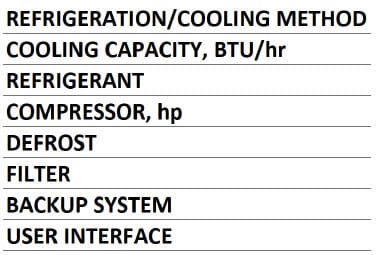 ECRI is currently compiling a full, side-by-side comparison of 35 models from 10 manufacturers. This apples-to-apples look at currently marketed models covers specifications such as alarms offered, pysical characteristics (shelving, locks, caster, dimeansions), and more.
ECRI experts also present specific recommendations for minimum performance requirements—called ECRI Recommended Specifications.
CDC has indicated that ultra-low freezers need not be purchased in order to successfully accept delivery of and store current vaccines. Other methods are deemed acceptable, such as dry ice, and the speed with which the vaccines will be used means long-term storage is not an issue.
“The temporary storage containers enable the hospital to keep the vaccines at the proper temperature if they are refilled every 5 days with dry ice up to 30 days and then the contents can be transferred to a freezer for another 5 days so overall the vaccines may be stored for up to 35 days without a ULT freezer,” added ECRI’s Gaev in relation to the Pfizer vaccine.
ECRI polled participants at its December 16, 2020 live webcast on COVID-19 distribution and administration for insight on hospitals’ plans to buy low-temperature freezers for COVID-19 vaccines and to assess the availability of dry ice supplies. Of the 602 survey responses, about 34% said they are planning to buy low-temperature freezers; 64% are not. Asked to assess their supply of dry ice, nearly two-thirds said they do not have adequate supply at this time.
It is possible that future iterations of the vaccines may not need such low temperatures. However, understanding low-temperature freezer’s basic design and use, as well as an awareness of available options, ensures an informed decision should the need arise.
This article is adapted from ECRI’s Healthcare Product Comparison of ULT Freezers and ECRI’s December 16 webinar, “COVID-19 Distribution and Administration: Is Your Hospital Prepared?”
To learn more about this technology and guidance, visit ECRI’s COVID-19 Resource Center at https://www.ecri.org/coronavirus-covid-19-outbreak-preparedness-center/ To learn more about ECRI membership, visit www.ecri.org/solutions/device-evaluations, or contact ECRI by telephone at (610) 825-6000, ext. 5891, or by e-mail at clientservices@ecri.org.
