



Healthcare technology training, including apprenticeships, remain a common topic of discussion. It is an especially important topic because of the growing number of open positions being created by the retirement of an aging workforce. TechNation reached out to HTM professionals to find out more about the current state of training in the industry.
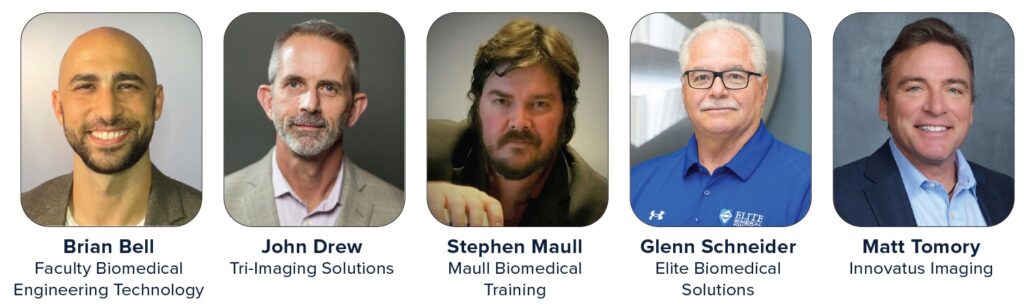
Participants are:
- Brian Bell, Ph.D., Faculty Biomedical Engineering Technology, St. Petersburg College, and Founder of HTM Workshop;
- John Drew, Tri-Imaging Solutions, Vice President of Operations;
- Stephen Maull, Owner of Maull Biomedical Training
- Glenn Schneider, MHSA, CRES, Chief Service Officer, Elite Biomedical Solutions; and
- Matt Tomory, Vice President Sales and Marketing, Innovatus Imaging.
Q: What are the benefits of an apprenticeship?
Bell: An apprenticeship offers the benefit of employer-sponsored training, providing hands-on, and up to date industry-specific skill directly related to the employer’s strengths. Apprenticeships strengthen the relationship between employee and employer, fostering mutual trust and better communication.
Drew: I can talk to our program here at Tri-Imaging. We are having great success bringing new engineers into the field with our program. To date, we have had approximately 60 apprentices complete our program. It is a great way for a new HTM candidate to enter our industry with more than just a class under their belt. The program offers them a submersion into working with us day to day diagnosing, repairing, testing and calibrating diagnostic imaging systems in a controlled environment. The result of this is twofold. First, the engineer is far more comfortable when they enter the workspace. Having been exposed to multiple modalities such as X-ray, mammography, mobiles, C-arms, cath lab and CT. Second, the employer is confident that they are hiring someone who has been vetted and has more than just a basic understanding. We also work with our customer to tailor the training need of the apprentice to meet their needs.
Schneider: Since we are a manufacturer, we have positions that require low-skilled labor to perform. Our apprenticeship program provides opportunities for employees in those positions to develop a career in the HTM field, if they show an interest and the necessary aptitude. We already know their character and work ethic, so investing in them is an easy decision.
Tomory: Apprenticeships have many benefits beyond the individual apprentice. Of course, the individual receives the accumulated knowledge and years of experience of the mentor, but the mentor also benefits. Over the years, I have taught hundreds of classes and trained countless individuals and the one constant is that even though I was the subject matter expert, I learned something from each class and person. The industry also benefits; there is a dramatic shortage of new personnel in the HTM field and every day, knowledge is lost. Apprenticeship brings new blood into the industry and provides them with an excellent foundation to build upon and become the next generation of this essential workforce.
Q: How can a biomed be sure to obtain quality training from an OEM, ISO, school, training center, conferences and webinars?
Bell: To ensure quality training, a biomedical engineer should verify the experience and past performance of the trainer when possible. Also, seeking feedback from biomeds who have previously attended the training is another great way to confirm the quality of the training. Additionally, the value and opportunities for networking provided by the training should be a part of the consideration when evaluating its quality – not just technical skills.
Drew: I would say it’s critical for several reasons, but I will just give a couple.
- Personal growth. Engineers today are looking for continued growth with an employer, and educating and expanding skill sets is one piece of that plan.
- Due to the shortage of engineers, employers are requiring employees to cover more and varied systems. Continuing education is essential to make this successful for both the employee and employer. Once there is a base established, it can be the launching pad for other specific areas.
- Degrees are another way to distinguish yourself from another as well.
Maull: In our industry there are basically two types of training courses; concept courses and actionable courses. A concept course is what we often get at tradeshows; introduction to X-ray, introduction to contrast injectors, or infusion pumps or ventilators, etc. When you take a concept course you are going to learn generalities and lingo about that particular type of equipment. An actionable course is one where you are going to learn how to operate, maintain and/or repair a specific type of equipment. A quality course is one where you actually learned what the course curriculum said you were going to learn. If you went to school to learn how to do a PM on a ventilator and you can actually do a PM on a ventilator when you get back to your medical facility, then you received quality training.
Schneider: Like many things, you get out what you put into training. I’ve attended training in the past where students did only what was necessary to complete the course and others asked a lot of questions and really tried to get the most out of it. I think you’ll find most instructors love to teach the subject matter and like questions from students that challenge them and the other students to better understand the device or subject matter. Don’t try to multi-task while listening to a webinar. You’ll get very little out of the presentation if you’re not paying attention. You’ll be surprised by the number of people who have the same questions you do.
Tomory: There are many channels for biomedical training available today with a wide variety of outcomes. The questions to be asked include: What limitations will I have to comprehensively service and maintain XYZ device after this training? What barriers will remain including diagnostics/passwords or software? I recommend a mix of sources for training as well as continuing education to grow your knowledge base. Conferences such as AAMI and MD Expo are excellent events for a wide variety of complimentary or inexpensive education. The OEM training can be a great source as well although usually expensive. It is best to negotiate for OEM training at the point of purchase when they are the most flexible. ISO training (my previous specialty) can be excellent with pragmatic, real-world applications and situations as long as the instructor has the experience and training materials to fully equip you to service XYZ device.
Q: How is new technology impacting training?
Bell: New technologies like remote learning and VR are significantly enhancing training in biomedical engineering tech by providing flexible, accessible and immersive learning experiences. Remote learning kits from HTM-Workshop.com or virtual training from NVRT labs is a great way to build confidence for technicians alongside more traditional live training and labs.
Drew: Training is continuing to evolve thanks to technology. Remote classes continue to increase as an alternative to traditional in-person courses. This really seemed to grow during COVID of course. This could not have been effective without the technology to deliver the courses getting better. Although offering courses online has shortened the amount of time an engineer has to be away, it has not eliminated the need for hands-on training. VR is awesome and has its uses but I believe Augmented Reality (AR) is where we will see great strides made. Having the ability to work in the real world and virtual world together is the key.
Maull: The adoption of remote training is a slow-moving tortoise, but it is moving forward. We started our remote training options in 2015 and it was slow to catch on. Being a relatively new concept in our industry, BMETs were unsure of the effectiveness of training you didn’t have to attend in person. But, like all legitimate technological advancements, it slowly picked up steam. Now, many companies are offering a form of remote learning; some are dedicated specifically to it (NVRT for example). Our first year offering remote training we had around 20 students choose that option. Now, it’s close to 10 times that. With VR, AR and AI, the training will only get more and more effective (both in practicality and cost), which is making it easier on budgets and personally to the students who don’t have to leave home to get the training they need. Geography and lack of manpower are being eliminated as obstacles to attending training, and that’s huge.
Schneider: VR and remote learning make access to training so much easier. The video quality and availability of VR has improved exponentially over the last 5 years. For any remote training, I still believe hands-on for labs is necessary. Partnering with a hospital or medical device repair facility for required hands-on training is essential to the student’s success.
Tomory: Remote training can be valuable, however I view it as a complement to in-person training. When in-person, people are dedicated to the class and attention, proficiency, and knowledge retention is apparent to the instructor. When remote, people tend to “multitask” (I say this euphemistically) and are not fully focused on the task at hand. With technical training, nothing compares to hands-on, in-person interactive instruction.
Q: What are the benefits of earning a certification?
Bell: Earning a certification such as CBET, CABT or CRES offers several benefits. It validates expertise and knowledge in biomedical engineering, enhancing professional credibility and career prospects. Certification often leads to better job opportunities and higher salaries, as employers recognize the value of certified professionals. However, each employer is different and it’s important to understand each employer’s perception of each certification. There are great technicians that are not certified, certification is more of a badge of accomplishment and a statement of career commitment to continual education. Your reputation is your most powerful tool and certification is just one part of your overall brand and reputation as a technician.
Drew: I will answer this leaning to the diagnostic imaging space specifically. Certifications lend to credibility or competency in a specific area or a general knowledge. If someone is entering into this space and has completed our BMET to Imaging courses, an employer can be confident they have a base of knowledge that can be built upon. Certain certifications for specific specialties may be required, but we have not seen much of that just to enter the field.
Schneider: As an employer, I see the certification as a minimum knowledge base for that technician. It tells me that the certified technician had to invest their own time, most likely their own money, and effort above and beyond the normal job duties to pass the exam. If comparing people during the hiring process and everything else is equal, I’ll always choose the certified technician. Also, the certification is nationally recognized, so it provides the technician with the possibility to earn more and work anywhere.
Tomory: Certifications are important for a variety of reasons. Having the discipline to complete a program such as CBET demonstrates commitment as well as proven proficiency in the program materials. Each program has a curriculum students must complete and pass exams to earn that certification. The certification in turn opens doors to new or additional professional responsibilities opportunities and associated financial benefits. Certifications may also be a requirement for certain positions or career paths.
Q: What else do you think TechNation readers need to know about training opportunities?
Bell: TechNation readers should know that training opportunities are continually evolving, offering more flexible and diverse options than ever before. It’s essential to stay informed about industry trends and updates, as new certifications and specialized courses are regularly introduced. Networking through training programs can be invaluable, offering connections with industry experts and peers that can enhance career growth and development.
Drew: We have been talking to people for years about the need for new engineers in our industry. The early warning signals are long gone, and we are deep into a severe shortage of diagnostic imaging engineers. I would encourage anyone who is interested in a career field that has great pay, a good work environment, and longevity to visit our website, www.triimaging.com, and inquire about our programs to get started.
Maull: There is a well-known adage about growing old: “When you stop moving, you die.” This basically means as you age and retire, don’t become complacent and lazy about your physical activity. Whether it’s running, bike riding or walking or whatever, keep active … keep moving every day and enjoy a long, healthy life. In our industry, the same can be said about training. This career field is, by its nature, always on the cutting edge of technology. The medical industry moves technology forward as fast as nearly any other industry in the world, so when someone decides to become a BMET, you are committing to a life of never ending learning. The equipment is always evolving, so the BMET needs to constantly keep up with these technological advances.
Schneider: Being asked to attend training is a privilege. It’s an investment by the employer that should not be taken lightly by the student. There are intangibles like quicker turn-around times. The value training brings to an HTM department favors the employer, student and, ultimately, the patients. Effective training provides a department with the ability to keep equipment in the hands of the caregivers for longer periods of time.
Tomory: Training is essential for ALL of us regardless of the field you are in. Stasis in any business means no growth while others are growing around you – leaving you behind. I am fond of saying that staying still means going backwards. Whether your current position is technical, managerial, executive it does not matter – continuing education ensures professional growth or, at the very least, ensures you are not passed by your peers.
