



Imagine the chaos for firefighters in a firehouse if the alarm rang incessantly. What is worse, imagine if only a small percentage of the alarms were real emergencies. The firefighters would be exhausted after only a day or two and their mental preparedness would surely suffer.
 After reacting to the onslaught of false alarms, the reaction of the firefighters would eventually be like dealing with the proverbial boy who cried wolf. The danger posed by this situation is that when a legitimate emergency comes along; it can be a life-or-death situation. This holds true in the hospital setting.
The hospital is no Aesop’s Fable; it’s a place where constant awareness is demanded. Clinical alarm safety deserves the attention of all the stakeholders because the most vulnerable stakeholder is the patient.
A cacophony of alarms can hide the real emergency.
It is likely that none of this is news to anyone reading this article. The issue is a frontrunner among issues that will be addressed by experts across the health care spectrum this year and in the future.
On ECRI Institute’s “Top 10 Health Technology Hazards for 2015,” the top spot was “Alarm Hazards: Inadequate Alarm Configuration Policies and Practices.” In 2013, The Joint Commission (TJC) issued Sentinel Event Alert Issue 50, “Medical Device Alarm Safety in Hospitals.”
AAMI’s National Coalition for Alarm Management Safety held its initial meeting in April of 2014. Like cybersecurity, EMRs and dealing with newer regulations from CMS, the topic of alarm management requires new thinking and the adoption of intelligent guidelines.
Although a majority of alarms will never require clinical engagement, the risk to patient safety requires that attention be paid to all of them. Many will be sounded with no basis for an urgent response. There are some recurring reasons for these non-significant alarms.
As TJC and AAMI have pointed out, many alarms result when “conditions are set too tight; default settings are not adjusted for the individual patient or for the patient population; ECG electrodes have dried out; or sensors are mispositioned.”
With devices monitoring a patient’s blood pressure, heart rhythm, blood oxygen level or ventilator status, the variables become a consideration. Normal blood pressure for a person in their 80s may be different than that for someone in their 30s, for instance.
Alarms on cardiac monitors, pulse oximeters, ventilators, CPAP/BiPAP devices, infusion pumps, feeding pumps, bed exit alarms, chair exit alarms, vacuum assisted closure devices, hypo/hyperthermia machines, SCD machines, intra-aortic balloon pumps and continuous renal replacement therapy devices all add to the orchestra of confusion.
The Joint Commission’s National Patient Safety Goal (NSPG) on alarm management recognized that the story from the fable is rooted in a real problem. No real alarm can ever be missed. At the same time, the multitude of false alarms tire out clinicians to the point of mental exhaustion; alarm fatigue.
The old adage; “no man is an island,” has application in this instance. No hospital should be an island when an issue effects thousands of hospitals. The issue has created a paradigm that finds patient safety at its core everywhere.
Mining for Tweaks
The challenge of managing alarms becomes somewhat more vexing when you compound it with the goal of integrating big data into a solution. The move from paper to electronic records was a monumental task in itself and many health care providers aren’t there yet. Data mining this growing universe of information, and assigning it an additional, and new utilitarian purpose,
is the next chapter in the health care environment evolution. If just one nurse can be spared one headache, it is a step in the right direction.
The monumental amount of data collected these days has helped to provide some key insights into what can be done to reduce the number of alarms that don’t require immediate attention.
Looking forward, there are changes that must be incorporated into the protocols of hospitals everywhere.
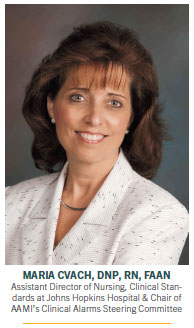
 “Major changes are needed to improve alarm management. Vendors need to improve alarm specificity — the trueness of alarms,” says Maria Cvach DNP, RN, FAAN, assistant director of nursing, clinical standards at Johns Hopkins Hospital and chair of AAMI’s Clinical Alarms Steering Committee.
“This may mean better alarm algorithms that manufacturers use to test their devices; and incorporating short delays prior to an alarm sounding to allow for alarm auto-correction when a HR or Pulse Ox momentarily changes due to artifact or patient movement,” Cvach says.
“We need multi-parameter device analysis to decide when an alarm should sound versus crossing a threshold momentarily. This means that we need for devices to use more than a single threshold breach to determine when to sound,” she says.
Like many health care systems, Rex Healthcare in Raleigh, North Carolina, took action to address the alarm management challenge.
“We began with collecting and reviewing our equipment database with select individuals from various areas of clinical responsibility; the committee then determined which systems and equipment should be targeted for improvement and which clinical areas having these systems would benefit most from our efforts to enhance the overall clinical alarm environment,” says Steven Bowers, CET, manager of Biomedical Engineering at Rex.
“The obvious choices for us became the critical care areas of Cardiac Intensive Care Unit, Medical Intensive Care Unit and Cardiac Thoracic Intensive Care Unit. We conducted alarm assessments and collected actual alarm data previous to imposing any intervention to validate our decision to focus on these clinical sites and departments,” he says.
Once they were validated, the biomedical engineering team ordered and acquired updated software for its monitoring assets, installed, tested, and then worked closely with clinical staff and vendors to drill down for the best alarm protocols for each area.
“Admittedly we went back a few times to make adjustments to protocols and monitoring set ups before we felt we had achieved the best case scenario for patient care while presenting a more effective and efficient alarm environment,” Bowers adds.
He says that soon after the changes were made, the department began sampling and taking data off its network to provide a clear picture of what the initiative had achieved.
“While everyone working in the ICUs had noticed a considerable change to their working environment, the data reports concluded that we had exceeded expectations. Our clinical ICU staff all report a much more staff- and patient-care-friendly environment and one that delivers a more safe, effective alarm notification system overall,” Bowers continues.
Indeed, during a 14-day review period, both pre- and post-intervention and after software upgrades, alarms had dropped anywhere from 26 to 48 percent in the units where the problem was confronted.
Clinician Suggestions for HTM
 What can HTM professionals do to aid their clinical counterparts in managing alarms in their facility?
Speaking as a nurse, Cvach finds these things helpful:
1.Providing us with regular data to see how we are doing with our alarm management strategy
2.Establishing back-up alarm management systems — secondary alarm notification systems — to ensure that alarms are heard.
3.Working collaboratively with nurses to customize default parameter settings based on the population served
4.Being a resource to acquire information from vendors regarding how to improve alarm management
5.Suggesting new strategies for future improvements.
The Caregiver’s Role
From nursing’s perspective, there are steps that can be incorporated into current protocols. One such practice, according to Cvach’s research, is for nurses to make “modest changes to monitor default parameters and empowering nursing staff to customize alarms for patient need resulted in large reductions in clinically insignificant alarms and a quieter environment.”
How does the nursing staff know how to tailor an alarm to a particular patient and
what parameters are employed?
“Nurses working with monitored patients receive in-depth training on arrhythmia recognition and management and are well trained to understand what arrhythmias are actionable for patients,” Cvach explains.
Cvach points out that nurses are also trained to critically analyze an individual patient to determine if the default monitor threshold settings — heart rate, BP, RR Pulse ox — make sense for that patient.
“For instance, if the monitor default heart rate settings are 50-120 bpm, but the patient has a baseline heart rate of 45 because of the medications they are taking, if the nurses didn’t customize the alarm setting for that patient, the low heart rate alarm would ring continuously for a non-actionable alarm,” she points out.
“So, licensed nurses use their knowledge and experience to make this determination. When needed, they can confer with other experienced nurses/MDs to help make the decision. The important thing is that when the alarm is going off, it means that an action is needed. If the nurse hears an alarm, and it is non-actionable, it needs to be readjusted for that patient.”
HTM has Been Active
 The HTM department has much to offer when it comes to data mining and report creation to aid in the alarm management dilemma. As more standardized protocols are adopted, this can be one of the areas of contribution from clinical engineering.
“At Huntington, Clinical Technology is the leader of the Clinical Alarms Management Committee and works very closely with all key stakeholders to support the NPSG,” says Izabella Gieras, MS, MBA, CCE, director of clinical technology at Huntington Hospital in Pasadena, California.
Huntington Hospital is part of the National Clinical Alarms Coalition, according to Gieras, which was established by the AAMI Foundation, Healthcare Technology Safety Institute (HTSI).
“In general, with the knowledge that the HTM departments across the country have on medical equipment, it is imperative that these departments be part of the clinical alarms initiatives in some form or another and many are leading these initiatives,” Gieras adds.
She says that her department has been able to reduce the overall alarm traffic, along with the accompanying caregiver fatigue, by evaluating alarm configurations.
“We are also updating our clinical alarms policies to align ourselves with the requirements of the NPSF and our discoveries,” she says.
“From pumps, we send monthly reports to an alerts review committee consisting of physicians, pharmacists and clinical analysts,” says Jeffrey Hooper, director of biomedical engineering at Children’s National Medical Center in Washington, D.C. The reports show the “number of soft and hard limit over-rides by drug type, [the] number of ‘guardrails’ over-rides when user determines to run outside the built-in protocols and the main goals are to assure ‘guardrails’ [are] being used and that all drugs are included in library,” he says.
Hooper also offers examples of monthly reports generated from monitors and provided to a multi-disciplinary alarm committee. These show the number of total alarms by type and by unit, the average number of alarms per patient per day per unit and the average response time for critical alarms, he says.
He also says that from Nurse Call, they send monthly reports to nurse managers for units showing the number of codes and response time and the average response for pillow speaker response to [the] time a nurse goes into [the] room.
Hooper also points out that their department has been doing this for about six years, so some of the newer initiatives are not yet changing what they do.
“However, it is an evolution as the data becomes stale and we have to ‘re-vitalize’ it to be sure it is valuable to the users,” he says. “We also store a lot of data for research purposes.”
Solutions and the Future
What are some solutions to this vexing problem? Cvach has some suggestions that will move the ball down the field.
“We need to rethink why patients are put on monitors to begin with,” she says. “If it is for arrhythmia monitoring, then standard physiologic monitors are OK. If it is for evaluation of vital signs such as HR, BP, pulse ox; perhaps we need surveillance monitoring which looks at trends in these measures over time, versus alarming for an isolated threshold breach.”
 “When a purchase is made for monitors, we need regular upgrades to these devices,” Cvach adds. “Because these are multimillion dollar purchases, the software needs to be upgraded routinely. And manufacturers need to be able to integrate with other devices (vendor neutral) to assure that hospitals can develop an alarm management strategy for the patient, no matter which vendor they purchase equipment from.”
Cvach also says that manufacturers need to develop better training guides — made for nurses, not engineers — and have practice tips on the device for reducing alarms and use of the equipment.
“Although AAMI-HTSI continues to contribute greatly to this very critical area of addressing alarm fatigue, there is still a lot of work required to educate the clinicians as well as organizational leadership as to the real problem of alarm fatigue and the reason that The Joint Commission set up the National Patient Safety Goal,” says Shashi Avadhani, regional vice president, Crothall Healthcare Technology Solutions.
“I have experienced numerous facilities where the understanding of the NPSG is quite different from what it was intended to achieve. I would definitely say that the AAMI-HTSI webinars went a long way, but there still remains a lot to be achieved,” Avadhani adds. “My goal as an HTM professional is to continue to educate as well as work with nursing and organizational leadership in the hospitals to address this very important aspect of alarm fatigue, and to increase the effectiveness of patient care.”
In general, Cvach remains optimistic that all stakeholders can make improvements as attention remains focused on solutions to this issue.
“I believe the future is bright if we can get manufacturers, hospitals and engineers/IT to collaborate in partnership to make alarm management a priority,” she says. “We should learn from other industries who have done this successfully [such as] aviation [and] nuclear plants.”
