



Prior to World War II, volunteer aviators urged the formation of an organization that would incorporate civilians flying planes in the defense of the U.S. They reasoned that this would put their flying skills and planes to good use. Just prior to the attack on Pearl Harbor, the Civil Air Patrol was born. The attack boosted the necessity for the new organization’s mission. Thousands of volunteers took to the skies over the U.S. to log air miles in defense of the country.
During the war, the Civil Air Patrol (CAP) sunk two enemy submarines and saved hundreds of crash victims. President Harry S. Truman signed a bill that made the organization official as a benevolent, not-for-profit organization. Two years later, Congress passed the bill, making CAP an auxiliary of the U.S. Air Force. They also recognized the three primary missions of the organization; aerospace education, cadet programs and emergency services.
In pursuit of offering aerospace education, the CAP’s efforts are divided among two groups; their own volunteer members and the general public. Participation in these programs allow the group’s members to advance. The program teaches cadet level members as well as senior level members. The cadets build their knowledge of aerospace to progress through different achievement levels. The senior members are urged to use their knowledge as a resource in their local communities and school systems.
Additionally, CAP offers external programs to educators.
 “These workshops highlight basic aerospace knowledge and focus on advances in aerospace technology,” according to the organization’s website.
CAP also saves approximately 75-100 lives every year through its search and rescue missions. The group has more than 55,000 members.
The cadet program focuses on aviation to train thousands of young people, ages 12 to 21. The program includes 16 steps. One of the volunteer instructors, who contributes to the success of the cadet training program, is an HTM professional in Fort Lauderdale, Florida.
“I have been in CAP for the past 10 years and have spent the majority of my time working with cadets, with some search and rescue thrown in.”
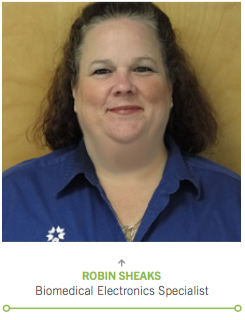
Robin Sheaks, a Biomedical Electronics Specialist in the Clinical/Biomedical Engineering Department for Broward Health has a decade of CAP experience.
“I have been in CAP for the past 10 years and have spent the majority of my time working with cadets, with some search and rescue thrown in,” Sheaks says. “When I was younger I wanted to be a teacher and work with children, then later in life I thought of joining the military. This gives me the opportunity to get a little of both and I love to volunteer.”
She holds the rank of major, but says that ranks don’t really mean much.
“I was never in the military but, I did try to join about 30 years ago, but I did not have a college degree at the time. I got my biomed training at Broward College in 1997,” she says.
She also says that she is not a pilot and she does not fly in the CAP planes, since she has a fear of flying, although that has improved over the years.
“I prefer big planes, not the little CAP planes. The three missions of CAP are Cadet Programs, Emergency Services and Aerospace Education. I actually started volunteering because my son was a member,” Sheaks says.
EXPANDING YOUNG MINDS
Helping to shape the minds of the next generation of aviators, or at least instilling a knowledge and respect for aviation and much more, is one of the things that Sheaks has most concentrated on as a CAP volunteer.
“Cadets can join as young as 12, and as long as they join before they are 18, they can stay a cadet until 21,” she says. “Some of the projects I have worked on are encampments which are a one-week training mission at a military base where cadets learn many things such as drill, customs and courtesies and lots of extras depending on the base, such as repelling and leadership reaction course.”
Sheaks says that cadets must attend an encampment to progress to a cadet officer rank or attend any of the special activities that are offered all over the country. She says that the cadets actually staff and run the encampment and that senior members are there for guidance.
“I took a 13-member drill team to Oregon in 2009 for a national competition, where we placed third out of the (whole) country,” Sheaks says.
“I was a Squadron Commander for five years and my squadron sent care packages to the 332nd Expeditionary Medical Support Squadron biomeds. I even designed our patch from theirs, even though I am a University of Florida fan, and their patch has a huge bulldog on it,” she jokes. “I also incorporated their motto ‘Whatever it takes’ in our design.”
Sheaks says that while there is no commitment to the military once cadetsage out, many cadets do decide to join one of the branches — not just the Air Force. “I have prior cadets in West Point, the
Air Force Academy, Marine OTS and the Citadel,” she says.
“Many commit to one branch and join ROTC so when they graduate they are an officer and will transfer right into the service. Some cadets join just to get their service hours to graduate,” she adds.
As a biomed electronics specialist, Sheaks helps bridge the gap with IT.
“As for my job, I am the IT Liaison for my department and I also specialize in vents and EEG,” she says. “I also do all of the drug library pushes for our infusion pumps.”
Many of the next generation of well-trained military members can thank this HTM professional for getting off to a good start. The continuing mission of CAP is to “save lives and preserve liberty,” according to the group’s national commander. With the help of HTM professionals, who give of their time, many organizations are able to meet their goals.
FIND MORE INFORMATION about the Civil Air Patrol at www.gocivilairpatrol.com.
