



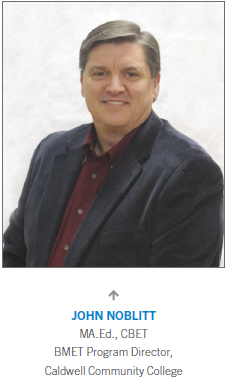
By John Noblitt
 One month the PMs are due on the infusion pumps in your facility and you have way too many PMs to perform. The next month your PM list is extremely short in comparison. When this happens you have a feast or famine PM scenario. Depending on how you look at it, you would have a famine in your time to do other things besides searching for infusion pumps in the first month and a feast in the second month for completing other duties. Some consider this to be the ebb and flow of your work cycle. One month you feast and the next you have a famine. This month you have a decrease in your work load followed by an increase in your work load and the cycle continues throughout the
This feast or famine or ebb and flow in work load is seen in many different industries. A great example may be a CPA each April when tax filing deadlines are fast approaching. Higher education also has its workflow follow these patterns of feast or famine as it pertains to student enrollment.
I have written fairly extensively about several issues related to the HTM career field and education. I’ve discussed how you may better prepare yourself or someone you know about seeking an outlet for educational services. I hope you have found the information useful. This article is about how you can help, but first a little background on higher education’s feast and famine.
Currently, in the community college system, we are experiencing a little bit of a famine when it comes to student enrollment. This is a natural feast or famine cycle experienced in higher education and is directly tied to the economy. Student enrollment in the community college system has an inverse relationship with the economy. When the economy is doing well potential students usually do not have time or a desire to enhance their job skills as they are too busy working. On the other hand, when the economy is not doing well and the job market is really tight, many folks find this to be a great time to return to school to enhance job skills and better prepare themselves for the limited number of jobs available.
The feast or famine analogy is applicable in regards to student enrollment, but with a sadistic twist. It has been my experience in 25 years of teaching in the community college system that when I have full enrollment there are a limited number of entry-level job openings. However, when enrollment is down there seems to be much better entry-level job availability. To illustrate this point, one major health care provider in my state has seven entry-level positions currently open. I can’t remember a time when one hospital system had that many entry-level positions ready for new graduates. However, this year we will only graduate 10 students. Unlike eight years ago when I had three times this many students but only knew of two entry-level positions in the state. So, we continue to feast on students when job availability is short and when the jobs are plentiful we endure a famine in regards to the availability of quality students.
This is where everyone in the HTM field can help. Steer that bright young kid into the HTM field. You know the kid I’m talking about, he or she was on your child’s baseball team or went to church with your family. Or how about the well-spoken young kid you see all the time when you are checking out at the grocery store. Odds are most of these kids have never heard about this career field. What better way to ensure the next leaders of the HTM field are of the caliber you would be proud to work with?
No one knows what it takes to be successful in this career better than each person reading this. When you see someone with the potential to be successful in this field, please take a moment to reach out. Inform them about this wonderful career field and all the wonderful opportunities that await them. Share with this person how you make a difference in the patient outcomes with your job performance and how they can experience that same type of satisfaction in their career. Please be proactive in helping choose tomorrow’s leaders of the HTM community so we can ensure a quality health care feast for all.
year.
