



By K. Richard Douglas

There’s just something about moving down a rural highway, on two wheels, with nothing separating you from the scenery except for possibly a face shield. Movies have been made about the carefree, exhilarating feeling of the open road on the back of a motorcycle. Many motorcycles are made just for that purpose; long distance touring.
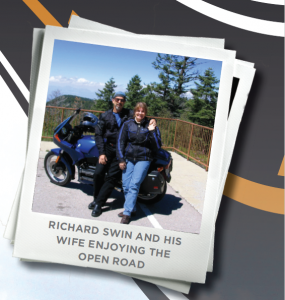
Richard Swim, CLES, MCSE, team leader of clinical technology in the Healthcare Technology Management Department at Baylor Scott and White in Dallas, Texas can speak in volumes about the experience. Swim has logged many a mile on the back of a couple of touring motorcycles over the past 11 years. Yet, for Swim, it all started many years before.
“I started riding off-road motorcycles when I was 14 years old in Abilene, Texas. While in high school and college, motorcycles were a primary mode of transportation. I’ve owned Hodaka and Bultaco dual sport and trials bikes,” Swim says.
“On the street, I put many miles on a Honda CL450 and a Kawasaki KZ750. Those last two got me through my college days and my start of work in the industry. After I started my full-time job in biomedical engineering — now HTM — I always wanted to tour the mountains and ride long distance. But work, finances and personal commitments never allowed those long road rides,” Swim recalls.
Swim took a brief hiatus from his hobby, saying that he and his wife had two “wonderful children” and he put motorcycling aside until around 2006.
“My son was going into college, and I had more expendable time. That’s when I started working on my desire to tour long distance,” he says.
“When I was in high school, BMW motorcycles always caught my attention as reliable and well-designed machines for distance touring. Back then, there was no way I could afford one. And in 2006, I still could not afford a new BMW, but I was stuck on the idea of finding a K75RS. I could not find a K75RS in the Texas area and wound up buying one from the Pittsburgh area,” Swim adds.
On a business trip to Pittsburgh, a couple of years later, Swim visited with the former owner. He says that there is a tight community of BMW motorcycle owners who share technical and travel tips.
 Racking up the Miles
Since returning to the open road in 2006, Swim has visited 35 states and Canada. He has made these trips with fellow riders and on solo treks; always stopping to take pictures along the way.
“I rode 41,000 miles on my first BMW and have logged another 89,000 miles on my K1200RS, that I acquired in 2010. A lot of these miles were with trips organized by my local riding club. Motorcycling is a very social sport, both on the bike with radio communications, and off the bike, sharing ride stories,” Swim says.
He is a member of the Lone Star BMW Riders. Back in 2006, Swim discovered the club and learned that they were “devoted touring motorcyclists that were friendly to all riders of any make of bike.” He found the club members to be friendly and willing to share knowledge and their experiences.
“I think that I rode roughly 50 organized events with the Lone Star BMW Riders. Some were solo and on other trips my wife joined with me and other couples,” Swim says. “These organized rides were a mix of day trips and week-long journeys through twisty mountain roads and wide-open plains. Through these organized events, with other more experienced riders, I too gained my own experience and self-confidence to venture out on my own.”
Swim says that traveling on two wheels brings a certain dynamic into travel that might be unique to motorcycle touring.
“There have been so many good trips being organized club rides, solo rides and trips that my wife and I took to north New Mexico and Colorado. I love the wide-open American West and have met travelers from all around the world. Motorcycling breaks down socioeconomic barriers,” Swim says. “When I stop for fuel, it is common for other travelers or locals to approach me to see where I have been or where I’m going.”
After seeing so much of the country, the backroads and rural highways, it is hard to single out just one experience as being the most scenic or exhilarating. One trip does stand out though.
“One of the most interesting trips I have done was a 14-day, 6,500-mile ride into Canada and down the Pacific Northwest. This may have also been my start of long-distance riding,” Swim says.
“My local club left two days earlier than me, and I joined them in Banff, Alberta after riding 2,000 miles over several days. We rode together through the ice fields of the Canadian Rockies seeing elk and grizzly bears on the sides of the roads,” Swim says.
Swim split from the group to ride back into the states where his wife, Debbie, joined him in Seattle.
“Deb and I rode back up into Canada to Vancouver and took the ferry to Victoria. We rejoined my riding club in Washington, and journeyed Highway 101 to Coos Bay, Oregon. We split from the club and rode to Lake Tahoe were another of my riding partners, Tom, joined to ride with us. Tom and I continued on to Texas after I dropped Debbie at the Reno airport so she could get on back to home and work,” Swim adds.
Follow Along
If it seems like it would be nice to join Swim on some of these adventures, it is possible to do so in a virtual sense. Swim also has writing and photography skills and he puts those to use on a blog that documents his two-wheeled adventures.
“The blog was started as a personal journal of my trips. Over the years, I realized that many people follow the blog for various reasons,” he says. “They may not be able to do the rides I am able to, or they may be fellow riders that just enjoy the stories from the road. I do love photography, and the motorcycle gives the perfect method for ‘seeing’ that is so important in photography.”
Swim gives credit to another touring biker who has documented his adventures in a blog for inspiration.
“I have to attribute Bo Griffin [to] introducing me to long-distance motorcycling. I followed Bo’s ride reports while he traveled from Dallas through Central and South America to the southernmost point of Tierra del Fuego. Bo was a member of the Iron Butt Association and he competed in the 11-day 11,000-mile Iron Butt Rally held every two years,” Swim says.
On the Job
It’s not all travel adventures for Swim, he has to work to have funds for his trips . On the job, Swim works with his team and enjoys the daily challenges.
“What I do to support my motorcycling addiction is clinical system implementation project management. My team gets involved with construction of new nursing areas and hospitals where connected medical devices will be deployed. Examples are patient monitoring systems, infusion pump management applications and other connected devices where patient vitals are being transmitted over the network to patient electronic health records,” Swim says.
“I’ve been working with Baylor Scott and White since 1979- then Baylor University Medical Center. I have seen all aspects of medical device management from first-hand service on clinical laboratory analyzers to management of biomed teams to where I am now leading a system-level clinical engineering team,” he says.
“About the time I thought about leaving the biomed field, something changed in the industry where I felt I could leverage my experience in networking and clinical systems. It has very rarely been a uninteresting job,” Swim adds.
To follow along on Swims upcoming rides, or read more in depth about some of his past adventures, you can find his blog at http://NTMoto.net
