By K. Richard Douglas

Located in the Bay Area of California, the city of Pleasanton is a suburban enclave about 25 miles east of Oakland.
One of the leading health care providers in the city is Stanford Health Care Tri-Valley, part of Stanford Medicine. It is affiliated with the nationally known university.
A member of the Tri-Valley biomed department leadership is Assistant Manager Renato Castro, CHTM, CBET.
Castro’s early interactions with members of his local biomed association influenced his decision to enter the profession.
“I originally was going to go into computer engineering technology at DeVry. One of the counselors showed me a presentation on the biomed profession. I was interested and switched to that program. While in school, the dean had close ties to our local professional biomed society (the California Medical Instrumentation Association/CMIA) and encouraged students to attend. At these meetings I got to interact with leadership and technicians at different hospitals. Seeing how passionate these individuals were assured me that I was making the correct decision in pursuing this career path,” he says.
Castro attended DeVry University and earned a Bachelor’s of Science in Biomedical Engineering Technology.
“These classes included general electronics hands-on work, a lot of electrical engineering theory, a bit of biology/chemistry and programing. When I entered the field, the general electronics courses I took helped with understanding some troubleshooting, however I was still mostly a blank slate and needed a lot of on-the-job learning,” Castro says.
Upon graduation, Castro went to work for an ISO, and through happenstance, ended up working for his current employer.
“I started my career as a BMET 1 with Renovo Solutions stationed at a 200-plus-bed community hospital (ValleyCare Health System). Here, through attrition, I was quickly promoted to BMET II and site lead,” he says.
Castro says that a few years into the ISO’s contract, the hospital was acquired by a university health care system; Stanford Health Care.
“This new system had an in-house biomed program, so the contract was terminated, and a new in-house program was created. I seemed to have made a positive impression to the department leaders as I was recommended to be brought back and join the new in-house biomed team as a biomedical equipment technician/shift lead. During this time, I acquired my CBET (Certified Biomedical Equipment Technician) certification which allowed me to be promoted to a Certified Biomedical Equipment Technician,” Castro says.
He says that after a couple years with Stanford, he was offered the opportunity to enter operations management and become the biomed site manager with the third-party company Agiliti at Alameda Health System.
“This had me manage the biomed program for three acute care hospitals, a psychiatric hospital and a dozen clinics. After a couple years I was offered the biomed manager position for the Central Valley Market for Tenet Healthcare. This market included three acute care hospitals, a psychiatric hospital and a couple of clinics,” Castro says.
More recently, Castro was notified that the original community hospital (ValleyCare Health System which had since changed its name to Stanford Health Care Tri-Valley) had an opening for an assistant biomed manager and that he was the top candidate for the position.
“My career has effectively gone full circle and allowed me to enter a leadership position where I started,” he says.
Association Affiliation from the Start
Projects have been a part of Castro’s career as both an assistant manager and a technician. One of those projects involved working with department leadership to create five-year capital replacement roadmaps.
“This involved me evaluating our inventory across multiple hospitals by both end-of-life/support status as well as general age of the equipment. I then created priority tiers to place each device. I also utilized ECRI for ballpark costs of replacement. This was our first draft which I took to each department manager/director to confirm clinical needs and adjust priority levels per our discussions. We then spread out the replacement costs of the top two tiers of priorities across five years to help create capital budgets,” he says.
As a technician, one of the bigger projects he was involved in was transitioning from older GE CIC patient monitoring to Philips PIIC iX.
“This had me assisting with installation technicians in setting up a brand-new monitoring solution without taking down the old system. We tested each new pulled cable (we had old infrastructure and needed all new cable pulled for each bedside and central monitor). Throughout the project I was able to learn a lot about how the system works from the installation specialist which made it easier for me to support the system in the coming years,” Castro says.
 Off the job, Castro enjoys being active and spending time with family.
“I have a wife, Janine, and a 6-month-old daughter Gaby (short for Gabriela). My mother-in-law lives with us and helps provide child care. I am close with my parents and little brother,” he says.
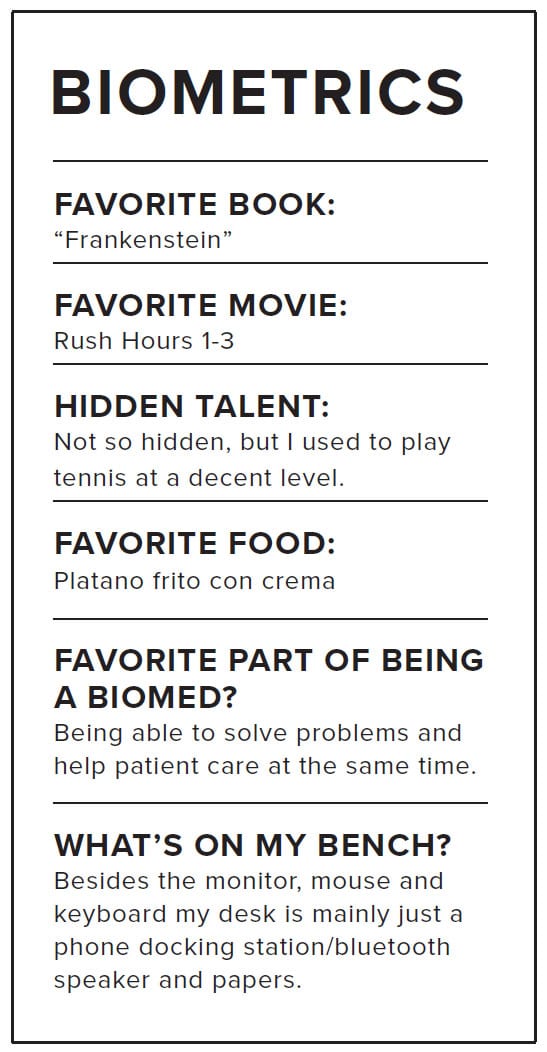
“I love to play tennis any chance I get. I am also an avid soccer fan, following both F.C. Barcelona and Manchester United. I am also a gamer,” Castro adds.
Castro has also been active in his local biomed association; the same group that influenced his career choice.
“I have been an officer with Bay Area Chapter of the CMIA for six years now. From vice president to president to now a board member. I enjoy our chapter meetings and conferences for networking and the opportunity to see old friends/acquaintances again. I also love keeping up with the field and learning how our industry is progressing,” he says.
Castro’s career and association affiliation came full-circle and, in both, he has found success.