



By K. Richard Douglas
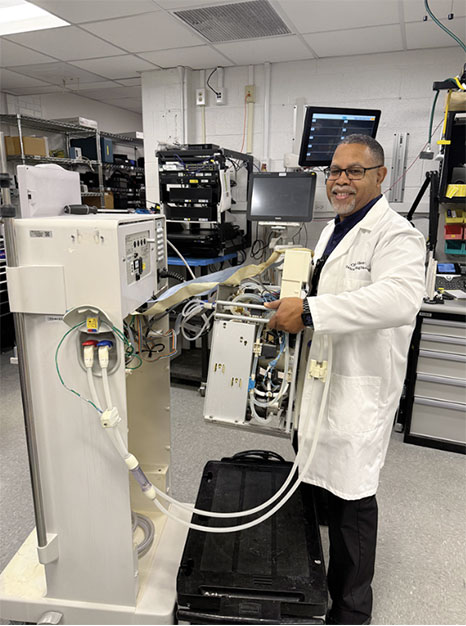
More than 20 years ago, mission trips to two developing countries sparked an interest in HTM for one biomed.
“When I was in my 20s, I used to go on mission trips all over the world, remembers Chris Shores, a clinical engineering tech II in the Department of Clinical Engineering at Fairview Hospital in Cleveland, Ohio. Fairview Hospital is a part of the Cleveland Clinic system. Back in 2004, we went to a small village not far from Guatemala City. They [had] only had electricity for a year and that sparked my curiosity. As time moves on, who will work on their electronics or power when it goes down or malfunctions?
In 2006, I went to Ghana. I asked our driver ‘Who works on the hospital equipment when it malfunctions?’ I know they receive donated medical equipment from other countries, but who repairs them? He told me they don’t have too many people, if any, to work on them. He shared that they need help in those regards.”
Shores went on to get his formal training to enter HTM and transition from his former occupation.
“In 2013, I received my degree in electrical engineering technology. Before that, I was a state tested nursing assistant for 15 years at a nursing home and a patient care nursing assistant for three years at Cleveland Clinic Hospital,” he says.
Since entering HTM, Shores has been advancing with a goal to continue to reach new heights.
“I started as a tech I and now I’m a tech II. I’m currently trying to be the next work leader for the West Region of Cleveland Clinic,” he says.
Shores says that he has a focus on dialysis as an area of specialty.
“I’m the only one in the West Region Cleveland Clinic who works on dialysis. I take care of echo, EKG, lab, pharmacy, multi-specialty, neurology, cardiac rehab and cancer departments (radiation oncology, hematology oncology, breast health, breast surgical, chemo infusion suite),” he says.
PROJECTS & KEEPING THE BEAT
Many biomeds had their mettle tested during the COVID-19 pandemic when circumstances required resourceful thinking, out-of-the box ideas and stamina. Shores was involved in preparation and overflow management during this period.
“During the pandemic, I played a key role in ensuring our hospital was ready for patient surges. This included overflow planning: coordinated setup of additional patient care spaces to handle increased volume, monitor preparation: I configured and deployed extra patient monitors on mobile stands for rapid deployment in overflow areas,” he says.
He was also involved with IV pole procurement in which he ordered and distributed additional IV poles to support expanded treatment zones and equipment readiness where he ensured all devices were tested, calibrated and ready for immediate use in critical care environments.
Beyond pandemic-related projects, Shores has kept busy with other projects.
“I was involved in the shadow box project, Philips telemetry upgrades, new dialysis department relocation and expansion. I was involved in relocation of the clinical engineering supply room as well as Environmental Services’ storge relocation. Philips monitoring upgrades in OR, dialysis, and ICU. In charge of leading the West Region monthly Leader Guided Discussion (Avon Hospital, Lutheran Hospital and Fairview Hospital). I oversaw the phone upgrades for our department,” he says.
The shadow box project involved walk-throughs across the hospital and placement of shadow boxes which shows patient room and vital signs without breaking HIPPA.
“[I was] involved with Philips with what’s needed for the monitors. Making sure they all function properly and educating the rest of the clinical engineering team on purpose and repair. Worked with other third-party vendors on installation,” Shores says.
Away from work, Shores is most comfortable with a pair of drumsticks in his hands.
“I’m a percussionist! I teach two drum lines, I give private drum lessons and I drum at church. The first drum line I co-coach with my older brother, Ivan. The organization is called ‘The Deputies Club.’ It’s a baton and drum corps. This organization has been around for 44 years. We’ve performed in multiple countries, Cavs NBA games, parades, churches, Walt Disney, etcetera,” he says.
Shore met his wife, Rachel, in high school.
“She was in the KACP drum line with me back in the ’90s. We were reacquainted back in 2019. She’s a nursing supervisor for a rival hospital. She has two daughters and I have two sons. Her girls are 19 and 16 and my sons are 18 and 16. We raised our kids to be drummers; go figure. We have a three-year-old dog named Pearl,” Shores says.
He says that he loves working as a biomed. His mother was a nurse in a hospital, and Shores spent a lot of time around the hospital environment growing up. He actively tries to introduce the profession to young people.
“Hard work pays off and I’m still pushing forward to be an example for my children and anybody else who wants to pursue a career in saving lives through technology. I currently bring in high school students to see what I do and encourage the youth at the different drum lines I teach,” Shores says.
He has been a biomed for nine years, in healthcare for decades and has been drumming since he was seven. Shores has been an example of why practice and experience pay dividends with perseverance and focus.
BIOMETRICS
Favorite book:
Holy Bible
Favorite MOVIE:
“War of the Worlds” with Tom Cruise
Favorite FOOD:
Seafood boil
Hidden talent:
Empathy
Favorite part of being a biomed?
Saving lives through technology and bringing smiles to clinicians’ faces.
Why do you read TechNation?
Informative and encouraging
