


K. Richard Douglas
Those who took metal shop or woodshop, welding or auto shop in school often pursue a career in a trade. While these courses had been on the wane during the past two decades, they have reappeared under career and technical education (CTE) in many districts.
Those comfortable with working with their hands often got their first taste of working with wood or metal in a shop class and that includes Keith Hall, director of service, imaging, Western USA at RENOVO Solutions.
“I first became interested in woodworking in junior high. When I was much younger, I enjoyed disassembling pretty much anything I could get my hands on, and then reassembling it. Woodworking gave me an outlet to create unique things from raw materials,” Hall says.
He adds that the first skills he learned were using lathes and the tools used to shape wood.
“These oversized chisels can be quite dangerous and my shop teacher spent considerable time demonstrating how to safely use them. This is a skill that I instantly felt connected to, and that I have honed over time. Today, one of my favorite things to do is turning a raw log or chunk of wood into whatever shape speaks to me; sometimes it’s a vase, sometimes it’s a bowl, and, on occasion, it’s therapeutic to simply turn the log into a pile of shavings,” Hall says.
He refers to this as a “Zen” activity, which allows him to reflect, organize his thoughts and find perspective on any issues that may be bothering him.
What tools are necessary to engage in woodworking as a hobby?
“At its root, woodworking can be simply defined as cutting wood from its natural form and reassembling the cut pieces to create a new object. If we assume this definition to be true, then woodworking at any scale ‘could’ be accomplished with a mallet, a hand saw, a chisel, and a working surface like a bench,” Hall says.
He says that these are the primary requirements, however, it becomes more convenient when you add power tools such as a random orbit sander, drill(s), table saw, miter saw, band saw, track saw (his personal favorite), planer, jointer, dust collector, vacuum, router table/hand held router, CNC, laser engraver, and many, many more.
Hall says that you can’t forget the safety equipment as well.
“I always wear eye protection, ear protection and run an air cleaner when I’m working in the shop. It’s easy to become complacent and it only takes a momentary error to lose part of your finger (Don’t ask me how I know), or damage your lungs or eyes, or worse”, he says.
Many woodworkers describe the hobby as therapeutic and Hall is no exception and says it is a benefit he gets from the hobby.
“I like the idea that something I created may still be around long after I’m gone. Akin to nearly all hobbies, this endeavor can be as simple or extensive as your heart desires. It’s possible to enjoy woodworking with only the basic hand tools. It’s also possible to spend tens of thousands of dollars to own every tool imaginable and to spend thousands more on a fancy workshop and exotic or specialty wood,” Hall says.
He says that he believes that he strikes a happy balance between cost and benefit.
“I rarely take on paid projects for others; I find that it dampens the enjoyment of the process. It’s not as enjoyable to be on a timeline or to be held to specifications for a project. I much prefer to build what I want to build, when and how I want to build it,” Hall adds.
When Hall joined the Army, he left woodworking behind for over 20 years. He eventually returned to the pastime.
“I have always had a love for creating new things from raw materials. During my 20+ years in the Army, it wasn’t practical to own my own woodworking tools (at least not the large ones like a lathe, bandsaw, table saw, or CNC). Upon retirement from the Army, I found myself sitting at a desk most days and my hands felt idle,” Hall says.
The yearning to work with his hands and build things returned.
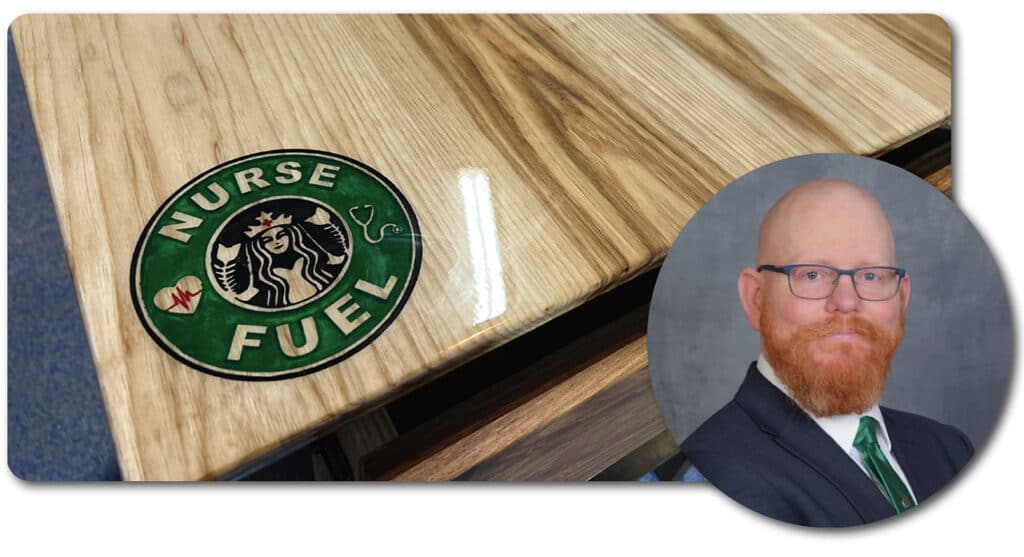
“I enjoy digitally designing a project in CAD and bringing those plans to life in the workshop. My wife casually mentioned that she was looking for a table for her office, so that she could put a coffee maker on it. This prompted me to make her a custom table, with a custom logo, sealed in epoxy resin,” he says.
MAPPING A MAP
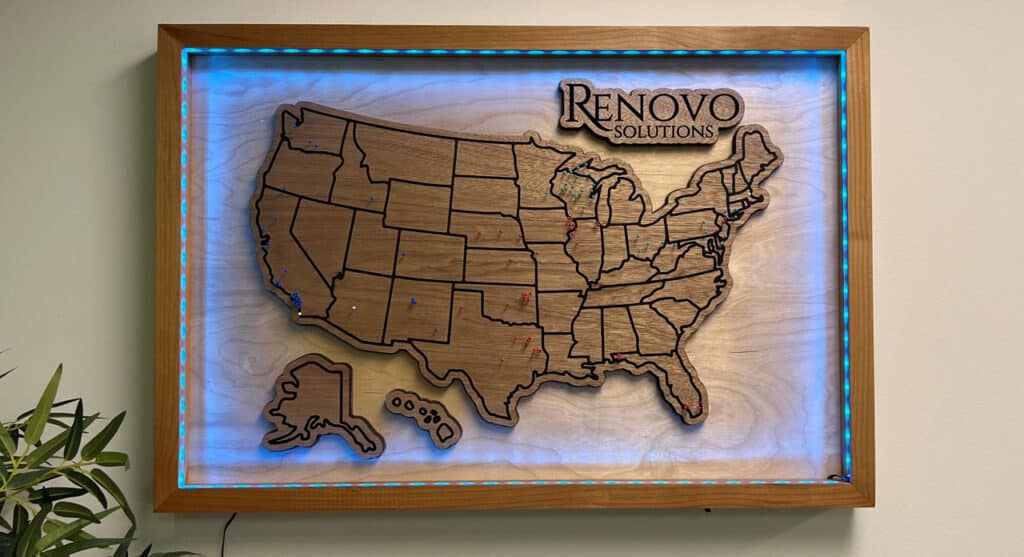
One of Hall’s projects that has a lot of visibility is a map he did for his employer. The wooden map hangs on the wall of RENOVO’s corporate headquarters.
“The idea to create the map came from my visit to our national headquarters in Irvine, California. It’s a beautiful space with our logo hanging on the walls in various ways throughout. I thought it would be nice if we could display where all of our customer sites are, using push pins. Maybe different colors for different regions. I mulled over a few ideas and shared them with leadership to get their buy in and we settled on a plan,” Hall says.
He says that to begin the project, he first built a map of the United States in CAD software and scaled it to the size he needed.
“Using my CNC machine, I cut out a test of the map and made minor corrections. Once I was satisfied with the result, I loaded the chosen piece of wood and masked the entire piece with special masking material so that when the machine made the cuts, I could paint the whole thing black. Now that the raw map had been cut out, I removed the masking and only the lines between the states were colored black,” Hall says.
To make the frame, he built a shadowbox frame for the map to sit in (recessed) and cut a groove around the entire frame so that he could recess LED strip lighting.
“I knew that mounting this large, heavy piece on the wall could be challenging, so when I built the frame, I included a French cleat on the back and the marrying French cleat was packaged and shipped with the frame. I mounted the map into the back of the frame, applied the strip lights and sent photos for final approval. The leadership team blessed the piece, so I carefully wrapped and packaged it and shipped it to headquarters,” Hall says.
With the mounting hardware in place, all that was needed at the headquarters was to install and level half the French cleat to the wall.
“Then, the entire frame slid down into place and is held very securely,” Hall adds.
In addition to woodworking, Hall is also involved in blacksmithing, laser engraving and 3-D printing. He is clearly a person who likes to work with his hands.
On the job, Hall is director of service, imaging, Western USA at RENOVO Solutions.
“I enjoy engaging with imaging service engineers and traveling to customer sites for in-person visits just as much as I enjoy developing national strategic service plans and participating on several internal and external HTM committees,” he says.
From knowledge of X-ray tubes to shaping wooden blocks and so much more, Keith Hall is a man who likes to work with his hands and understands others who do the same.
