



K. Richard Douglas
How many people consider leaping off of a 486-foot tall bridge as a celebratory act on their 73rd birthday? This is something that HTM professional Mike Chuma had planned on, but due to weather conditions and other conflicts it was delayed.
Chuma’s plan was to do a tandem BASE jump from the Perrine Bridge over the Snake River in Twin Falls, Idaho. The location is a famous BASE-jumping location because it’s the only man-made structure in the United States where BASE jumping is permitted year-round without a permit.
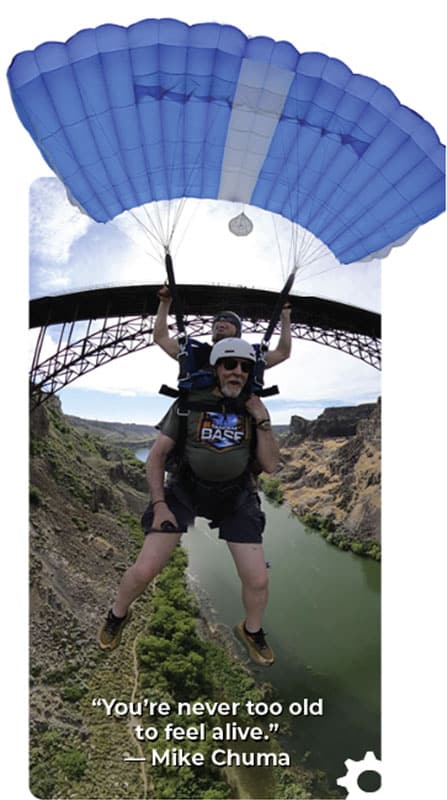 BASE jumping is an extreme sport where jumpers leap from high, fixed objects and deploy a parachute to descend safely to the ground. The name “BASE” is an acronym for the four types of objects jumpers leave from: Buildings, Antennas, Spans (bridges) and Earth (cliffs).
“My son called me and asked me the day before Father’s Day if I wanted to jump. So, we combined it into a birthday/Father’s Day jump and that’s how we did it. This jump was my third jump off of Perrine Bridge. I have also done two jumps off of KL Tower in Malaysia, both tandems with my son,” Chuma says.
Chuma’s son just happens to be one of the premier BASE jumpers globally.
“My son, Sean, is the pioneer of tandem BASE jumping. He is known as one of the best in the world with over 9,000 BASE jumps. I believe over 1,500, maybe more, are tandem,” Chuma adds.
What is required to do a tandem BASE jump?
“You have to be less than 175 pounds and that’s about it. He goes through the safety routine, what you need to do and all that stuff and then you go out to the bridge. He goes over everything again at the bridge and then you go out there and you try to stay home which is impossible and you jump. It is one of the most fascinating things I think I have done; everybody will enjoy it. You can also go to Moab, Utah, and jump and also Monte Brento, Italy, and jump,” Chuma says.
The Italian location has established strict requirements, although self-enforced, in order to jump there.
For solo jumping, Chuma says that taking a class would be a good starting point. He says classes require students to have many skydives. His son’s class requires 200 skydives.
“There are some people out there that teach BASE jumping with no experience at all; that is crazy. I have watched many people hit the trees and get hurt by not having any experience whatsoever. I did solos because my son is a base jumper. I did two and that’s about all I’ll ever do, because as other people watched, they wanted to let their friends do BASE jumps and it was too dangerous, so my son said stop and we did,” Chuma says.
In terms of safety protocols, Chuma says that with BASE jumping, there are no reserve chutes, so you really can’t make a mistake.
“Off of Perrine Bridge, six seconds you hit the water or the ground if you’re chute doesn’t open. There have been many people that get line tangled, they have to get out of it quick enough to not get hurt; some do, some don’t. The best thing to do in BASE jumping is not be stupid; most people that get hurt bad, or don’t make it, do stupid things,” Chuma says.
He says that there are very few that have fatalities that keep their head straight and stay calm.
“Not saying that you’re not going to get hurt. It is one of the most dangerous sports in the world. The biggest thing is packing your chute,” Chuma says.
He says that this is the primary safety protocol, and his son is very meticulous about it.
DOES EXPERIENCE COUNT?
Did Chuma’s previous jumps prepare him for the Father’s Day jump; especially at 73?
“I’m not sure a whole lot prepared me for my Father’s Day/birthday jump. Getting over the rail of the bridge every time is scarier than hell. It’s difficult because I am old and my body doesn’t bend and my legs were terrible getting over that rail. Your mouth gets dry, you look down you’re scared,” Chuma says.
He says that the experience with the rail was the same with the previous jumps.
“But once we jump, it’s the most fascinating sensation you’ll ever feel. I would do it again and again. I’m going to be scared as hell getting over that rail. Now I do plan to go to Moab, Utah, and jump off of a cliff and I do plan someday hopefully, before I get too old, to go to Brento, Italy and jump out there off of a 5,000-foot cliff. Will I be scared; hell yes!” Chuma says.
What extra challenges are there, even with a tandem jump, for a 73-year-old?
“I think the biggest challenge is, no matter who you jump with on a tandem skydive, a tandem BASE jump, you have to trust that person with your life. I used that analogy in a safety huddle to give a perceptive of a safety moment and I said patients need to trust us in the hospital as I had to trust my son on that tandem BASE jump,” Chuma says.
He says weather conditions are also a big factor.
“There are times we stood on the bridge for 45 minutes watching the wind. One of the good things about my son is, if he doesn’t feel comfortable, we walk off the bridge; that’s why I’m safe and alive today,” Chuma says.
What advice would Chuma give to someone contemplating their first BASE jump?
“If you’re going to do a tandem, investigate the person you’re going to jump with. There are several out there. Check them out, check their history. As far as doing your first BASE jump, have skydives and take a class from some reputable instructor. I highly recommend that before attempting to BASE jump,” he says.
Chuma has been in the biomed business for 54 years. He started out in the Air Force and then worked for ServiceMaster. He entered the management ranks, but later went back to work as a technician, which he considers a good decision.
“I have enjoyed my career; I wouldn’t trade it for anything. I would urge anybody that loves healthcare and being part of the system to go for it,” he says.
Take it from a 73-year-old who jumps off bridges; biomed is a good career. Anyone with the guts to jump off a 486-foot bridge is worth listening to.
