



By K. Richard Douglas
The healthcare industry is experiencing a profound transformation, propelled by a wave of technological advancements that are reshaping the way care is delivered, managed and experienced.
As healthcare looks to the future, the landscape is defined by the continued prominence of emerging technologies, with artificial intelligence (AI) remaining a central theme. Breakthroughs in biomedical technology are bridging the gap between scientific discovery and clinical application, ushering in an era of more personalized, efficient and data-driven healthcare systems.
The key trends and innovations poised to redefine healthcare and biomedical science include everything from AI-driven diagnostics to advanced regenerative medicine and enhanced cybersecurity.
Artificial intelligence and machine learning (ML) stand as one of the most exciting and promising technological advancements in healthcare, significantly improving the speed and accuracy of diagnostics. AI algorithms are capable of analyzing vast datasets, including medical imaging, genetic information, and electronic health records. It can identify patterns and predict disease outcomes with unprecedented speed and efficiency.
The AI revolution will shape the future of medicine for clinicians and patients and find applications in HTM that are already changing the way things are done in the biomed shop.
For clinicians, AI is already aiding in patient care. In diagnostics, AI-powered tools are becoming increasingly adept at interpreting medical images like X-rays, MRIs, and CT scans. In some cases, it detects early signs of cancer and other conditions more accurately than human radiologists.
For instance, AI algorithms can swiftly process CT scans to detect pneumonia patterns.
Beyond imaging, AI models can predict wound healing by analyzing various factors and suggest optimal debridement methods for diabetic foot ulcers, leading to tailored treatment plans and reduced risks. AI is also being integrated into platforms for patient appointment scheduling, utilizing electronic health records (EHRs) to match patients with the most appropriate providers.
The biomed department, a repository of technology and tech-focused professionals, is a participant in healthcare innovations, along with trends and applications for new technologies.
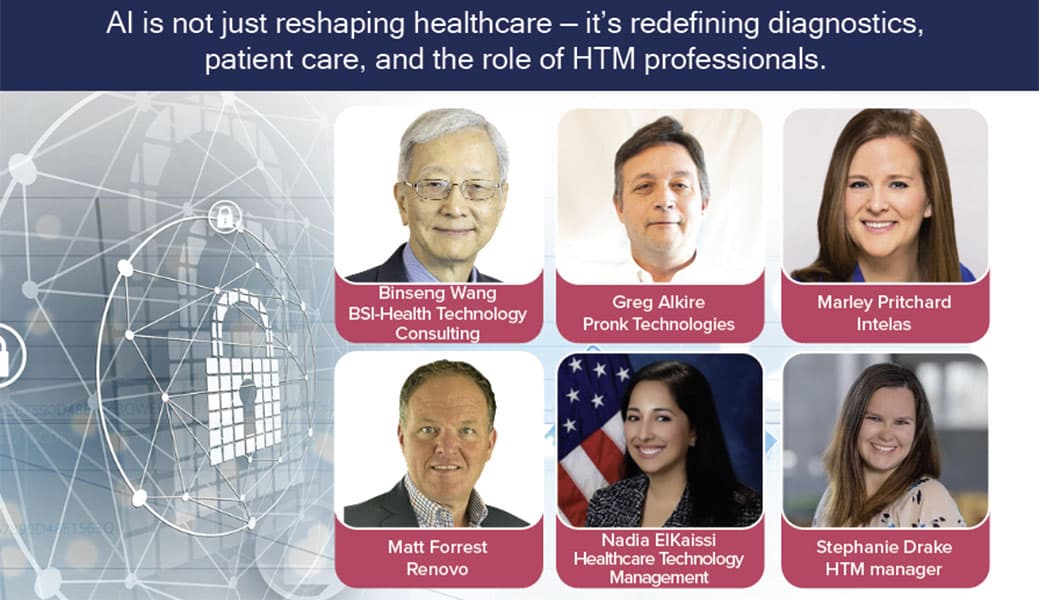
“HTM is developing into a proactive, strategic and data-driven field. In addition to being a biomedical equipment technician (BMET), the modern HTM professional also serves as a clinical technology integrator, cybersecurity steward, and strategic asset manager, making sure that the entire clinical technology ecosystem is secure, safe, effective and efficient,” says Naveed Ahmed Khan, assistant maintenance manager at Saudi German Hospital in Riyadh, Saudi Arabia.
AI’S MANY APPLICATIONS
In any discussion of trends or emerging technologies in HTM, it is hard to ignore AI as the leading topic.
During the early days of the Internet, it wasn’t recognized that the technology would be world-changing. Today, with more of an understanding of technology, millions understand that AI is a game changer.
“One of the biggest trends in HTM is the growing application of artificial intelligence (AI) to predict equipment failures, optimize maintenance strategies, and enhance overall reliability. Alongside AI, connected devices and remote diagnostics are making it easier to support equipment across multiple sites, and cybersecurity is now front and center as everything becomes more networked,” says Nadia ElKaissi, CHTM, biomedical engineer with the VHA Office of Healthcare Technology Management.
Khan says one AI trend is predictive maintenance.
“In order to maximize uptime and resource allocation, maintenance is moving away from reactive and scheduled procedures and toward predictive ones,” he says.
He says that HTM’s additional duties will include analyzing warnings produced by AI to rank interventions and overseeing novel predictive analytics.
“I believe AI/ML will become more commonly used for continual monitoring of equipment condition and failure diagnostics with minimal, if any, human intervention, thus leading to remote predictive maintenance,” says Binseng Wang, principal consultant, BSI-Health Technology Consulting.
He says that this will make most planned/scheduled maintenance obsolete and will significantly reduce failure rates and downtimes, with significant benefits to the healthcare delivery organizations.
“Unfortunately, this approach is only available for OEMs due to the access control they have on their embedded software – aka ‘privileged access’ – and therefore, will further limit the service ability of in-house teams and ISOs,” Wang adds.
AI may also lead to more HTM intervention in the home healthcare area.
“AI is being used with remote monitoring to make sure patients who need 24-hour surveillance are being watched by a camera instead of having to pay for a person to sit in the room and watch. This can be used with suicide patients or those who are a fall risk,” says Allison Woolford, M.S., CBET, clinical engineering-operations manager at Duke Raleigh Hospital and Duke Regional Hospital, part of the Duke University Health System.
She says that using AI in telehealth can help streamline which patients need to come to the emergency department or who can be seen at home.
“Their symptoms can be reviewed virtually, and treatment plans can be provided in real time for minor symptoms. No need to crowd the emergency department for the common cold,” Woolford says.
MORE ROBOTS
Other innovations in healthcare, which will impact medicine, and have already changed the surgical suite, are robotics and nanotechnology.
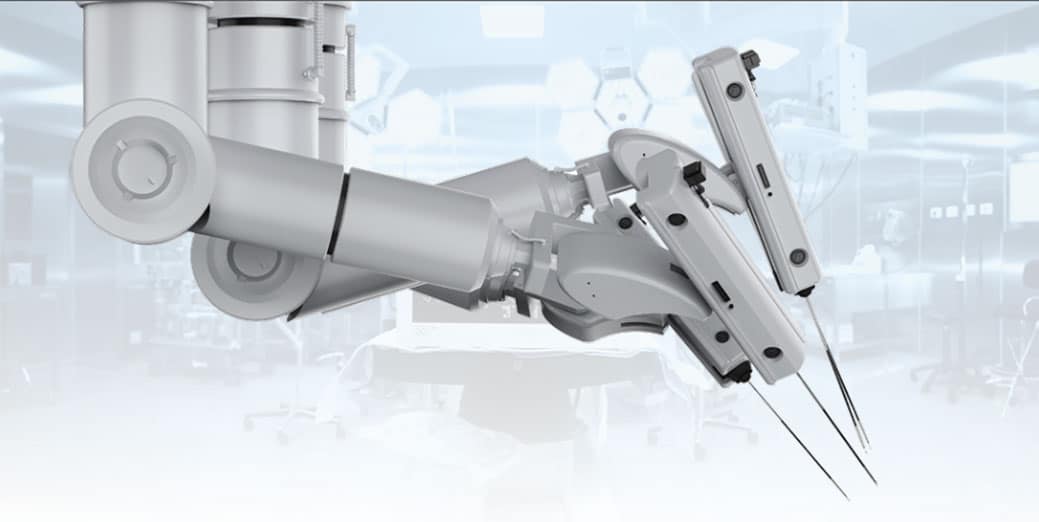
Robotics in healthcare is advancing rapidly, particularly in surgery, patient care and rehabilitation. Robotic-assisted surgery, exemplified by systems like the da Vinci Surgical System and a growing list of others, enables surgeons to perform minimally invasive procedures with greater precision and control, leading to reduced complications and shorter recovery times.
Diagnostic robots can accurately guide needles in biopsy procedures, improving specimen quality.
Beyond surgery, robots are being deployed to support medical staff by automating sanitation-related or supply management chores, protecting human employees from infection risks and burnout.
“The big name in robotics is Intuitive and the da Vinci robot, but Medtronic Hugo or Johnson and Johnson OTTAVA is trying to get into the game. Also, surgeons are opting to use more and more robots for their cases, saying that it minimizes downtime for the patient, which means the HTM community has to push harder for training,” Woolford says.
CYBERSECURITY REMAINS A FOCUS
Cybersecurity has become an unwelcome trend for HTM. The rapid digitalization of healthcare brings significant cybersecurity challenges. Health system ransomware attacks nearly doubled in 2024, affecting over 1,000 U.S. hospitals and impacting millions of people.
The February 2024 cyber-attack on Change Healthcare highlighted the extreme interconnectedness and delicacy of the entire healthcare ecosystem, disrupting operations nationwide and revealing vulnerabilities.
HTM plays an important role in mitigating threats and the safe networking of medical devices.
“The single most important force behind change is cybersecurity. Digital vulnerabilities are being included in device safety, in addition to physical dangers,” Khan says.
He says that HTM can do its part and find unpatched devices by doing vulnerability scans. Also, coordinating patch management with healthcare teams and vendors to guarantee effectiveness and safety. Dividing up medical devices on secure networks in cooperation with IT and joining incident response teams if a cybersecurity intrusion involves a device.
Companies are now beefing up security, scrutinizing technology vendor partners, and increasingly deploying AI and machine learning tools to detect abnormal network activity that could signal a breach. The downside of AI enhancement is its potential exploitation by hackers to create sophisticated malware and hyper-realistic social engineering attacks, necessitating high-end data protection mechanisms.
Adherence to regulations like HIPAA and annual cybersecurity checks are crucial to preventing data breaches.
“Although there are few proven cases of attacks through medical devices, there are numerous gaps and holes that would allow such attacks to happen without warning. Unfortunately, this challenge is draining significant HTM resources everywhere, thus limiting the ability of HTM professionals to think outside of the box and replace ‘doing the same old, same old’ with what is truly worthwhile doing, and putting the advancement of the field at risk,” Wang says.
REPLACING AN OS AND VIRTUAL TRAINING
In addition to the many potential applications of AI, cybersecurity advances and robotics are non-AI technologies including innovations in replenishing the HTM pipeline and retiring a major OS.
“The trend I am seeing rise is technical schools that offer a certificate for biomedical equipment technology. With more retirements happening, entry-level positions are more common. Employers would like to hire people with some basis for their education,” says Stephanie Drake, HTM manager.
She says that she knows an anesthesia tech who is attending an HTM school online that includes VR training, so he can go through the hands-on training without having to move to another state.
“I anticipate that many of these students will be receiving their certificates within the next year and looking to start working in the HTM field,” Drake says.
OEM support for operating systems has posed a challenge for HTM and IT in the past. That challenge re-emerges with the retirement of active support for another OS.
“End of support for Windows 10 and older models is approaching next month, which can be a problem for medical devices running on Windows 10 or older. Running older operating systems can leave facilities open to security vulnerabilities. However, nobody has the funding to replace all devices that are running on Windows 10 to Windows 11,” Woolford says.
ElKaissi says that AI remains a leading area of focus; but it’s not the only game-changer.
“Hospitals are also investing in smarter asset management to cut downtime, remote support tools to save time on-site, and stronger cybersecurity strategies to keep connected devices safe. These developments are enabling HTM professionals to reduce downtime, improve cost efficiency, and ensure that clinical technology supports safe and effective patient care,” she says.
INNOVATIONS TO HELP THE FIELD
Providers in the HTM space have their own perspective on what is hot in HTM today.
“At Intelas, we’ve focused on solving one of the biggest challenges HTM leaders face today – visibility and decision-making around medical equipment readiness, utilization and cybersecurity. Our solutions such as EquipREADY, EquipTRAX and CyberHub are designed to help hospitals move beyond reactive maintenance toward proactive, data-driven management,” says Marley Pritchard, vice president of client experience & strategy at Intelas.
She says that EquipREADY ensures critical devices are always patient-ready, reducing downtime and preventing care delays. EquipTRAX gives leaders real-time insights into equipment utilization and availability, which helps optimize capital planning and reduce unnecessary rental costs.
“CyberHub addresses the growing cybersecurity threat by providing hospitals with a clear inventory of connected devices, risk scoring and prioritized remediation pathways. By integrating these tools with our HTM service model, we help health systems tackle equipment availability, budget pressures and patient safety risks simultaneously,” Pritchard adds.
Other insights come from provider Renovo Solutions.
“The challenge: Hospitals are juggling dozens of service vendors, driving up costs and creating inefficiencies. Renovo’s solution: We consolidate contracts under one transparent agreement, delivering guaranteed savings and simplified management,” says Matthew Forrest, vice president of business development at Renovo.
Forrest says that another challenge is that many health systems want to keep in-house talent but lack specialized expertise or resources. He says that his company offers flexible hybrid programs to supplement in-house teams, or fully outsource solutions where needed.
In order to update or create devices or services, Pritchard says that her company is grounded in continuous client feedback loops.
“We gather input directly from frontline biomedical engineers, clinical staff, and health system executives through multiple channels: Day-to-day operator feedback, captured through our service teams embedded on-site,” she says.
Pritchard says that client satisfaction surveys come via platforms like ClientShare Pulse, which provides real-time, structured insights into service performance.
Another solution for HTM departments are automated detailed records.
“We have created smart, automated ‘checklists’ that address several issues that HTM departments face today. These bring huge time savings to very busy departments. They bridge the gap between testing per the manufacturers’ requirements in the service manuals – which can be confusing and very time consuming – and getting through a PM in significantly less time,” says Greg Alkire, vice president of business development at Pronk Technologies.
He says that the Pronk Mobilize checklists are dynamic, sending sequences to the test equipment from a single interface and wirelessly capturing all the work performed.
“The detailed records make it easy sailing during audits and, more importantly, ensure that medical devices are safe to return to the hospital departments,” Alkire adds.
As the biomed community enters 2026, the old observation “change is the only constant in life” will once again be confirmed. It really is healthcare technology with the emphasis on “technology” that remains hot and trending.
