



By K. Richard Douglas
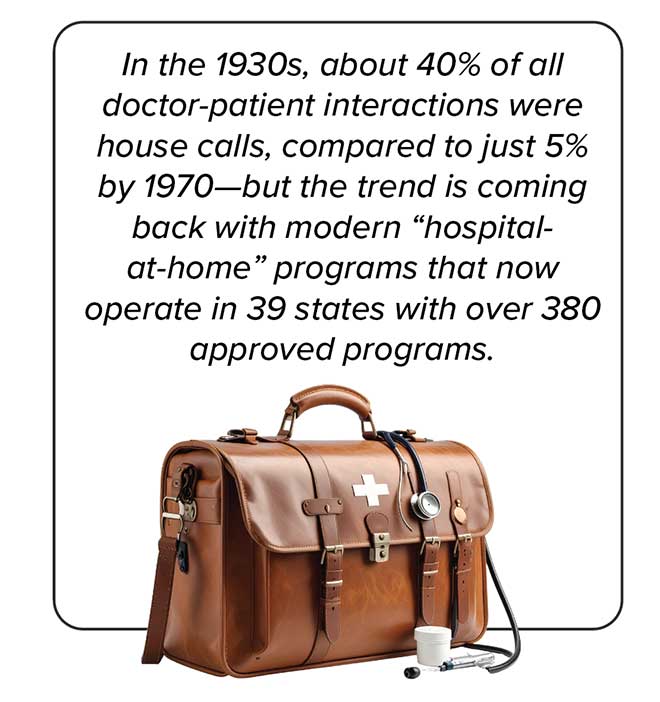
In 1931, it was not uncommon for a doctor to pay a visit to their patient at home. The house call accounted for about 40 percent of all doctor interactions with patients during the 1930s. By 1970, that number had dwindled down to five percent.
The house call made sense for many reasons including the patient’s comfort level, enhanced by familiar surroundings, the ability for family members to be nearby, the avoidance of hospital or doctor office expenses and relieving the patient of the need for travel or arranging transportation.
The downside was that the medical equipment available was primarily what the physician could fit into their black bag, the lack of more robust diagnostic equipment, the absence of specialists who might be required for many conditions and a method for continuous monitoring.
The concept of bringing healthcare services to the home has seen a resurgence since those house calls of the 1930s with the resurgence of the “hospital-at-home” (H@H) approach to home healthcare. This new care model recognizes advances in technology alongside an aging population.
The baby-boom generation accounts for 73 million people. That population has been aging and most are in their 60s and 70s, so the need for healthcare has increased with this aging demographic. The home care model may provide patients some relief from the cost of a typical hospital stay.
The benefits offered by the traditional house call remain a constant, with familiar surroundings, the presence of family members and home-cooked food all contributing to the wellness of the patient. In addition, the risk of many pathogens found in hospitals, and contributing to hospital acquired infections (HAIs) may be reduced.
For hospitals and health systems that have been early adapters of the hospital-at-home model, many provide hospital-level care in the patient’s home. The model can accommodate patients with a myriad of needs, including post-surgical care, wound care, urinary tract infections, dialysis, pneumonia, COPD and blood draws.
There are more than 380 approved hospital-at-home programs in 39 states. Patient outcomes are better than with a hospital stay with lower rates of complications and lower rates of readmissions as well as lower rates of mortality according to a CBS News report. The approach helps alleviate the over-crowding in hospitals seen during the pandemic.
 Some of these programs, like the “Advanced Care at Home” program administered by the Mayo Clinic, include a tablet which allows the patient to access a clinician through a video chat. It also shows scheduled appointments.
Other medical equipment in the Mayo Clinic program can include a blood pressure cuff, a scale, a SpO2 measuring device, a personal emergency response bracelet or necklace, a telephone that dials directly into the patient’s care team, a Wi-Fi extender and a backup power supply in the event of a power outage.
The hospital-at-home or home healthcare approach often requires that medical devices, often found in the clinical setting, are now present in a patient’s home. This brings an entire set of challenges and concerns that require oversight and maintenance workarounds.
Some medical devices that are found in home healthcare include dialysis, oxygen concentrator, blood pressure monitor, use of a CPAP or BiPaP machine, nebulizer and even a hospital bed.
ECRI, in its list of the “Top 10 Health Technology Hazards for 2025” posed the concern that supplemental oxygen can be a fire hazard, listing “Fire Risk in Areas Where Supplemental Oxygen is in Use,” as a potential hazard.
Also, the organization listed “Unmet Technology Support Needs for Home Care Patients” as a concern. ECRI pointed out that many modern medical devices are complex and in the home healthcare environment, this poses concerns when a lay person is responsible for operating a complex medical device.
The organization states: “Devices such as ventilators, dialysis machines, and infusion pumps traditionally have been used in acute care settings under clinical supervision but increasingly are being used in the home.”
Although the cost of home healthcare can be expensive, the cost of a stay in a nursing home can typically run $120,000 annually and a hospital stay of just a night or two can easily cost the patient and their insurance in excess of $10,000. Social Security only covers about 20 percent of nursing home expenses. Medicare will only cover nursing home expenses if the nursing home admission follows a qualifying hospital stay.
Telehealth existed before the COVID-19 pandemic, but it exploded during the pandemic out of necessity. The technology allows a clinician, either through a phone call or through a video chat, to converse with a patient, also often seeing vitals or engage in an assessment of the patient.
Consumer medical technology, including wearable technology, has increased in acceptance with fitness bands, smart watches, VR headsets, AI-powered hearing aids, smart rings and other devices gaining widespread use.
The hospital-at-home approach may put many biomeds outside their comfort zone. While many have experience as mobile techs visiting satellite clinics, the non-clinical environment of a patient’s home is another challenge. Those techs who were previously appliance or cable techs in a past life will find the routine more familiar.
Many hospitals have a home-health department responsible for providing home-based care and the devices sent home with patients. Major retailers, such as Best Buy Health and Amazon One Medical and Amazon Health, have entered the home healthcare market.
HTM AT HOME
If it involves medical equipment, HTM has some involvement. Much of HTMs involvement with the hospital-at-home healthcare model may unfold in the future as the concept becomes a larger percentage of all care.
In a 2023 panel discussion at the Houston MD Expo titled “HTM-at-Home” the participants shared their personal experiences. The discussion, led by Carol Davis-Smith, president of Carol Davis-Smith & Associates, included Dave Scott, CBET, a senior biomedical equipment technician; Rafia Saqib, MSBE, LSSGB, a director of clinical engineering; and Rick Bowie, CBET, a director of clinical engineering.
The panel highlighted the different potential service models that may evolve to eventually become a standard. Davis-Smith posited; “What are the questions we should be asking?”
Davis-Smith pointed out in the discussion that the regulatory world for home health looks different than in the hospital. She asked the panel how they would now define the environment of care outside the hospital environment?
Bowie said that his first experience came at the end of the pandemic when his system was left with excess medical equipment and the question arose, “How do we warehouse this stuff?” That led to to the questions, “How could the stored equipment be used for a hospital-at-home program?” “Would equipment be shipped to the patient as replacements were needed or would there be a mobile van model?”
Saqib said the home health devices are easy to implement. She said that a lot of non-biomeds can implement the technology. She said that they would consider what type of person would be supporting the home health devices.
Davis-Smith asked what the panel thought of the regulator’s approach to home health. How does the environment of care extend to the patient’s home?
Scott said that most wearable devices are not covered under FDA regulations. With home dialysis, the tech must take contemporaneous notes: the water system in the home, an audit of the home environment, filters were changed, PMs were completed and this information is kept in a binder at the home health station. This allows TJC or state inspectors to review this information.
One participant speculated that even an ICU patient could theoretically be brought home as the model expands. He asked how there can be controls on the home environment? There are water and power requirements to be considered.
Davis-Smith cited ANSI/AAMI HA60601-1-11 as evidence that regulation of the home environment, at least in terms of electrical, is already in existence.
Another session participant pointed out that almost anything is available out in the market, such as on eBay. He said that in some cases, it may get to the point where the hospital sends equipment home with the patient and has the patient sign a waiver, so they simply keep the device.
Davis-Smith said that HTM can influence the implementation of maintenance.
Bowie pointed out that if a patient brings their own CPAP into the hospital, the hospital can regulate its use in the hospital for purposes of infection control since some of those devices are clearly not sterile. In the same regard, if the patient purchases a consumer-grade device from a retailer for use during home care, the hospital needs to have a policy that requires use of their equipment for quality of care.
He asked, “How do you educate the user, the patient or family member in proper use of the equipment?”
A MORE STREAMLINED MODEL
HTM may have more of an arms-length involvement in many hospital-at-home settings. That is according to Perry Kirwan, executive, clinical engineering, eQuip-Center for Clinical Technology Management at Sutter Health.
“Most H@H tech works with 1-800 tech support number who will troubleshoot the device, and if it’s determined to be a hardware failure, will just overnight a device to the home. Some models rely on the travelling care navigators to do the exchange and they are provided perhaps a handful of exchange devices to do the swaps,” Kirwan says.
He adds that he hasn’t seen too many models where a biomed team is deployed to do that kind of work unless the hospital has a model to supply the tech without or with minimal support from a technology provider.
“And frankly, that model isn’t very efficient unless you’re dealing with more substantial tech in the home, [like] home dialysis or patient beds,” Kirwan adds.
He says that most of the time, in cases of repair – the most efficient model for the patient is exchange – rarely will you see the service team attempt a repair in the patient home environment. It’s not zero but ideally you want to swap the device, ensuring it’s working properly, take the broken device and service it in a depot center away from the patient home. There are all kinds of reasons for that – safety, liability, infection prevention, etc.
“Because most H@H programs feature smaller, portable tech – these devices are much easier to swap in the field and in some cases the tech provider will just mail a replacement. Once the patient/family member receives the mailed replacement, they follow a fairly straight forward set of replacement instructions and then a 1-800 technical support line if assistance is needed,” Kirwan adds.
Kirwan says that the bigger challenge may be preventative maintenance. He says that otherwise, repair is relatively easy to conceive and deliver upon.
“Right now, a lot of tech manufacturers in the space have no recommended PM procedures/intervals with their tech. On solid state devices, you can kind of get away with that, however on things more mechanical, PM has to be considered and that’s not easy because it’s hard to schedule visits to the patient home on any kind of reliable basis,” he says.
He says that patients will call with a down device, however they are not a cooperative with a “working” device that just needs scheduled maintenance.
“Some models attempt to get the patient or patient’s family to bring the device into a service center and that service delivery model is moderately effective because the model assumes that the patient or family member has the level of urgency that matches the PM schedule,” Kirwan says.
He says that it is because of this that a lot of H@H models end up working like home health models where anything requiring preventative maintenance just waits until a patient has discharged from the program and then you do maintenance on the devices when they are checked back in to [the] distribution site and before they are given out to the next program admission.
CONSUMER DEVICES FOR NOW
Wearable technology will play a bigger role in healthcare as the accuracy and capabilities continue to increase. The fitness bands/watches, rings and even clothing are all able to monitor certain vital signs, even measuring heart rhythm, and capture arrhythmias, oxygen levels and sleep quality.
How will wearable technology change healthcare? Scott presented “Wearable Medical Technology: What does it mean for BMETs?” at the Houston MD Expo.
“I think it will help identify problems earlier and will put healthcare more in the people’s hands to take care of their own wellness. Right now, all the data from wearables doesn’t go anywhere. There are starting to be subscription services that wearable owners can subscribe to that will monitor their vital statistics and notify the wearer of concerns as they show,” Scott says.
He says that he thinks AI will play a big part in wearable technology in the very near future.
“More healthcare will take place outside the hospital. I think acute care will still take place at the hospital. Wearable tech and AI will make doctors’ jobs easier. There seems to be more of a shortage of doctors now. The wait times for appointments has gotten worse in the last few years and this in-home tech may help the process in the near future,” Scott says.
Most of the wearables that consumers purchase are only consumer-grade and would not be up to the higher standards required of medical-grade.
“I think when a patient is in the hospital, the patient will most likely be put on hospital medical equipment, but I’ve seen patients bring home-use BiPaPs and CPAPs to the hospital now. I could see hospitals having to make rules regarding the use of wearable devices in the future if it becomes a problem. Or possibly, it is the same monitoring system? It could be but isn’t today,” Scott says.
As the hospital-at-home care model increases in acceptance and use, the likelihood that an HTM professional will have some exposure to this delivery method will increase. There will be a role for the biomed, even if it doesn’t mean visiting the patient’s home. Like cybersecurity and wireless technology; it isn’t going away.
