


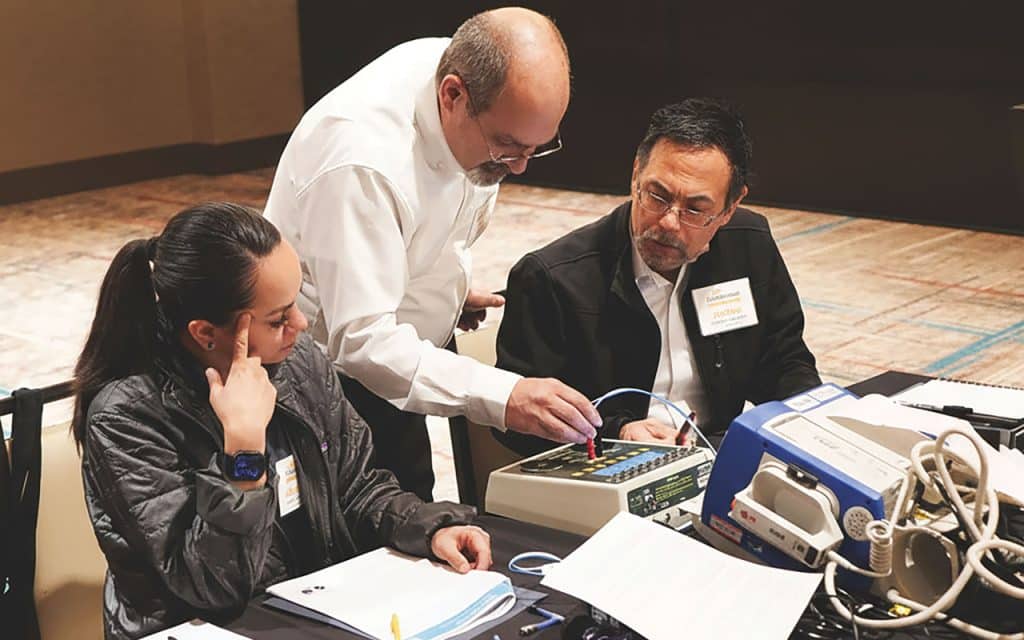
TechNation invited HTM experts to participate in this roundtable article focused on education, training, and apprenticeships in order to share their opinions with readers. The goal is to highlight challenges, successes and insights related to workforce development – how technicians are trained, how programs are evolving, and what the future holds for education in this vital profession.
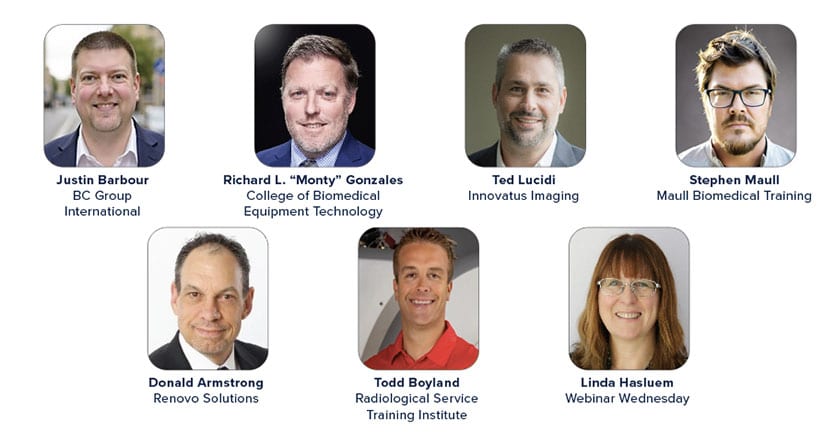
Participants in the 2025 Roundtable article on education, training, and apprenticeships are:
• BC Group International Director of Business Development Justin Barbour;
• College of Biomedical Equipment Technology President Richard L. “Monty” Gonzales;
• Innovatus Imaging Director of Commercial Operations and instructor in Penn State’s Biomedical Engineering Technology Program Ted Lucidi;
• Maull Biomedical Training LLC Owner Stephen Maull;
• Radiological Service Training Institute (RSTI) CEO Todd Boyland, CRES, CPSM;
• Renovo Solutions Technical Training Manager Donald Armstrong, CBET, CHTM, CABT, CRES; and
• Webinar Wednesday Marketing Manager Linda Hasluem.
Q: WHAT DO YOU BELIEVE ARE THE MOST CRITICAL SKILLS OR AREAS OF KNOWLEDGE THAT TODAY’S HTM PROFESSIONALS NEED?
BARBOUR: The most powerful skill we possess is also the one we often overlook: communication. It’s the foundation of every successful technician. Technical mastery means little if you can’t clearly connect with people. Each day, we engage with medical staff, administrators, vendors, contractors, patients and, yes, even the machines themselves.
GONZALES: In the rapidly transforming field of healthcare, the most critical skills for today’s professionals revolve around a fusion of technical mastery and adaptive expertise to address megatrends like AI proliferation, cybersecurity imperatives, and the demands of an increasingly varied field of necessary expertise. Foremost are proficiencies in emerging technologies – such as AI supporting predictive equipment maintenance, secure HIoT architectures for connected medical devices, and a nuanced understanding of advanced data analytics for life cycle optimization – which are indispensable for safeguarding patient safety. Complementing these are essential soft skills, including problem-solving, cross-disciplinary communication to align technical and clinical teams, and ethical acumen to empower HTM professionals. To cultivate a truly future-proof HTM workforce, three paramount training requirements must take center stage. First, blending curricula across biomedical, dental and veterinary device maintenance to foster versatile professionals who seamlessly service interconnected ecosystems, thereby reducing silos and enhancing cross-sector efficiencies. Second, expanding technicians’ roles via advanced certifications in diagnostic imaging, linear accelerator operations and other domains to enable proactive interventions beyond conventional pathways. Third, conditioning and equipping technicians for on-demand, just-in-time training through digital platforms, AR/VR and other innovative methods – prioritizing adaptive upskilling to align with fiscal realities and emergent demands, empowering lean teams to achieve more while transforming constraints into catalysts for innovation.
LUCIDI: As an instructor in Penn State’s biomedical engineering technology program, I believe that some of the most important skills for someone entering HTM are related to soft skills and customer service. We can educate most individuals on the how-to’s of troubleshooting, servicing and performing preventive maintenance. It’s more challenging to develop excellent customer service skills. Oftentimes in HTM, we have to fix the people, not the device. Many of today’s, and more of tomorrow’s, medical devices are and will be integrated into PC architecture. From a content perspective, students will benefit from programs that include content on PCs, networking and cybersecurity.
MAULL: The most important skill a BMET needs to have is ‘people’ skills. That is a skill that you kind of either have it or you don’t. Anybody can be taught how to maintain medical equipment, but it’s more difficult to make someone more of a people person than they currently are. You want the department to be glad to see you when you arrive, not be like, “Oh man, they sent Steve! I can’t stand Steve.”
BOYLAND: Today’s HTM professionals need a balance of technical proficiency, critical thinking and communication skills. As equipment becomes more integrated with networks and data systems, understanding connectivity, cybersecurity and interoperability is just as important as understanding the imaging hardware itself. At RSTI, we emphasize hands-on experience and root-cause troubleshooting because the ability to think through complex problems – not just follow a service manual – is what sets great engineers apart.
ARMSTRONG: While our field is highly technical, I believe the most critical skills for today’s HTM professionals are life skills – often called soft skills. Throughout my career, these have not received enough focus in training. If we can prioritize and empower our teams to develop and use skills such as communication, ethics, teamwork, openness, humility, willingness and a positive attitude, then technical training becomes much easier by comparison. Strong life skills create stronger, more adaptable technicians.
HASLUEM: Definitely communication – it should be the number 1 critical skill! Strong communication is vital for teamwork with hospital/clinical colleagues and vendors. Being a good problem solver is a good skill to have too. With the rapid advancements in healthcare technology, HTM professionals definitely need a varied blend of technical expertise. The HTM field has expanded far beyond traditional equipment repair to cybersecurity, data analytics, etc. so they need to stay current with the latest technologies transforming the industry. Here at TechNation, our Webinar Wednesday series has seen a big shift in webinar subjects over the past couple of years. Our traditional equipment webinars are still popular, especially our Tools of the Trade live demos, but the interest in our technical and IT skills webinars, especially cybersecurity, have generated a lot of interest and are always well received and attended.
Q: HOW EFFECTIVE DO YOU THINK CURRENT HTM EDUCATION AND TRAINING PROGRAMS ARE IN PREPARING NEW TECHNICIANS FOR THE FIELD? ARE THERE SPECIFIC GAPS OR STRENGTHS YOU’VE OBSERVED?
BARBOUR: In many ways, modern technician training has become more effective than ever before. Students and instructors now have access to an incredible range of resources that deliver the latest information in highly engaging and accessible formats (videos, whitepapers, safety recalls, social media and even AI-driven tools). Training materials and supplies are also more readily available than in the past. A thriving market for used medical equipment, along with affordable electronics components from platforms like Amazon and AliExpress, allows technicians to practice and refine their skills.
GONZALES: Key gaps include insufficient emphasis on core skills for emerging technologies, such as AI-driven predictive maintenance and HIoT integration, which hinders technicians’ proactive innovation; a lack of foundational training in ethics within healthcare technology management; underdeveloped skills in effective communication and customer service, essential for clinical collaboration and the adoption of a patient-centered approach; inadequate coverage of compliance and the evolving regulatory environment; pronounced deficiencies in cybersecurity and medical device integration, exposing graduates to risks in networked, data-vulnerable systems; and other shortfalls, such as limited focus on developing the next generation of HTM leaders. Bridging these gaps through industry-informed education and training programs is essential to equip technicians for resilient, forward-thinking contributions.
LUCIDI: I believe that the current content provided by most HTM programs is meeting the needs of the field. Today’s technology moves at an outstanding pace. It’s challenging for today’s institutions to “show” the latest technology. It’s important to focus on fundamentals, not the latest tech. Whether techs are testing the latest, flashy, new physiological monitor, or one that’s 10-15 years old, the same parameters need to be verified. Simulators change and monitors change, but the parameters being verified are the same. If an institution focuses on the fundamentals, it’s preparing students for any level of technology.
MAULL: I know that there is more help than ever before. Several companies are making training more accessible by doing the training remotely or bringing the training on-site, which is getting more and more common.
BOYLAND: HTM programs are doing a commendable job introducing the fundamentals, but there’s a noticeable gap between classroom theory and field-ready confidence – especially in advanced imaging. Many new technicians have the desire and baseline knowledge but need applied, real-equipment exposure to transition effectively into a service role. That’s where RSTI’s model excels – our training center houses more than 70 fully functional imaging systems and offers a 4:1 student-to-equipment ratio so every learner develops real-world proficiency.
ARMSTRONG: We believe that current HTM education and training programs are strong in developing technical knowledge, but there is a significant gap when it comes to preparing new technicians with essential personal and professional skills. Our Renovo internal training courses do an excellent job of covering the technical aspects of the role, which are both important and necessary. However, once new technicians enter the field, they often face challenges communicating effectively with clinical staff and hospital leadership – skills that require deliberate development. In addition, a strong understanding of safety and regulatory requirements is critical. We place great emphasis on ensuring our new technicians are well-rounded, combining both the technical competence and interpersonal skills needed to succeed in any environment.
HASLUEM: Here at TechNation, I hope that our Webinar Wednesday series helps prepare new technicians by providing more than foundational knowledge. Our webinars offer a wide range of topics which cater to all levels of abilities. I have noticed an increase in student attendees over the past couple of years, especially for our Tools of the Trade live demos, which have grown in popularity, so I hope that we are doing our bit to help prepare a new generation of biomeds for the field!

Q: DOES YOUR ORGANIZATION PARTICIPATE IN OR SUPPORT APPRENTICESHIP OR INTERNSHIP PROGRAMS?
BARBOUR: While BC Group International does not offer a formal internship program due to the sensitivity of our laboratory and manufacturing environments, we have a long-standing tradition of identifying exceptional individuals and developing them into outstanding professionals. Our company maintains strong relationships with many of the leading industry schools, and we actively support internships through training, mentorship and placement assistance.
GONZALES: Yes, the College of Biomedical Equipment Technology is deeply committed to apprenticeship, internship, and on-the-job (OJT) training programs, viewing them as vital bridges between students and our employer partners. Apprenticeships have ebbed and flowed in popularity over recent decades – once a cornerstone of skilled trades that declined with the rise of formal academia – they are now resurging as an attractive option for healthcare organizations seeking to build pipelines of trained technicians while managing budgets, with apprenticeships, pre-apprenticeships and hybrid OJT initiatives providing an effective means to achieve both. We have long championed the Association for the Advancement of Medical Instrumentation (AAMI) Apprenticeship Program. Our recent collaboration with American Healthcare Apprenticeships (AHA) has further enabled the college to expand its national reach, introducing students to HTM education and career pathways. Last year, we formed a partnership comprising AAMI, AHA, the college and HOSA-Future Health Professionals. This year, HOSA-Future Health Professionals formally introduced and launched a biomedical equipment technician competitive track for talented high school STEM students nationwide. We take great pride in this partnership and the opportunity to engage with the talented students participating at state and national levels and feel strongly that this initiative will fuel interest in apprenticeship opportunities.
LUCIDI: Innovatus, because of our specialized focus, is rather limited on the content that could be shared during a full apprenticeship or internship program. We are open to students shadowing our techs, but apprenticeship programs are best hosted by healthcare facilities and independent service providers with a wide scope of support. Students are best served by selecting an internship or apprentice program (or site) which offers exposure across the widest variety of devices and environments.
BOYLAND: Yes. RSTI proudly supports both DoD SkillBridge and GI Bill approved programs that provide pathways for service members and veterans transitioning into civilian HTM careers. These programs are structured around career-ready, hands-on imaging service training followed by industry placement partnerships with hospitals, ISOs and OEM-alternative service organizations. The impact has been tremendous – graduates leave with technical competency, industry certifications and a clear path to employment in an essential healthcare field.
ARMSTRONG: At Renovo, we run our own internal apprenticeship program while also engaging with AAMI’s national initiative. Our apprentices are typically recent graduates or second-career professionals new to HTM. They complete a six-month blended training program combining remote learning and on-site experience. After progressing through three phases and demonstrating readiness, apprentices are typically promoted to BMET I, with oversight from both the on-site and training managers.
Q: HOW CAN PARTNERSHIPS BETWEEN SCHOOLS, HOSPITALS AND INDUSTRY LEADERS IMPROVE HTM EDUCATION AND WORKFORCE READINESS?
BARBOUR: We are a community. Although we each play distinct roles within this skilled trade, our success depends on mutual support and collaboration. Through a robust digital network, we can instantly share information, ensuring trainees have access to the most current knowledge and the best opportunities as they enter the workforce. This bidirectional exchange benefits everyone. Companies gain access to highly qualified candidates, while schools receive real time feedback to strengthen their programs. Across the country, many schools, hospitals, and organizations proudly champion their local HTMA chapters, further reinforcing our professional network. Like any skilled trade, well-rounded technicians must cultivate a broad range of experiences to remain efficient and adaptable. Our community makes this possible by providing hands-on exposure that maximizes every technician’s potential.
GONZALES: One of my favorite quotes from Arthur Levine and Scott Van Pelt’s “The Great Upheaval” is that “some organizations will survive, and some will thrive” amid the complexities of our technology-driven society. The current transformation in higher education – fueled by industry, demographic, economic and technological shifts – is profoundly reshaping our approach to supporting the healthcare industry. To navigate such radical change, strong industry partnerships are not merely advisable but essential to achieving our mission. Strong relationships between the college and our industry partners amplify workforce readiness by fostering innovation, research and the iteration of training development to target gaps in workforce development and training aligned with the career pathways of today and tomorrow. Ultimately, such partnerships not only close skill gaps but elevate HTM as a profession responsive to changing expectations, producing adaptable professionals who enhance patient outcomes and operational resilience across the healthcare continuum.
LUCIDI: Partnerships between industry and education are vital to the success of HTM. As an educator, I only have a short, very limited time to expose students to a wide variety of medical devices. In fact, the content that students are exposed to in the classroom is most likely less than 10% of the devices they will encounter in the field. Many HTM programs include some type of internship within a healthcare facility. It’s my belief that HTM students would be best served by participating in clinical rotations throughout their education, similar to nursing and radiation technology students. Students would learn at an accelerated rate, and the healthcare facility would benefit from having additional HTM personnel.
MAULL: I have long thought the biggest hurdle to the growth of our career field was the lack of knowledge of the existence of our career field. The day I became a BMET (military trained) was the first time I had ever heard of a BMET. I was a college graduate and didn’t even know this was a job. Bryant Hawkins is a BMET who is doing a great job leading the charge in developing awareness of the HTM career field in middle schools and high schools. The associate degree for clinical engineering also appears to be making a bit of a comeback as well after many schools dropped the degree program over the last 15 years or so.
BOYLAND: Collaboration is the key to bridging the workforce gap. When schools provide foundational knowledge, hospitals offer clinical exposure, and industry partners like RSTI deliver specialized technical training, we create a comprehensive training pipeline that builds competent and confident professionals. These partnerships also ensure that training stays aligned with real-time industry needs from technology updates to regulatory compliance – so graduates are workforce-ready on day one.
ARMSTRONG: I serve on the EQ-WG05 HTM Educational Programs Standards Committee, where we work to standardize and strengthen HTM education to ensure students are well-prepared for success. Collaboration between schools, AAMI and industry leaders is essential to aligning training with real-world needs. Regular roundtables at conferences help us share challenges and successes, fostering a strong community dedicated to developing and sustaining high-quality HTM programs and graduates.
HASLUEM: Just continue to work closely together to ensure that future and seasoned techs get exposure to experts in the field. Webinar Wednesday will certainly continue to provide up-to-date education and information on products and services to the HTM industry.
Q: WHAT ROLE DO YOU THINK CERTIFICATION PROGRAMS PLAY IN ADVANCING HTM CAREERS?
BARBOUR: Every training program, certificate, degree and certification provides technicians with a way to demonstrate their proficiency and mark their professional achievements. While certifications alone do not define a technician’s worth or overall qualification, they do serve as a reliable indicator of a certain level of skill and competence.
GONZALES: Certification programs such as the Certified Biomedical Equipment Technician (CBET) and Certified Healthcare Technology Manager (CHTM) serve as pivotal accelerators for HTM careers, validating specialized expertise and signaling a commitment to excellence and lifelong professional growth. For emerging technicians navigating changing demographics and evolving workforce expectations, earning an AAMI certification offers a tangible pathway to credibility, enhancing employability as employers increasingly prioritize certified talent to manage complex, patient-centric environments. Certifications are widely respected professional credentials that underscore an individual’s dedication to continuous development and service to the industry. As an educational institution, the College of Biomedical Equipment Technology prioritizes equipping students with a thorough understanding of the credentialing process and its profound relevance to their career trajectories; to this end, we integrate AAMI certification preparation directly into our curricula through targeted content and discussions aligned with AAMI credentialing requirements. All graduates are strongly encouraged to pursue the appropriate AAMI credential, ensuring they enter the field not only skilled but also strategically positioned for advancement.
LUCIDI: I believe that certifications can help in advancing a career. Today, only a small portion of employers require certification as a condition for employment, and even fewer offer increased pay for achieving it. Seeing as there are no state or national-level requirements for licensure or certification (yet) and little to no salary incentive, I view certification as an activity pursued by those desiring to improve themselves. Certifications help elevate the individual. I value certification but would not commit to limiting employment offers to only those who are certified. When considering choosing between two individuals with similar experience, interpersonal skills and personal recommendations, the certified individual would be my choice.
BOYLAND: Certifications validate expertise and demonstrate a commitment to professional growth, but they’re most meaningful when paired with hands-on, practical experience. Earning a CBET or CHTM can open doors and provide recognition, but the real advancement happens when technicians continue to learn, adapt and apply new skills. We often encourage our students to pursue certifications after completing core training, so they have both the knowledge and the confidence to succeed.
ARMSTRONG: I’m a strong supporter of certification and its role in advancing HTM careers. Certifications like CABT, CBET, CRES and CHTM not only validate technical knowledge but also build confidence and professional pride. The CABT, introduced by AAMI as an entry point for students and newcomers, is a great way to start. As someone who has taught the CBET review course for several years, I’ve seen firsthand how certification transforms technicians – it shifts their mindset from having a job to building a career and a true profession.
HASLUEM: Every certification is important, as it encourages people to have a higher standard of competence and professionalism. Certifications validate skills, so we are proud that we can offer CE credits for our webinars, live and on-demand, to help biomeds advance in their careers. Added bonus – our webinars are free!
Q: LOOKING AHEAD, HOW DO YOU SEE HTM TRAINING AND PROFESSIONAL DEVELOPMENT EVOLVING IN THE NEXT 5-10 YEARS?
BARBOUR: I’m optimistic about the future of our field and the growing effectiveness of technicians, regardless of their initial level of training. With instant access to resources, technicians can now solve problems more efficiently and make data-driven decisions that reduce unnecessary contracts and parts purchases (ultimately lowering costs and improving outcomes). Advancements in tools, intelligent and intuitive test equipment, AI driven knowledge bases, and augmented reality technologies are transforming the learning curve, enabling even junior technicians to perform with exceptional effectiveness.
GONZALES: Over the next 5-10 years, HTM training and professional development will likely shift toward hyper-personalized, technology-infused models that harness virtual reality (VR) and augmented reality (AR) for immersive simulations of AI-driven device troubleshooting and Healthcare Internet of Things (HIoT) deployments – rendering education more accessible and scalable amid hospital financial constraints. This evolution will prioritize short-duration programs, micro-credentials and curated learning paths, enabling technicians to upskill in real time and ensuring a diverse workforce remains equipped to match the rapid pace of technological and healthcare advancements. Professional development will increasingly emphasize holistic competencies, seamlessly blending technical expertise with essential soft skills such as ethics, communication and customer service – areas often undervalued yet vital for success. As evolving expectations demand greater agility, hybrid apprenticeships incorporating remote mentorship will proliferate, lowering barriers to entry and retention. Ultimately, this trajectory will position HTM as a forward-thinking profession: resilient to disruptions and indispensable to the sustainability and efficacy of the U.S. healthcare system.
LUCIDI: As mentioned earlier, I believe that we’ll see HTM programs increase the amount of time spent in the clinical environment via internships and apprenticeship programs. No doubt, many in-person programs will transition to hybrid or to fully virtual training in combination with clinical rotations. With the huge vacancies in HTM, I believe it’s the most effective means of reaching the greatest number of potential students.
MAULL: There will be a lot of remote training via VR (virtual reality). With a headset, the student(s) can be in one city and the instructor(s) can be in another city but they can meet in a virtual classroom and perform operation and maintenance training on a virtual piece of medical equipment. The technology to do so is already here and is constantly improving; this method of delivering training will become more and more common in the coming years.
BOYLAND: The future of HTM training will blend immersive, technology-driven learning with experiential education. Virtual simulations and online theory modules will complement – but never replace the need for hands-on practice. We’ll also see greater emphasis on networking, cybersecurity, AI integration and multi-modality service skills as imaging systems become more interconnected. At RSTI, we’re committed to evolving right alongside the industry, ensuring that every technician – whether new to the field or advancing their career — has access to training that’s relevant, rigorous and impactful.
ARMSTRONG: I see technologies like virtual reality (VR), augmented reality (AR) and artificial intelligence (AI) playing a major role in the future of HTM training. I hope colleges and training programs adapt quickly to integrate these tools so our field stays ahead of the curve. HTM professionals have always been adaptable, and this will be another exciting evolution. I welcome these advancements – they’ll attract new talent and enhance how we learn and grow in this profession.
HASLUEM: I’m sure AI and VR will no doubt play a central role at some stage, but until that time Webinar Wednesday we will continue to provide continuous education for the HTM field as long as we are needed. 2026 will be exciting for us as we are adding two new ideas to our series – a Roundtable spotlight and Unlock and Learn series. I’m sure they will help our attendees with their HTM training and professional development.
Find out more at webinarwednesday.live.
