


By K. Richard Douglas
It’s a safe bet that some veterans retired to Florida over the years, either after a career in the military or after retiring from active duty and then retiring from a civilian career. For those who live in the Northeast and Midwest, Florida is a popular destination to avoid long winters.
One option in the Sunshine State is Orlando. Veterans can have their healthcare needs met at the Orlando VA Medical Center.
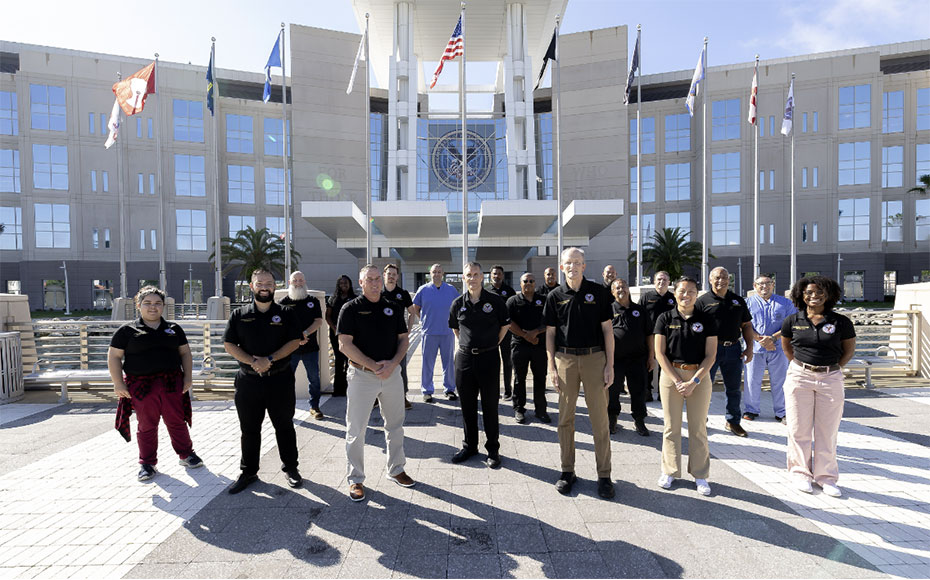
The facility’s competent group of HTM professionals comprises the Orlando VA Healthcare System Healthcare Technology Management (HTM) Department.
The team includes Supervisory Biomedical Engineer Paola Rivera; three lead biomedical equipment support specialists in Edward Reyes, MHA; Brian Whitaker; and Xavier Betts. The three staff biomedical engineers are Arael Monroe, Christine Motz and Stephanie Vazquez Hernandez.
“HTM supports the Orlando VA Medical Center at Lake Nona, which serves as the flagship hospital of the Orlando VA Healthcare System. This is a major VA facility providing inpatient, outpatient, emergency and specialty services to veterans in Central Florida,” Reyes says.
He says that the facility includes advanced diagnostic and treatment areas, outpatient clinics, a 120-bed community living center, mental health programs and more, such as MEAV of more than $141 million, with six MRIs, eight CT scanners, two LINACs, multiple new da Vinci robots and much more HTHC equipment.
The team also supports three outpatient clinics with full radiology, lab and pharmacy services, seven small community clinics and three vet centers throughout Central Florida.
Reyes says that the HTM department has one network-biomedical equipment support specialist who manages the servers and network modalities for the medical equipment.
MULTIPLE CHALLENGES ADDRESSED
The biomed team has been involved in a number of projects in recent years including the installation of equipment at a new facility and the custom interface testing of advanced imaging systems.
“In 2024, HTM was crucial in the relocation and opening of a new outpatient clinic in Daytona Beach. The previous facility was more than 20 years old and did not meet the needs of the growing patient community. The opening of the new clinic expanded services in the following departments: radiology, sterile processing, eye clinic, cardiology, audiology, and physical therapy,” Reyes says.
He adds that HTM managed the de-installation, relocation and re-installation of existing equipment as well as installation of multiple new technologies, some of which were new to the national VA hospital system.
The team faced the challenge with talent and dedication.
“When our HTM team managed the de-installation, relocation and new installation of equipment, there were several significant technical and logistical hurdles,” Reyes says.
Those challenges included coordination across multiple trades and departments.
“We worked closely with facilities engineering, IT, radiology, nursing leadership and external vendors to sequence work so clinical operations could continue with minimal disruption. That meant planning shutdown windows, staging equipment and confirming connections for power, data, gases and room integration systems before any physical moves started,” Reyes says.
Another challenge was dealing with new technology that was unfamiliar to the VA system.
“Some of the technologies being introduced were new to the national VA hospital system. This meant we had to develop detailed procedures from scratch rather than following existing VA playbooks. For example, advanced imaging systems and integration with our operating-room visualization/networking platforms required custom interface testing. Installation of new OR middleware systems that bring multiple video feeds and clinical data into one user interface,” Reyes adds.
Another project involved real-time location systems (RTLS) for asset tracking and wayfinding across the campus.
“For each of these, a key challenge was understanding vendor requirements, coordinating site readiness – power, structural, network – and validating that they worked within VA security and compliance standards,” Reyes says.
He says that the Orlando VA campus spans buildings of different ages and configurations. Integrating new systems into older electrical, network and physical spaces has required creative workarounds.
“We often had to source custom adapters, verify grounding and safety in older conduits, and patch systems so modern equipment could operate without interruption,” Reyes says.
There is also the challenge of moving large diagnostic equipment like CTs or MRI scanners; a task that isn’t as simple as unplugging and re-plugging.
“Each piece is sensitive to vibration, requires recalibration after relocation, and must be certified before clinical use. Our team planned detailed lifts, used specialized transport gear and coordinated final placement with imaging physics teams,” Reyes says.
The team also needed to move a large imaging suite while the hospital was still fully operational.
“We needed to relocate a CT unit into a newly renovated space, but during the prep phase, we discovered outdated wiring and room framing that didn’t meet the vendor’s requirements for noise, grounding and power quality. Power panels needed re-evaluation and upgrades. Shielding requirements weren’t met in the renovation design. There was no room for additional electrical conduits without impacting adjacent clinical areas,” Reyes says.
The department stood up multiple cross-discipline planning meetings with facilities and construction to redesign the room layout.
“Worked with the electrical team to bring in a temporary power solution so the rest of the department remained unaffected while upgrades were completed. Coordinated with the vendor’s engineers to adjust shielding specifications and certify performance once installed. Despite a compressed schedule, we delivered a fully operational imaging suite that met all clinical performance and safety standards. Because we rehearsed each step with stakeholders before execution, we avoided major downtime and kept patient care flowing,” Reyes says.
The team has successfully completed other special projects.
“HTM at the Orlando VA Medical Center isn’t just about fixing broken gear. We’re problem-solvers who navigate complex technical installs, cross-discipline coordination, compliance requirements and mission-critical service continuity. The innovations happening here push us to adapt and grow our skills constantly. And as technology changes, so do we,” Reyes says.
Veterans in Orlando are well served by the Department of Veterans Affairs in Orlando and patients can be confident that a sharp group of HTM professionals has their back.
