



By K. Richard Douglas
According to a recent TechNation/AAMI survey of the HTM field: “Military-trained professionals represent 25.6 percent of respondents.” These Department of Defense-trained biomeds receive an intense and comprehensive HTM education.
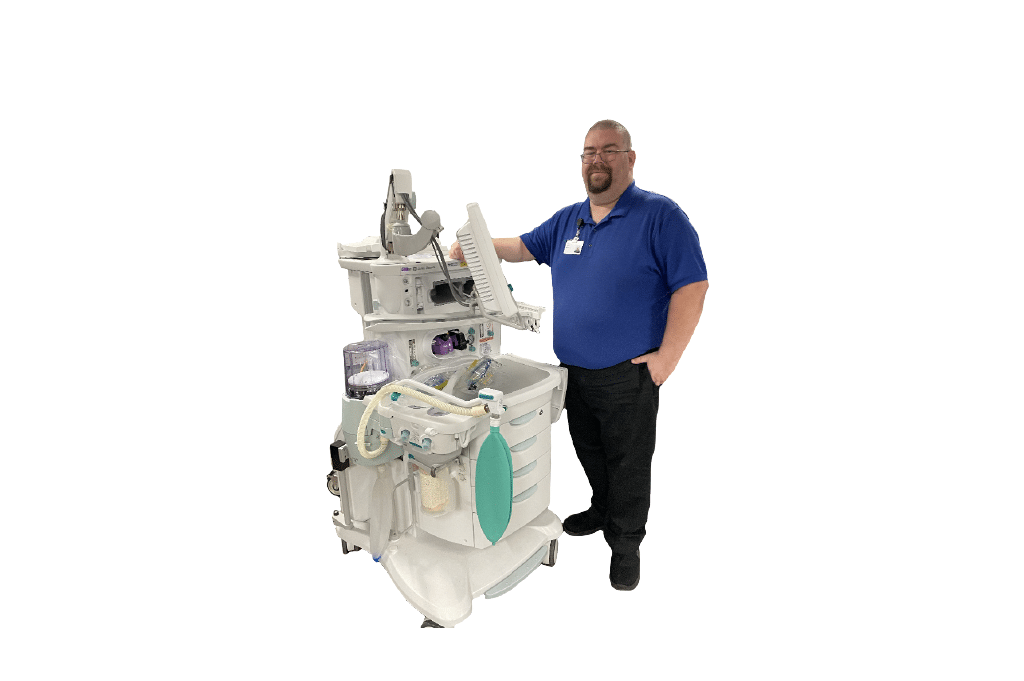
One military-trained biomed, who completed the DoD BMET program at Sheppard Air Force Base is Ryan Brent. He currently works as a lead biomed in the clinical engineering department at Cleveland Clinic Martin Health in Stuart, Florida.
Brent’s mother was a field service engineer for GE, working on imaging equipment. She is the person who introduced him to HTM.
“It seemed like a logical area to work in as there are always hospitals and equipment that need repairing,” he says.
Brent started his biomed career as an active-duty Army biomed, first at Walter Reed Army Institute of Research, then with the 173rd Airborne in Italy.
“After leaving the Army, I worked field service with Getinge. Went to work for UHS/Agiliti as a third party/in-house biomed. After that, I went on to become a biomed II/III with Goldbelt at Hill Air Force Base,” he says.
In his current position with the Cleveland Clinic, he oversees the Martin North, Martin South and Tradition Hospitals in Florida. His areas of specialization include pulmonary and anesthesia.
Brent said he usually gets to work early to check emails and pending work orders. He uses his early arrival to get a general feel for what the day is going to bring.
“At 6:45 a.m., [I] have a huddle with all techs to put out any information, discuss any problems, the previous night’s on call. From there I speak with the team at the hospital I am based out of to discuss a plan of action which, as always in our field, hardly ever goes to plan,” he says.
Brent compares his job to that of a conductor.
“I am constantly trying to facilitate multiple things at once to make sure operations are running smoothly,” he says.
Brent says that his early military training has served him well in his career.
“The DoD school was a great experience; they brought together some great instructors from across the DoD and civilian sectors. It offered up a great range of equipment. The experience I gained from both the theory and the hands-on training formed the basis of the tech I am today and has served me well all these years,” he says.
He believes that the way the program trains a tech prepares them for success.
“The hands-on aspect of the training allows the tech to hit the ground running with minimal extra training and, since the theory is so well instructed, it makes DoD techs highly flexible to any situation,” Brent says.
FROM HOSPITAL CONSTRUCTION TO TIKI MUGS
Working with a large multi-facility employer as a biomed can mean several projects that go beyond the routine.
“Over the past couple of years with Cleveland Clinic, we have had multiple equipment alignment projects. We have converted over our entire IV pump fleet to a different manufacturer; anesthesia units have been modernized to name a few. With the large-scale replacement/upgrade projects across multiple sites, the major challenges are coordination across all the affected departments, training requirements for both techs and end-users and just manpower to get everything inventoried and inspected,” Brent says.
He says that it is always a balancing act to get projects completed on schedule, while attending to the daily running of the department with corrective and preventive work orders.
Again, military experience can serve a civilian biomed well.
“When I was deployed back in 2006, I assisted a multinational effort to build a modern hospital in southern Afghanistan. I was the only biomed on the team. Coordinating equipment deployment, assembly and safety standards with an international group of workers, [meaning] most instructions had to go through interpreters,” Brent says.
He explains that in a normal day, the biomeds had to translate tech speak to clinicians; this was not only translating tech speak to regular people, but even into another language.
Beyond his workplace, Brent also sees an industry-wide challenge in a lack of qualified candidates able to keep up with the demand within HTM.
“Many people outside of our profession have no idea what we are or what we do. This, I think, leads to a critical shortage of qualified BMETs,” he says.
Away from the workplace, Brent’s pastimes include 3D printing, gaming, computers and collecting tiki mugs.
“I have a 3D printer that I [use to] print various things around the house and the workshop. Expanding my knowledge into creating my own 3D print designs for public use. I own gaming consoles back to the Super Nintendo,” he says.
He says that he is big into retro gaming.
“I started building my own desktop computers after my DoD biomed course. I build, mod and update all the time. I have built many systems for friends and family,” Brent says.
He says that his tiki mug collecting started about 20 years ago.
“Got fascinated with the atomic age ‘Polynesian’ vibe. Started collecting various mugs/cups from various places and online. Collection slowly grew to about 30 ceramic and glass items,” he says.
Family includes his mom, sister and two sons.
“I have been a biomed for 26 years; both in house, OEM and third party. Love hockey (Florida Panthers), grew up in south Florida and have been on all but two continents (Antarctica and Australia),” Brent says.
With more than two and a half decades of experience, and a wide range of skills to draw from, this south Florida biomed leads the way while delving into a bit of Polynesian pop culture.
