



Sponsored by Rigel Medical

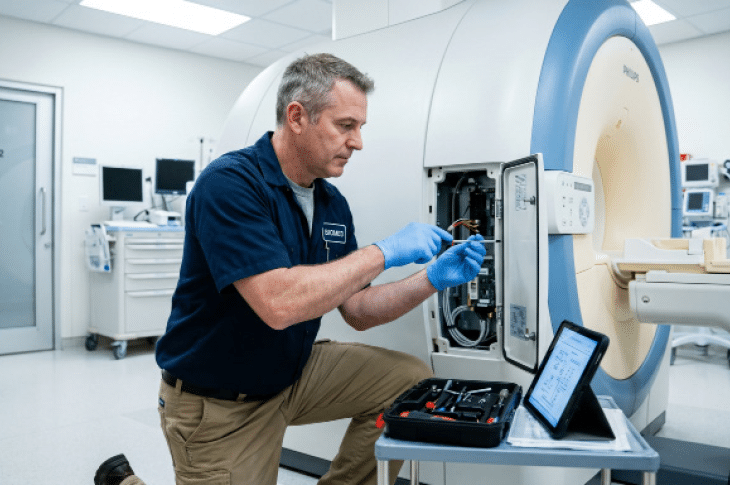
Spend enough time in any HTM department and you will hear the same thing repeatedly. There are simply too many preventive maintenance work orders to complete. The workload keeps growing, the expectations do not ease, and the question that sits underneath it all is rarely said out loud.
Are we doing all of this because it improves patient safety, or because it is what we have always done?
NFPA 99 gives us a strong foundation for how we approach equipment maintenance in healthcare environments. It encourages a risk-based approach, asking us to consider the impact of equipment failure and how that translates to patient care. When you look at it through that lens, it becomes clear that not every device carries the same level of risk, and not every device should be maintained in the same way.
Thus, the conversation around Alternative Equipment Maintenance (AEM) begins to take hold. AEM programs are not about reducing work. They are about focusing it. CMS allows flexibility in maintenance strategies, but only when those strategies are supported by evidence and can be justified. If you are going to move away from manufacturer-defined intervals, you must stand behind that decision with confidence.
What is interesting is that this approach is largely unique to the U.S.
In my experience, AEM programs have not been widely adopted across Europe and Latin America. In many regions, maintenance schedules follow manufacturer recommendations much more closely, often driven by regulatory expectations or a more conservative approach to compliance. The idea of extending intervals based on internal data is far less common.
The U.S. model is progressive and, at times, more demanding.
Once you move toward AEM, the responsibility shifts. You are no longer relying solely on the manufacturer. You are relying on your own data, your own processes, and your own ability to demonstrate that equipment remains safe and performs as intended.
It is an approach that pushes the conversation beyond electrical safety.
Maintaining a device is more than confirming it is electrically safe. It is confirming that it performs as intended. A defibrillator that passes an electrical safety test but delivers incorrect energy is still a risk. An infusion pump with acceptable leakage but inaccurate flow is still a problem. AEM programs force us to consider safety and performance together.
Under NFPA 99, electrical safety testing remains a key part of demonstrating compliance and reducing risk. Leakage currents, earth continuity and insulation performance are still fundamental. In practice, many of these measurements trace back to principles defined in IEC 60601, which remains the global reference for medical electrical equipment safety. Even in a service environment, aligning measurements with IEC 60601 acceptance concepts helps ensure that what is being verified in the field reflects how the device was originally designed and approved.
Alongside this, performance verification becomes equally important. Flow rates, delivered energy, pressure, and timing are the values that reflect how a device behaves in real clinical use. If AEM is going to be successful, safety and performance must be measured in a way that is consistent and repeatable.
This is where the role of the engineer becomes more central.
Clinical and biomedical engineers are, at their core, metrologists. They use medical equipment to measure and verify performance, and understanding specification is key to choosing the correct test approach. Manufacturers will often recommend specific tools, and in some cases those tools are appropriate. But when equipment is brand specific in a service manual, there is usually an underlying or equivalent requirement that needs to be understood.
In many cases, there is freedom to determine how those requirements are met. That means evaluating options, comparing methods, and selecting the right tools for the job. It also means understanding what is being measured and why. The evaluation process becomes even more important within an AEM framework, where the quality of the data directly influences maintenance decisions.
Do you trust your test data enough to extend maintenance intervals in regards to safety and performance?
Over the past few years, I spent a lot of time speaking with HTM teams across the U.S., and there is a clear pattern. The teams that are most confident in implementing AEM are not necessarily the ones doing fewer tests. They are the ones doing more consistent and more meaningful tests. They have aligned their methods with recognized standards. They have reduced variability in how tests are performed. They have built a dataset that allows them to make informed decisions rather than relying on fixed schedules.
That consistency does not happen by accident. It comes from a combination of process, training and the tools being used.
Electrical safety testing can vary depending on setup and method, particularly when dealing with low level leakage measurements. The same applies to performance testing. Small differences in how a test is conducted can lead to different results. If those results are going to be used to justify extending maintenance intervals, they need to be reliable. They need to be repeatable. They need to mean the same thing regardless of who performs the test.
This is where test equipment becomes more important in an AEM environment, not less.
It is not about adding complexity. It is about removing uncertainty. When a technician can perform both electrical safety and performance tests in a consistent way, capture accurate measurements, and build a history of results over time, it changes the conversation. Instead of relying on time-based schedules, teams can begin to rely on evidence-based decisions.
I have seen this shift firsthand. Initially there is hesitation. Moving away from traditional PM schedules feels like introducing risk. The approach becomes more focused as confidence in testing and data grows. Time is no longer spread evenly across all equipment. It is directed toward devices where safety and performance have the greatest impact on patient outcomes.
NFPA 99 provides the framework for this way of thinking, but it does not dictate a single approach. That flexibility is what enables AEM, but it also places greater importance on how testing is carried out and how results are interpreted.
From where I sit, the direction is clear. The U.S. is leading in this shift, while much of the rest of the world continues to follow more traditional models. AEM is not about doing less. It is about understanding more. It requires confidence in electrical safety testing and performance verification. It requires trust in the data being collected. It requires a willingness to move beyond routine for the sake of it.
In the end, maintaining compliance is important. But maintaining confidence in the safety and performance of the equipment is what actually protects the patient.
