



By K. Richard Douglas
Wilmington, North Carolina, sits in a region which has had the nickname “Cape Fear” since 1585, when an English explorer’s ship was trapped in a bay there. Fayetteville, North Carolina, which sits north and west of Wilmington, has businesses, a museum and a high school, which have adopted the name.
One of them is the Cape Fear Valley Medical Center. The center opened its doors in 1956, and today is part of North Carolina’s 8th largest health system.
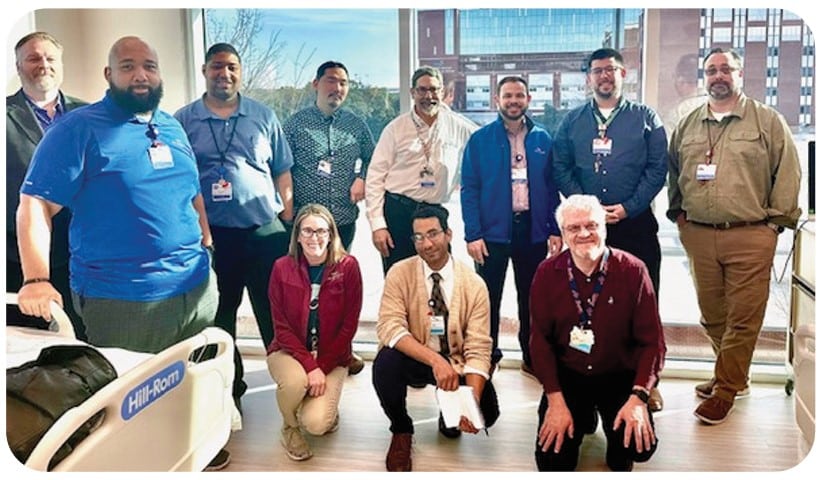
The system’s clinical technology services (CTS) department consists of 28 members and manages a large inventory of medical devices across seven facilities with a total of 1,028 inpatient beds.
Those facilities include Cape Fear Valley Medical Center, Cape Fear Behavioral, Highsmith-Rainey Hospital, Hoke Hospital, Bladen County Hospital, Betsy Johnson Hospital and Central Harnett. The system also includes 81 clinics, plus 23 more in the near future, the Center for Medical Education with a state-of-the-art simulation lab and the School of Medicine Building, in partnership with Methodist University.
The CTS team includes Director Nathan Brauer, Manager Ryan Whitted and a biomedical equipment team with two lead technicians and 11 BMETS. There is also a project team with two project managers and an ECD team, which includes one team lead and three ECD techs.

The imaging team leader is Johnny Simpson and the imaging team includes one imaging specialist, two imaging technicians and two imaging/BMET hybrids. The CTS team’s equipment coordinator is Joel Adams and its CMMS analyst is Glenn Chandler.
CTS plays a big role in service contract management.
“The CTS leadership team works in coordination with purchasing, the device manufacturer, legal, nursing administration, and hospital leadership to establish new contracts, modify existing contracts or terminate contracts as needed,” says Jody Booth, BMET I.
CTS is on top of its game with data collection and equipment management.
“Data collection is accomplished through multiple modalities. The safety improvement report process is utilized across the health system to capture potential risk, near misses and sentinel events for staff and patients. Any reports involving medical equipment are assigned to the CTS department for investigation and follow-up. The health system utilizes a centrally managed computerized maintenance management system to track planned maintenance activities, repairs, recalls and special projects. The CTS department also utilizes One Recall by Inmar Intelligence for recall notification and reporting,” Booth says.
The team includes members with a specialized focus, including three technicians assigned to anesthesia, one MRI specialist, one cath/interventional radiology specialist and one CT specialist.
New Construction Projects and Troubleshooting
New construction planning and equipment management have been among the special projects that the team has undertaken. The system opened the doors of the Dorothea Dix Adolescent Care Unit in 2022 and the team was an important part of that project and others.
“The CTS department played an integral role in standing up the Dorothea Dix Adolescent Care Behavioral Health Center. Only adolescent inpatient psychiatry unit, not only in Cumberland County, but also the surrounding communities (Bladen County, Fort Liberty, Hoke County),” Booth says.
She says that in addition to that, the medical center started a child and adolescent residency clinic, which is an outpatient program, for children awaiting regular outpatient treatment.
“The CTS department played an integral role in standing up the new hospice house for terminal and life-limiting illness. Less than five miles away from the main campus, the Valley Hospice House is a newly renovated 6,000-square-foot inpatient space with eight private ‘home-like’ patient rooms,” Booth says.
She says that Cape Fear Valley Health anticipates the facility will care for over 350 patients annually.
Another big project the CTS team supports is the Harnett Health Cancer Center.
“The CTS department will play an integral role in completing the new 17,000-square-foot cancer center within the medical arts complex on the campus of Central Harnett Health. Proposed features CTS will assist with [include] their new linear accelerator, CT scanner and infusion bays with new IV pumps,” Booth says.
On the problem-solving front, the team has brainstormed to find solutions to help clinical counterparts and patients.
One of those challenges involved sending 12-lead ECG strips to the EMR.
“To meet the requirements for our cardiology accreditation, there was a need to look at the process for obtaining and interpreting 12-lead ECGs for our cardiac patients coming through the emergency department,” Booth says.
She says that the CTS department worked closely with nursing leadership, the IT department and patient monitoring vendors to come up with a solution.
“We were asked if our Nihon Kohden monitoring system would be able to send 12-lead ECG strips to our Philips ECG interpretation server. After doing some research, and coordinating with both Nihon Kohden and Philips, we were able to find a company that offered a software that we could install on the Nihon Kohden server that would capture the 12-lead ECG strip, convert it to the appropriate format, and then send it to the Philips ECG interpretation software for the cardiologist and emergency physicians to review,” Booth says.
She says that this has greatly reduced the amount of time needed to obtain 12-lead ECGs and provide appropriate care for the patients.

Outside the workplace, team members also participate in the state’s biomed community through their affiliation with the North Carolina Biomedical Association (NCBA) and AAMI.
Unlike those English sailors in the 1500s, this Cape Fear is a place of healing and the system’s CTS team members are there to make certain that happens.
