



By K. Richard Douglas
While it’s widely known that biomeds from the U.S. help out on mission trips to developing nations, or repair donated medical equipment, the efforts of military biomeds in aiding counterparts outside the continental U.S. is not as widely known.
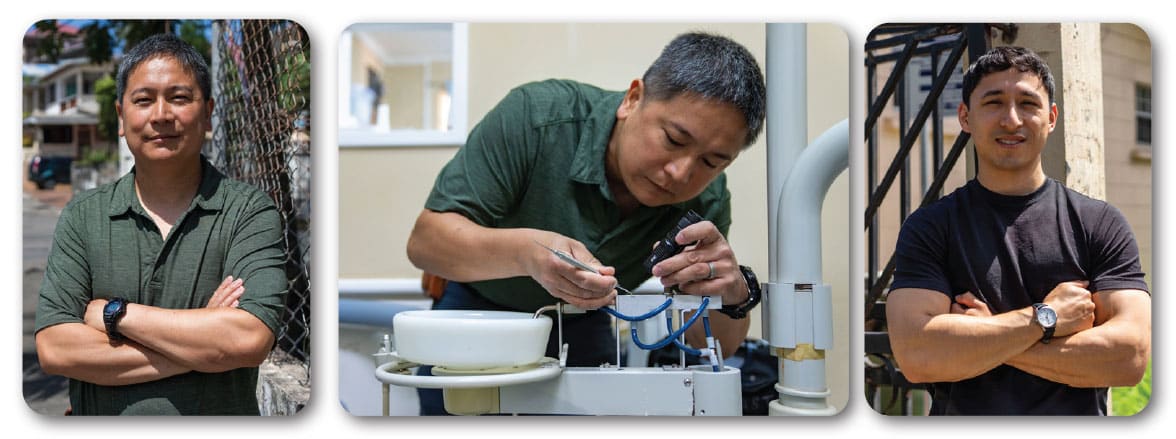
Staff Sergeant Ernest Duke Pastor was one of the biomed professionals who helped biomeds in St. Lucia as part of the Lesser Antilles Medical Assistance Team (LAMAT) mission.
“Our LAMAT team for St. Lucia consisted of two BMETs from the 349th Air Mobility Wing out of Travis Air Force Base, California; myself and Senior Airman Ricardo Perez from the 349th Medical Squadron (MDS). We are Air Force reservists that serve with two of the three medical squadrons under the 349th Medical Group. The BMETs for each squadron fall under the Medical Logistics Department,” Pastor says.
He explains that there was another team that visited St. Lucia prior to his mission that conducted a survey of facilities, equipment capabilities, and types of equipment that may require service.
“We were provided with great insight on what to expect and recommendations on which sites would need more resources,” Pastor says.
The island of St. Lucia, part of the Lesser Antilles, can be found as part of a string of more than 18 islands stretching from the Virgin Islands southward to Grenada; all within the Caribbean.
The Air Force mission allowed the biomeds to help their local counterparts at four facilities over two weeks.
“The largest facility is Millennium Heights Medical Complex, previously known as Owen King European Hospital (OKEU), a 122-bed, tertiary hospital. Next is St. Jude hospital, which was relocated to the George Odlum Stadium in 2009 due to a fire; a 9,000-capacity football stadium converted to an approximate 50-bed hospital. Then two dental clinics, each with two-chair capacity, at La Clery and Anse La Ray,” Pastor says.
He says that for this mission, the Air Force biomeds were to work with their St. Lucian partners to learn from each other’s unique specialty and skill sets to maintain and repair biomedical equipment being used to treat the community.
“We brought our own tools and supplies to prevent straining the local supply. We visited a total of four sites on St. Lucia: Millennium Heights Medical Complex formerly known as Owen King European Hospital (OKEU), La Clery Dental Clinic, Anse La Ray Dental Clinic and St. Jude Hospital,” Pastor says.
He says that the mission was organized by Air Forces Southern.
“Our entire LAMAT team were comprised of Air Force Reserve members from various Air Force Reserve squadrons across the United States,” Pastor says.
The LAMAT mission also includes clinical professionals who were able to collaborate with local counterparts, provide their skills and maintain readiness in an environment outside the U.S.
BRINGING RESOURCEFUL THINKING TO THE CARIBBEAN
Patients and clinicians were well-served after the Air Force Reserve biomeds visit to lend a helping hand to local biomeds.
“Our first week, we worked on a washer (AT-OS AWD655D) in central sterile alongside three of the BMETs from Millennium Heights Medical Complex. There were three washers and none were operational. They converted one of the washers for spare parts. The challenge they have are delivery times for parts. It takes a few months for parts to arrive to their facility. I was told by one of their BMETs that one of the service parts they were anticipating was already in country but it was stuck at the port because they were waiting for crew to unpack the container,” Pastor says.
He says that the local biomed team had already diagnosed the issue with one of the washers.
“We collaborated with the three BMETs to replace several parts that had just arrived: two peristaltic pumps for the cleaning chemicals and replaced two liquid flow sensors. The peristaltic pumps that were sent to them was a newer version and were not an exact fit. We had to use the mounting bracket from the old pumps and custom fit them to the new pumps. After replacing the parts, we were able to perform a wash cycle. In a place where logistics is a constraint, we were able to combine our minds to make a part fit with a bit of ingenuity,” Pastor adds.
He says that during the second week, the biomeds shifted their focus to the two dental clinics.
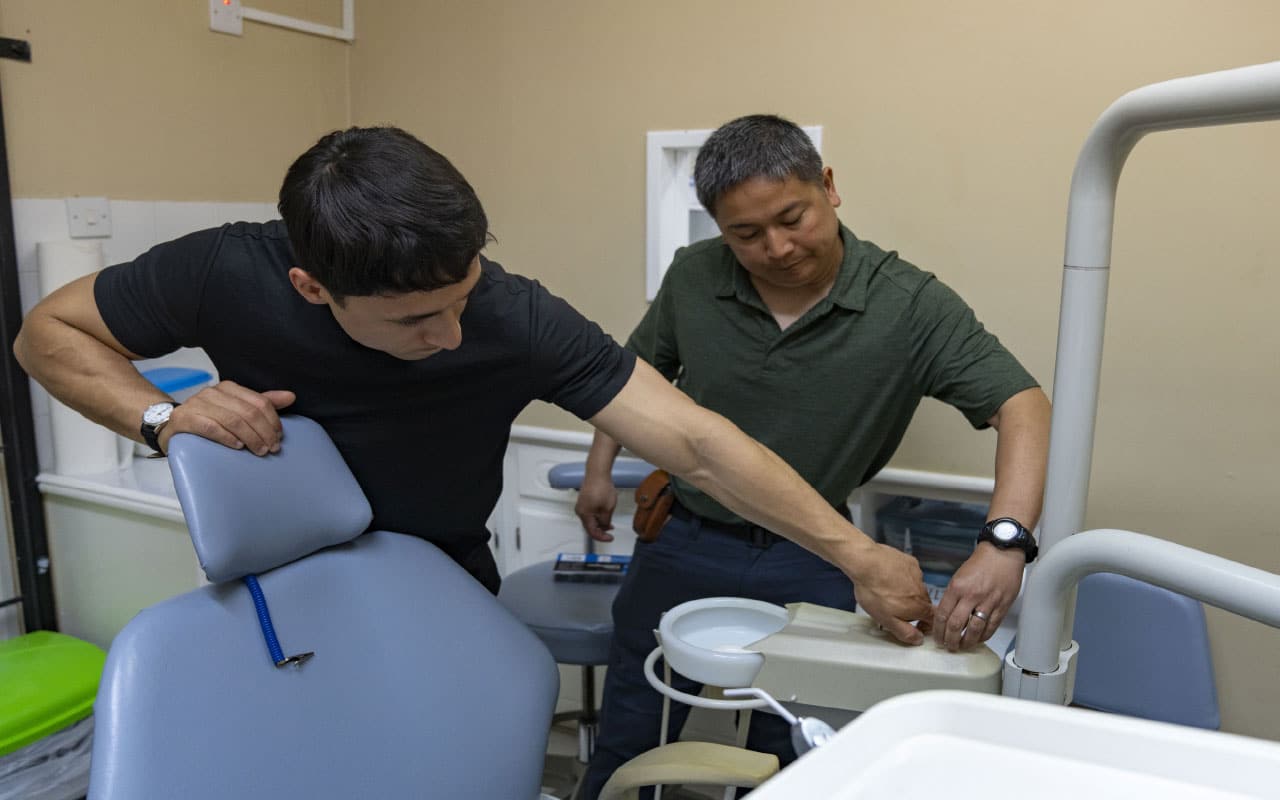
“The first site we visited was in Anse La Ray. The facility has two dental chairs but only one was in use because the other one was leaking water. The leaky chair was being used as an exam chair so we had to wait until we could work on it. When staff gave us the go-ahead to work on it, we found the leak immediately,” Pastor says.
He says that the leak was coming from one of the integrated master shut-off regulators.
“We shut off the water supply to the regulator and disassembled the part, applied some Teflon tape to the regulator control screw, and reassembled. We checked it again for leaks and put the chair back together. With this simple fix, we were able to restore the clinic’s operational capacity. They now had two fully functional chairs,” Pastor says.
He says that the biomeds encountered a similar experience at the La Clery dental clinic.
“We performed several minor repairs at this clinic. The most unique was fixing a leaky water block for the spit bowl faucet. We identified the problem to be a worn out O-ring. We drove to four different hardware stores in St. Lucia. We finally found an O-ring kit in one of the marine departments of the hardware store. Using the kit, we replaced the O-ring and the leak was resolved,” Pastor says.
The work done by the reservist biomeds adds to their experience while serving the patients in St. Lucia.
“Our entire team that took part in LAMAT strengthened our relationship with St. Lucia by providing medical assistance to their citizens,” Pastor says.
