


 By K. Richard Douglas
Ranked by U.S. News and World Report as one of the top 10 children’s hospitals in the nation, Children’s Hospital Colorado has a history that finds its origins in the cowboy days of the late 1800s and a group of tents.
Originally founded in 1908 in Denver, and converting a former residence in 1909, the first patients were admitted in 1910. The current facility was opened in 2007. The hospital is affiliated with the University of Colorado School of Medicine. Each year the hospital is consistently ranked among the best pediatric hospitals.
The Children’s Hospital Colorado Clinical Engineering Department manages the large inventory of medical devices that can be found in the current facilities.
Under the leadership of Director James Grissom and Manager James Stebbins, the CE team includes 28 technicians working across four hospital campuses with associated clinics and outreach program locations. Many of the techs are CBET-certified and some have B.S. degrees in biomedical engineering.
“We have 27,728 assets in active inventory. The team has approximately 250 years of combined experience,” Grissom says.
In addition to the four hospital facilities – with a combined 600-beds – the CE team manages medical equipment for a level 1 trauma center, two level 2 trauma centers, two urgent care locations, 50-plus anesthetizing locations and more than 30 clinic and outreach programs in multiple states.
The IT and CE teams are unique departments but often work jointly on projects.
“While we are still two separate departments, we maintain a strong working relationship, especially patient monitoring and EMR integration. We worked with IT to create CE user group and a folder with files, programs and service manuals to push to all technician’s accounts,” Grissom says.
The department plays a key role in equipment acquisition.
“The department sits on the capital procurement committee and has created a Biomedical Equipment Acquisition Review (BEAR) Committee to validate and standardize the purchases of all medical devices. We facilitate inter-departmental communication and support due to the vast institutional knowledge of the team members that have worked here for more than 15 years,” Grissom says.
He explains that service contracts go through multiple layers of approval and the team is working to bring these in through the BEAR program to provide a central repository for all equipment-related contract data.
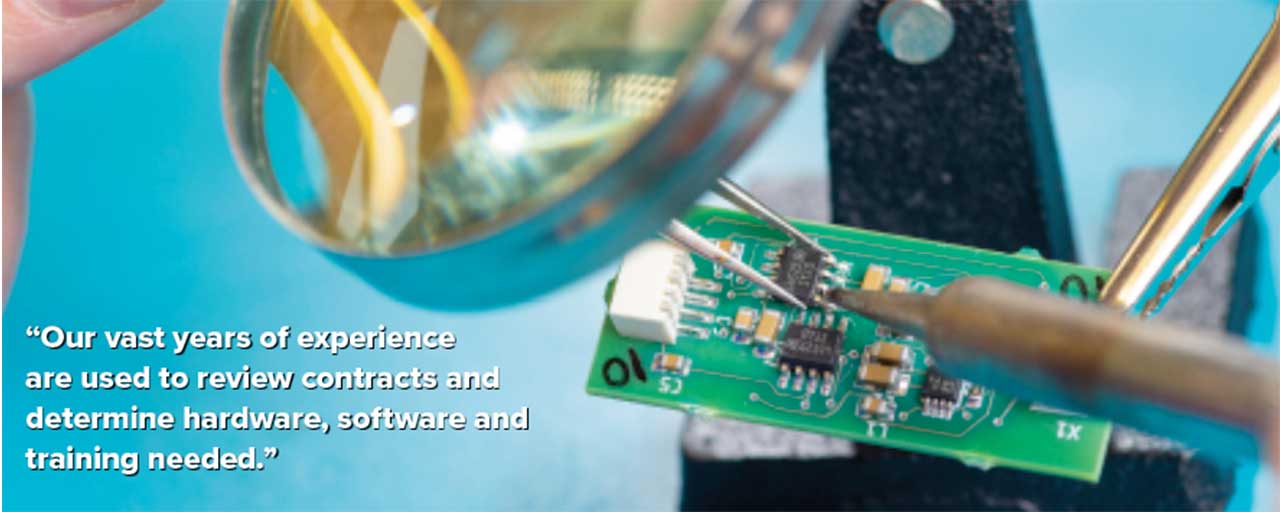
“Our vast years of experience are used to review contracts and determine hardware, software and training needed. When contracts are proposed, the department workload, as well as quantity across the enterprise go into determining if the service line should be brought in-house. We are working toward integrating our contracts into our computerized maintenance management system (CMMS) to alert technicians of coverage status, as well provide customers with accurate ROI/renewal recommendations,” Grissom adds.
For data collection, Grissom says that new equipment is directed to the department at each facility to be checked and for inventory information entered in the CMMS.
“We align our information with accounting for install date, purchase price and depreciation tracking. We assign four-year inventory validation work orders on all equipment deemed to have no required maintenance per the manufacturer. Manual data validation is performed during preventative maintenance cycles, as well as when specific department requests come in,” he says.
Projects and Challenges
For special projects the team members rely on their years of experience. Those projects run the gamut from upgrading feeding pumps to the challenges posed by the pandemic.
One of those challenges was the need for patient floor expansions.
“We participated in the opening of a new campus during COVID. We provided project and program management on specialized treatment floors to ensure that proper medical devices are available for that patient population, as well as technical resources for equipment purchases and installation,” Grissom says.
Other projects included research inventory tracking and a feeding pump fleet upgrade.
“Children’s Colorado’s growing research program needed assistance tracking equipment coming in/going out for recall and regulatory compliance. We had a short turnaround time for a system-wide feeding pump upgrade due to nationwide supply chain feeding cassette shortage and successfully coordinated with clinical and non-clinical departments for training, deployment and supplies,” Grissom says.
The team’s abundance of experience serves them well when it comes to problem solving. Grissom says that one example was creating a Philips testing station in department to work with the IT EPIC integration team.
The CE team also worked with anesthesia physicians to accommodate all the ancillary equipment mounted to the anesthesia machines. Team members worked with clinical educators to be called when new feeding pumps fail on the floor, the team responds promptly to witness/troubleshoot.
On the soft skills side, the group created a department flyer to inform customers what they do, how to get a hold of CE, as well as miscellaneous asset tags used in the CMMS if requesting work that is not directly related to a piece of equipment.
They also brought their experience to an MRI upgrade.
Grissom explained that a “manufacturer-performed upgrade led to a quenched magnet” and CE “assisted in facilitating rental and placement of portable MRI while the unit was repaired and re-certified.”
Away from work, members are involved with the Colorado Association of Biomedical Equipment Technicians (CABMET), AAMI and ECRI.
For pediatric patients and their families in Colorado, there is the assurance that they are being treated by a national standout facility, backed by the clinicians and HTM professionals who are up to the same standard.
