



 By K. Richard Douglas
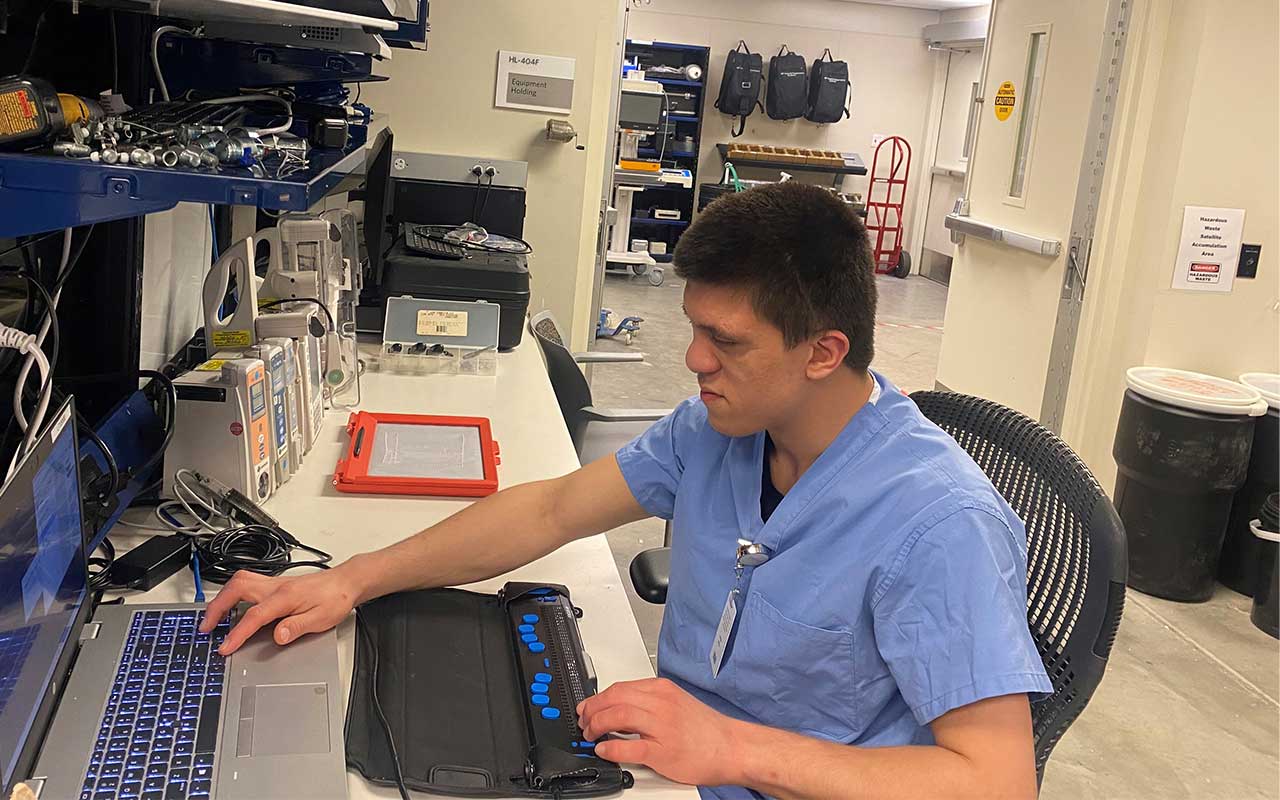
Chris Avila, a biomed intern, walks into the shop, sits down at a bench, and begins work on an Alaris pump. Just another day in the life of a biomed; right?
Well, not exactly, Avila should be an inspiration to every biomed. Heck, he should be an inspiration to any person … in any walk of life.
Avila is blind.
The sense that most biomeds depend on the most to maintain and repair medical equipment; Avila is doing without. Yet, he sits in his shop working on an important piece of medical equipment.
Avila lost his sight at the age of five as the result of an accident.
“I was born with sight and only went blind due to a car accident. I was five-years-old and was hit by a drunk driver outside of my grandparent’s house while speaking with my stepfather. I lost my sight and am now totally blind; for an example, I could stare at the sun all day and never blink,” he says.
Avila says that he is a braille reader and learned braille over the course of three months.
“I attended Salk Elementary School in Merrillville, Indiana. When I entered fifth grade, after talking with my mother, we decided that I would attend the Indiana School for the Blind and Visionally Impaired (ISBVI). I had been going there for several years at this point, starting when I was in second grade, but only as a short-course student. Short-course was a program that offered students like myself the opportunity to go to ISBVI for one week out of every month while still attending public school,” Avila says.
He says that in fifth grade, he switched to going full-time, which meant he would have to travel back and forth from Indianapolis each week, and stay in the dorms on ISBVI’s campus.
“I continued to go there until my graduation in 2017; my graduating class was less than 15 students and I was the valedictorian. During my time at ISBVI, I was introduced to many assistive technologies, such as screen-readers and braille displays, which I use to this day. I also participated in sports from seventh grade to my senior year of high school; track, goalball, wrestling and swimming,” Avila says.
In his sophomore year, he began taking classes at North Central High School; world history, AP U.S. History (only for a semester), global marketing and business law.
“For college, I originally went to Indiana University-Purdue University Indianapolis (IUPUI), pursuing a business degree, but after a year, decided to give it up and switched majors; thus began my journey as a biomedical engineer. Now, after the divorce of IU and Purdue, I am a Purdue student,” Avila says.
He says that over the summer of 2024; he participated in an internship program facilitated by the Gregory S. Fehribach Center at Eskenazi Health.
“I am a biomedical engineering student that was interested in medical devices; specifically, the process of maintaining and repairing them,” Avila says.
The challenges of working as an HTM professional as a blind person were precipitated by the challenges of training a blind person to be a biomed.
“Originally, I wanted to be a business major and work for a shipping company off the East Coast. However, after taking a year of classes I realized it just wasn’t for me, and because of a book I read, ‘23 Years on Fire,’ I chose to then try my hand at biomedical engineering. To [the best of] my knowledge, I am the first blind student in either the IU or Purdue schools to pursue this degree, and it has been quite the challenging experience,” Avila says
He says it wasn’t only a challenge for him, but also for everyone involved; professors, the university staff, and his auxiliary aids.
“We all had to figure out how to best present to me the information being taught, it was a learning curve that just kept going. With new challenges and difficulties seemingly arising every semester; how to present the information, how to navigate programs that were not designed for people without sight, getting course material in a timely manner, etcetera,” Avila says.
How did Avila actually transition to hands-on work?
“In the beginning, I was introduced to many different devices, and was given the task of disassembling and then reassembling said devices. The purpose of which was to familiarize myself with the components of each; when reassembled, everything was tested to ensure I had put things back together again correctly. From there I was shown how to do the PMs for several of the more common devices that came through the shop. I thoroughly enjoyed my time working in the biomed department, and returned for another internship in the spring of 2025,” he says.
 Utilizing Technology
The ability to go hands-on with medical equipment repair and maintenance still did not come without challenges. It took some ingenuity and trial and error to move toward a workable solution.
“During my first internship, I very much enjoyed working with the other technicians in the department; there was an issue however. The programs and software used for the preventive maintenance were inaccessible to me; this made it so that one of the techs would always have to be present when I worked on a PM. Towards the end of that internship – and what I have mainly focused on during this current internship – my objective was to figure out a way to complete a PM independently,” Avila says.
He says that since the Alaris pump is the most common device that needs to be repaired, the Alaris program became the first to be tackled.
“The main challenge was determining how to navigate the Alaris program using a tool called JAWS; a text-to-speech screen-reader. JAWS would read certain things within the application window but not others, and not consistently.
Another challenge was that when mapping out the program, JAWS would not read the different tabs, windows, icons, or buttons in the order they would appear on the screen; if at all,” Avila says.
He says that after weeks of testing, the solution proved to be something called the touch cursor.
“The touch cursor is one of several possible cursors used to move about the screen; this process is slower than I would like, but works. The next steps would be to gain a better understanding of the JAWS script editor. Instead of using the arrow keys to navigate across the screen, I could just press a key on the keyboard and skip directly to the area I want,” Avila says.
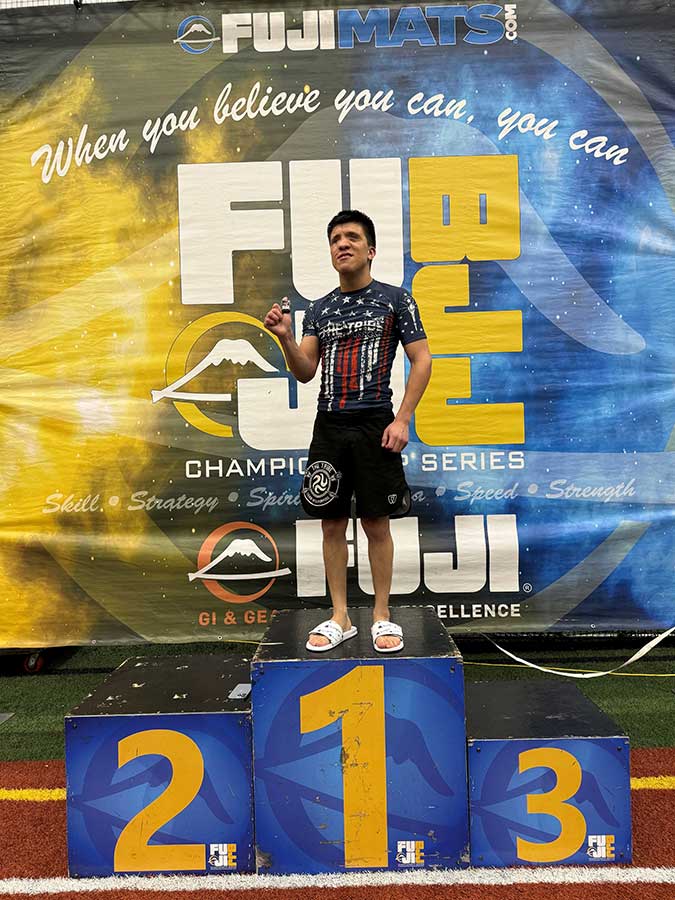
Away from his biomed work, Avila has trained in Jiu-Jitsu for about three years and has competed in tournaments. He also spends time keeping his mind challenged.
“Instead of watching TV, I listen to audiobooks, favorite genre as of right now is litRGP. I enjoy studying and playing with numbers to see the different patterns that arise. If I’m feeling particularly adventurous, I experiment with cooking,” he says.
Avila’s family members include six siblings: two brothers and four sisters.
Can a blind person compete in Jiu-Jitsu or repair and test medical equipment? If that person doesn’t know the meaning of the word “obstacle,” they can. When Chris Avila is faced with a challenge; he just figures out a work-around. Obstacle has no meaning.
BIOMETRICS
Favorite book:
The Wheel of Time series by Robert Jordan
Favorite FOOD:
Steak tacos with corn tortilla and a glass of horchata
Hidden Talent:
I am rather good at playing darts, not getting the exact score needed to win a game but hitting the bull’s eye; the most I ever hit in one night was six.
Favorite part of being a biomed?
I have always found working with my hands to be quite satisfying; as a child I always loved taking things apart – my toys, radios, engines, etcetera. Being a biomed allows me to do the same with medical devices, and unlike then, I actually can put things back together again and have them work.
