For more than eight years, I’ve been working on Right to Repair issues full time. From the start of my work, we have advocated for reforms that ensured hospitals and independent service organizations could access the full slate of repair materials that manufacturers give to their own authorized providers – including service keys, repair manuals and other documentation, and parts.
My work changed considerably at the start of the COVID-19 pandemic, when we started hearing from panicking HTM professionals who were unable to service ventilators.
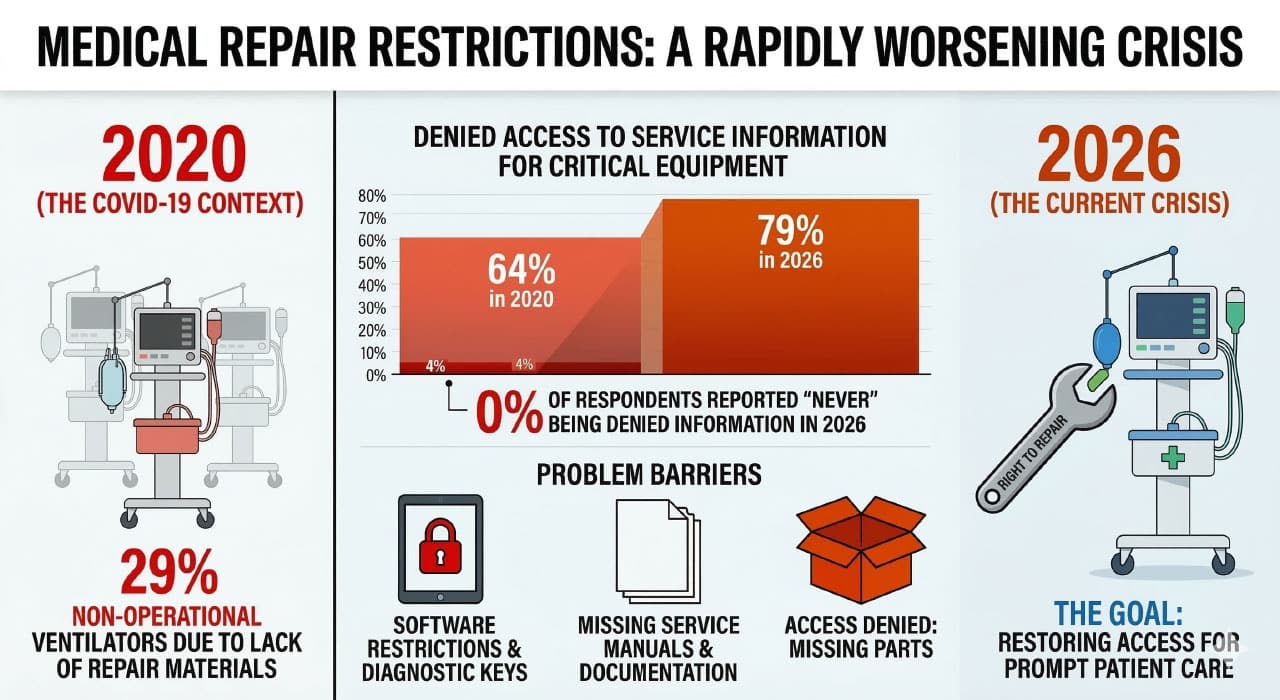
We surveyed more than 200 biomeds and HTM professionals, and released a report in July of 2020, called “Hospital Repair Restrictions,” which laid out how widespread this issue was – including finding that, of the technicians who work with ventilators, 29% had non-operational ventilators they couldn’t fix because they lacked access to parts and service information from the manufacturer.
It’s been nearly six years since this research and U.S. PIRG Education Fund initiated a new survey to discover what the latest conditions around repair are. Here are the takeaways from that research, published in a new report in March.
Biomeds/HTMs report that manufacturer repair restrictions, especially barriers related to the software in medical devices, increase equipment downtime and create delays in prompt patient care.
Approximately 83% of survey takers reported that equipment downtime increases from repair barriers either “somewhat frequently” or “most of the time.” Furthermore, 70% responded that they “commonly” experience diagnostic tool restrictions causing a delay in prompt patient care.
A higher percentage of biomeds report having trouble getting access to service information for critical equipment than in 2020.
In 2020, 64% of surveyed technicians (141 of 219) reported being denied access to service information for critical equipment (defibrillators, ventilators, anesthesia machines, imaging equipment, etc.) either “somewhat frequently” (48%) or “most of the time” (17%).
In our 2026 report, a total of 79% (84 of 107) reported being denied access to this service information “somewhat frequently” (48%) or “most of the time” (31%). The most frequent response was “somewhat frequently (48%), and the second most frequent response to this question was that manufacturers would deny access to service information “most of the time” (31%).
None of the respondents in our recent survey reported that they had “never” been denied information for critical equipment, versus 9 (4%) of respondents in 2020.
Meanwhile, the restrictions on repair materials are more likely to cause delays in rural settings.
Rural hospitals are under incredible pressure, and many have stopped providing in-patient care or have closed entirely. When looking at the responses of biomeds who more frequently serve rural hospitals, our concerns about the impact of repair restrictions grow more pronounced. Rural respondents are more likely to “commonly” experience impacts to prompt patient care from repair restrictions.
Biomeds view Right to Repair as a step toward improving care for patients.
It is uncontroversial to assert that removing restrictions to fixing medical devices will reduce repair and maintenance costs for hospitals and other medical facilities. To defend these restrictions, manufacturers argue that they prevent improper maintenance. Meanwhile, the overwhelming majority of medical device repair professionals we surveyed, 94%, believe that patient safety would be improved by enacting Right to Repair reforms.