




By K. Richard Douglas
Most jobs, especially in larger companies, have set onboarding procedures that managers follow with a new hire. Onboarding familiarizes the new employee with policies, procedures, job skills and enhances engagement with the new employee in their new position. This process often follows a set orientation that helps the new recruit understand the culture and expectations.
There is paperwork that must be completed, often a workstation or office that is assigned, introductions are made and mentors are often identified. All of this can take several months with human resources and hiring managers hoping that the result will be retention and integration.
While much of this process on the company side is methodical, procedural and structured, the experience of the new hire can be very different. They need to acclimate to the culture, ramp up learning and take in a lot of data within a short period and know how to navigate the expectations of the new job.
This is particularly true for those entering the HTM profession. While some may just be entering the job market out of school, others are transitioning from other fields, and some adjusting to a civilian job after serving in the military.
There is much to know, both post-hire as well as pre-hire, to ascertain preparation, acclimation and enjoyment. Knowledge is power and it is key to getting the job, excelling in the job navigating interactions with clinicians, HTM management and suppliers while learning the ropes.
While onboarding is well-defined within a hiring organization, the same preparation, planning and strategy needs to be embraced by the new hire. A new biomed who has the right skills and training can look forward to a long and rewarding career.
GETTING OFF TO A GOOD START
There is the old saying that you don’t get a second chance at a first impression. That wisdom applies to the actions taken by a new biomed that can guide their career.
“I would advise any new biomed to focus on mastering the fundamentals first, then never stop adapting and looking toward the future. Just about anyone would advise a new technician to develop strong foundational skills in electronics and troubleshooting – because no matter how sophisticated the device, success always comes down to clear, logical thinking under pressure,” says Richard L. “Monty” Gonzales, Ed.D., president of the College of Biomedical Equipment Technology (CBET).
“Quite honestly, what separates average techs from exceptional ones is mastering the psychology of troubleshooting: methodically isolating the problem and approaching every issue with the mindset of a true problem solver, or a solution architect. Biomedical equipment technicians are not just fixing broken equipment – they are designing reliable outcomes that directly impact patient care,” Gonzales adds.
He says that at the same time, new technicians should seek to be familiar with the widest possible variety of equipment early on.
“The healthcare environment is evolving at tremendous speed with networked systems, AI-driven diagnostic tools and connected medical devices. The technology they will likely encounter throughout their careers will be very different from the limited number of devices they may have experienced through initial education and training,” Gonzales says. “Technicians must remain curious and committed to continuous learning, recognizing that tremendous opportunities that exist in the HTM world and that the depth and breadth of their training and experience will directly shape their level of professional achievement throughout their careers.”
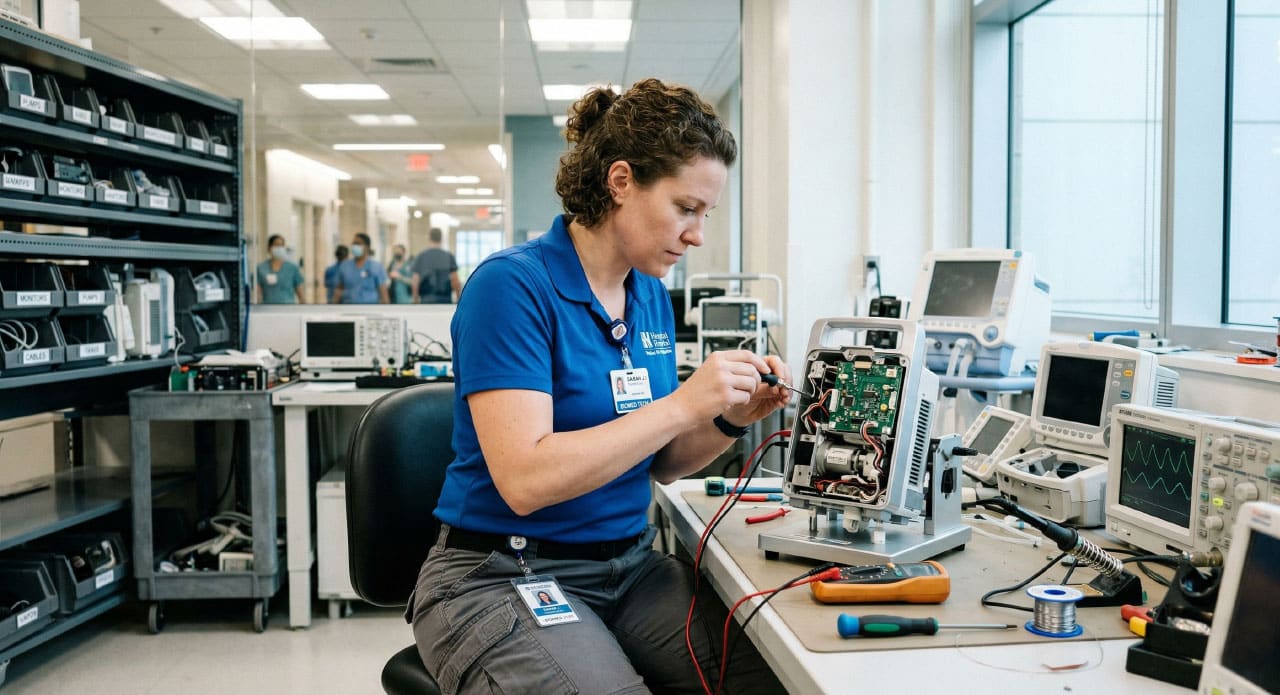
He says the technicians who will thrive are those who are well-rounded troubleshooters with a broad array of experiences and training – and who are truly service-oriented.
Claire Wilson is a BMET II with UCHealth at Yampa Valley Medical Center in Colorado. She says that the best advice she can give new BMETs is to accept that you will have to repair unfamiliar equipment.
Wilson presented “Career Guidance for Beginner BMETs” at the MD Expo Dallas in November of 2025. (tinyurl.com/5n8669cu). She has put a lot of thought into the topic. She works in a rural hospital in the northern Rocky Mountains of Colorado and supports approximately 3,000 non-imaging devices.
“Sometimes information from manuals can be limited or nearly nonexistent. Having a strong reputation with staff will help peers have confidence in your ability to learn and handle challenges while you build your skill set,” Wilson says.
She adds that if a new biomed wants opportunity, they have to be willing to find it.
“New technicians will have to take on responsibilities that their peers don’t want. Using these unplanned opportunities can either enhance your career exponentially or cause conflict. A smaller team has less competition,” Wilson adds.
She says that when a new biomed is reviewing employers and opportunities, it is important that they consider “the need for work-life balance.”
“It’s important that the job you choose challenges you enough to grow without immediate burnout. It’s important to love where you live. Plan activities outside of work to look forward to. Utilize time not on-call to take weekend trips, that are affordable and memorable. Have a community at work. People you look forward to seeing throughout the day and can ask for help with work orders. IT, Facilities and charge nurses will become your greatest support,” Wilson says.
She also suggests that biomeds reviewing job opportunities ask the hiring manager about available training that might help to advance a career. Are there opportunities for promotions written into the employee contract? Does the employer offer matching contributions for a retirement plan? She also suggests discussing annual PTO balances, FMLA, prenatal care and holiday hours. Discuss disability support and healthcare benefits.
Wilson says that a biomed reviewing employment in local hospitals should consider the distance to the hospital and other obligations. She says that most facilities require STAT work orders to be attended to within 30 minutes. The clock starts from when you receive the call at your home, so a new biomed should consider the commute time from home to the facility and factor in potential delays.
She says that rookie biomeds should consider the pros and cons of smaller facilities versus larger ones. Some of the pros with a smaller hospital can include fewer PMs each month, less competition for training opportunities, more chances to become familiar with a smaller staff and ease of locating equipment.
The cons may include less staff for support, less equipment in storage and rural facilities may not have the budget to replace older equipment.
With larger hospitals, Wilson says that there can be a larger staff in biomed which can mean less on-call rotations. A larger equipment inventory is more forgiving when there are equipment shortages. There is a greater likelihood of STAT calls and more PMs every month. She also points out that the cost-of-living can be higher in a large city.
Wilson suggests that newer biomeds consider getting device training on ventilators, anesthesia machines, heart-lung machines, cardiac stress-test systems and balloon pumps to help in career advancement. This specialized training can help a biomed reach the next level as a BMET or in a transition to imaging service work.
CREATE A TECHNICIAN PORTFOLIO
Wilson’s MD Expo presentation covered several topics important to those considering a biomed career and those new to the field.
For those just entering a work environment at a hospital, Wilson says that important contacts to know include the charge nurses and nurse managers, facilities, IT, EVS, equipment team, respiratory techs and therapists and the OR staff.
She points out that a new biomed should be mindful that they should not tell a customer that they can fix a device that they are not trained on or comfortable fixing. She says that a new biomed should also not be pressured to fix something they are not comfortable repairing. Instead, the new biomed should advise the customer that “this repair requires more research” or “I will escalate this to a senior technician or management” or “this requires vendor service” when appropriate.
If the repair requires parts that are not readily available, the new tech should advise that “this device requires new parts and I have no expected ETA for the shipment but I will keep you updated.”
How does a new biomed determine what equipment they might want to specialize in?
“The ability to learn and experience as many modalities and departments as possible will quickly reveal to a technician where their strengths and weaknesses are. Struggling with a certain equipment type due to a lack of experience shouldn’t discourage anyone from learning. Not feeling comfortable to repair a specific equipment type should be evaluated more closely,” Wilson says.
She talked about the benefits of a new technician beginning a technician portfolio.
“Assembling a portfolio is taking notes and daily work tasks and turning it into a career-long document that can be given to employers or shared with peers for support. It is a versatile collection of notes to individualize your resume and create a faster workflow for repetitive PM schedules and quick reminders. Having access to vendor support phone numbers, part numbers, PM checklists will give any technician confidence that they have what they need during the most important tasks,” Wilson says.
Newer biomeds should be aware of what considerations go into preparing for inspections by regulators.
“Close as many old work orders out as you can. Locate the MDS book. Being able to locate the nearest emergency exit and fire hydrant is vital. Having support items labeled and properly stored helps to avoid awkward questions. Have a document of quick access to codes. Remember that inspections aren’t meant to punish people, it’s meant to protect staff, patients and visitors from unnecessary hazards. Spend time updating stickers,” Wilson says.
Wilson’s presentation also covered topics like repairs, the troubleshooting process, tips on working smarter, not harder and balancing PM scheduling. All tips and insights to get a new biomed’s career off on the right foot.
Additional resources for new biomeds, and really all HTM professionals, are the HTMjobs.com website and MedWrench.com. MD Expo, AAMI eXchange and state biomed associations conferences are also outstanding avenues to explore for networking and possible mentors. Information about upcoming HTM Mixers and the fall MD Expo is available now at MDExpoShow.com.
CRITICAL SKILLS
In any “customer-facing” profession, there are skills that are imperative to maintain good relations with customers as well as inspire confidence in the customer. These skills are particularly important for a biomed. They are just as important as repair and service skills. While often referred to as “soft skills,” Gonzales believes this term understates this component of the job.
“The term ‘soft skills’ unfortunately suggests these competencies are somehow secondary or less important than they truly are. I prefer to call them critical skills because they are the very capabilities that empower strong technicians to flourish in today’s complex and rapidly changing healthcare environment,” he says.
Gonzales says that one of the biggest complaints we hear from our industry partners is that far too many technicians lack strong competencies in these areas – effective communication, negotiation, leadership, ethics, time management and a variety of other incredibly important characteristics that often separate the technicians who thrive from those who simply survive.
“The true differentiators for both individual career advancement and organizational success are critical skills: communication and customer service, leadership training and succession planning, and ethics. In today’s complex clinical environment, BMETs are not simply repairing equipment – they partner daily with clinical staff and often under intense pressure. The ability to explain complex technical issues in clear, calm language, listen actively, and always follow through builds trust and dramatically improves outcomes,” Gonzales says.
He says that leadership training and succession planning prepare emerging leaders to guide teams and build strong future leaders, while a solid ethical foundation ensures every decision prioritizes patient safety and integrity.
“Organizations that deliberately invest in these areas consistently outperform their peers, while those that overlook them face higher turnover, unnecessary operational difficulties, and direct bottom-line impacts. The most effective BMETs treat these competencies as non-negotiable and actively elevate the entire HTM team,” Gonzales says.
With regard to this skill, Wilson says “trust your instincts.”
“Over communicate with the staff. Don’t feel pressured to rush through every work order. If you can make the time to slow down and learn, you will grow faster. The willingness to try outweighs knowledge,” she says.
KNOW YOUR LIMITS
As Wilson previously stated, the new biomed should err on the side of honesty and a realization of their limitations when approaching an assignment on a piece of equipment they have never worked on.
“When approaching a repair, PM, or calibration on unfamiliar equipment, first confirm you are fully aware of your qualifications, training, and the ethical and legal limits of what you are authorized to do. Technicians must strictly follow prescribed procedures and protocols – never improvise or exceed your scope. If you feel unqualified or unfamiliar with the device, do not proceed. Instead, be transparent and immediately ask for help from a senior technician, manufacturer support or a trusted colleague,” Gonzales says.
He says that strong team relationships make this easy and effective – never hesitate to ask questions; it demonstrates professionalism and protects patient safety. Document every action – or decision not to act – accurately in the CMMS; this is both an ethical and legal requirement.
“When a clinician asks about the equipment, technicians would be well-advised to respond with honesty, candor and confidence derived from competence,” Gonzales adds.
He suggests an example that reflect Wilson’s suggestions. “I haven’t worked on this exact model before, but I’ve already consulted the right resources and here’s exactly what I’m doing to restore it safely and quickly,” he says.
“Demonstrate that you understand the urgency or priority of the device by offering immediate workarounds or alternative solutions and always over-communicate estimated timelines and anticipated next steps. In today’s fast-paced, complex healthcare environment, clinicians greatly respect this transparent, solution-oriented approach – far more than speculative predictions or guesses that create unrealistic expectations,” Gonzales says.
INTERESTED IN AN HTM CAREER?
Those interested in a career in HTM or who are new to the field can find Wilson’s presentation here.
Information about The College of Biomedical Equipment Technology can be found here.
